Navigating the Evolving Landscape of AI Agent Benchmarks and the Search for Reliable Autonomous Performance Metrics

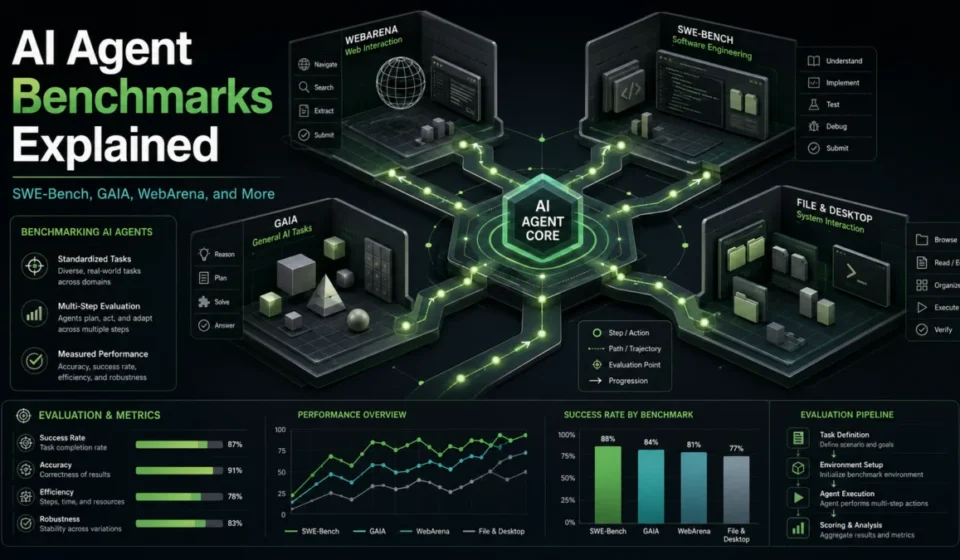
The rapid transition from static large language models to autonomous AI agents represents one of the most significant shifts in the history of artificial intelligence, moving the industry from systems that simply "know" to systems that can "do." As major technology providers like OpenAI, Anthropic, and Google DeepMind release increasingly capable models, a fierce competition has emerged on public leaderboards, where claims of "state-of-the-art" performance are made almost weekly. However, for enterprise developers and researchers, these percentages often fail to answer the fundamental question of reliability in production environments. The emergence of specialized AI agent benchmarks marks an attempt to standardize the evaluation of these complex systems, shifting the focus from linguistic fluency to functional autonomy and multi-step reasoning.
The Paradigm Shift: From Static Models to Active Agents
To understand the current state of AI evaluation, one must first distinguish between traditional model benchmarks and the new generation of agentic assessments. For years, the industry relied on metrics such as MMLU (Massive Multitask Language Understanding) and HumanEval. These benchmarks are essentially "one-shot" exams; they present a model with a prompt and evaluate the immediate text response. They measure a model’s internal knowledge base and its ability to predict the next token in a sequence, providing a snapshot of its raw cognitive potential.
In contrast, AI agents are designed to operate within an environment over an extended period. An agent does not just provide an answer; it executes a series of actions to reach a goal. This might involve browsing the web, calling external APIs, writing and running Python code, or interacting with a computer’s file system. Consequently, agent benchmarks must evaluate "closed-loop" performance. They drop an AI into a sandboxed environment and monitor its ability to navigate friction, recover from errors, and manage long-horizon tasks. In this context, success is not defined by a "correct-sounding" sentence, but by a verified change in the environment, such as a resolved software bug or a successfully booked flight.
A Chronology of Evaluation: The Rise of Agentic Metrics
The development of these benchmarks has followed the increasing complexity of AI capabilities over the last several years.
In late 2023, researchers from Princeton University and the University of Chicago introduced SWE-bench, which many now consider the gold standard for software engineering agents. Before this, coding benchmarks like HumanEval focused on short, isolated functions. SWE-bench changed the game by using real-world GitHub issues from popular open-source libraries.
By early 2024, the focus expanded beyond coding to general assistance and web navigation. The GAIA (General AI Assistants) benchmark was introduced to test "real-world" tasks that are easy for humans but difficult for AI, such as finding a specific piece of information in a PDF and cross-referencing it with a news article. This was followed by the release of WebArena and BrowserGym, which focused specifically on the agent’s ability to use a web browser as a primary interface.
The most recent frontier, established in mid-2024, is OSWorld. This benchmark represents the pinnacle of current evaluation complexity, requiring agents to navigate an entire operating system, including GUI-based applications like LibreOffice, VLC, and various system settings. This timeline illustrates a clear trajectory: the industry is moving from testing "thought" to testing "interaction."
Deep Dive into Primary Agent Benchmarks
SWE-bench and the Evolution of Verified Testing
SWE-bench evaluates an agent’s ability to resolve real GitHub issues. The system provides the agent with a codebase and an issue description, and the agent must produce a code patch. The "Success Rate" is determined by whether the patch passes the repository’s existing unit tests.
However, the original SWE-bench faced criticism for including "unsolvable" tasks or issues with ambiguous requirements. This led to the creation of SWE-bench Verified, a subset of 500 tasks manually vetted by human software engineers. This version ensures that the benchmark measures genuine engineering skill rather than the agent’s ability to exploit flawed test suites. Despite its rigor, SWE-bench remains a measure of "patching" rather than "architecting," leaving questions about long-term code maintainability unanswered.
GAIA: Testing the Limits of General Intelligence
GAIA takes a different approach by focusing on tasks that require "tool use" and "multi-modality." A typical GAIA task might involve downloading a spreadsheet, performing a calculation based on a specific cell, and then searching the web to see if that figure matches a public record.
Data from GAIA reveals a "human-AI gap." While humans typically score above 90% on these tasks, even the most advanced AI models struggled to break the 30-40% barrier during their initial releases. This benchmark highlights the "brittleness" of current agents—a single error in a five-step process often leads to total task failure.
WebArena and the Browser Interface
WebArena provides a simulated web environment featuring fully functional clones of sites like GitLab, OpenStreetMap, and e-commerce platforms. It tests whether an agent can perform tasks like "Find a red dress under $50 and add it to the cart." Unlike simpler benchmarks, WebArena requires agents to interpret visual layouts and handle the non-linear nature of the web.
The modularity of BrowserGym has further enriched this space, allowing developers to "plug and play" different browser environments. These benchmarks are critical for companies building "copilots" intended to assist users with administrative or research tasks.
OSWorld: The Full Desktop Simulation
OSWorld is arguably the most ambitious benchmark to date. It places the agent in a virtualized Ubuntu or Windows environment. The agent must use keyboard and mouse inputs to navigate the desktop. This tests "computer use" in its purest form. Data from OSWorld suggests that current agents are highly susceptible to "UI noise"—minor changes in icon placement or unexpected pop-ups can derail an agent’s reasoning loop, revealing that "pixel-to-action" mapping is still an evolving field.
Critical Data Points: What the Leaderboards Hide
While a high score on a leaderboard is impressive, it often masks the economic and operational realities of deploying an agent.
- The Cost of Success: High-performing agents on SWE-bench often achieve their scores through "brute force" methods, such as generating hundreds of possible solutions and running them against tests until one passes. This can result in astronomical token costs. A single successful "fix" might cost $50 to $100 in API fees, which may not be viable for many businesses.
- The Latency Factor: Current agentic workflows are slow. A complex task in OSWorld or WebArena can take several minutes to complete as the model "thinks," "acts," and "observes." For real-time user assistance, this latency remains a significant barrier to adoption.
- The Contamination Problem: As models are trained on increasingly large swaths of the internet, there is a growing risk that benchmark data is included in the training sets. This "data contamination" means a model might be "remembering" the answer to a task rather than "solving" it. This makes it difficult to distinguish between genuine reasoning and sophisticated pattern matching.
Industry Reactions and Expert Analysis
The AI research community has reacted to these benchmarks with a mix of optimism and caution. Leading researchers from OpenAI and Anthropic have noted that while benchmarks provide a useful "north star," they are not a substitute for internal "red-teaming" and safety evaluations.
Industry analysts suggest that the next generation of benchmarks must move beyond "success/failure" binary metrics. There is a growing demand for "Process-Based Supervision" metrics, which evaluate how an agent reached a conclusion. If an agent achieves a goal by taking a dangerous shortcut—such as disabling a security firewall to install a software update—it should be penalized, even if the task is technically "completed."
Furthermore, the "safety and alignment" community has pointed out that none of the current major benchmarks effectively measure "boundary following." In a corporate setting, an agent must know when not to act. Evaluating an agent’s "refusal accuracy"—its ability to stop and ask for human intervention when faced with an ambiguous or high-risk command—is becoming a priority for enterprise-grade AI.
The Path Forward: Custom Evaluations and Agentic Workflows
As the limitations of public benchmarks become clearer, the industry is shifting toward "bespoke evaluation." Organizations are beginning to realize that an agent’s performance on a generic web-browsing task does not necessarily predict its success in navigating a proprietary internal database or a specific legal workflow.
The current consensus among AI practitioners is to use public benchmarks like SWE-bench or GAIA as an initial "filter" to identify capable base models. Once a model is selected, the real work begins in building a private "eval set" that mirrors the specific environment, data types, and edge cases of the intended production use case.
Conclusion: A Foundation for Autonomous Reliability
AI agent benchmarks are essential tools in the transition toward truly autonomous systems, providing a necessary framework for measuring progress in a field that is moving at breakneck speed. SWE-bench, GAIA, WebArena, and OSWorld have each contributed to a more nuanced understanding of what it means for an AI to be "capable."
However, these benchmarks are not a destination; they are a starting point. As agents become more integrated into our digital lives, the metrics used to judge them must evolve to include cost-efficiency, safety, and long-term reliability. For developers and business leaders, the message is clear: use the leaderboards to understand the state of the art, but rely on rigorous, internal, and task-specific testing to ensure that an AI agent is truly ready for the complexities of the real world. The journey from "model" to "agent" is as much about the evolution of how we measure success as it is about the code itself.