
The landscape of professional recruitment has undergone a significant transformation in recent years, driven by the pervasive integration of artificial intelligence (AI). For individuals transitioning from academia to industry, particularly those with doctoral degrees, this evolution presents a complex set of challenges, predominantly centered around navigating automated screening processes and adapting to new hiring paradigms. The common experience of receiving generic rejection letters, despite possessing impressive qualifications, has become a stark indicator of the systemic shifts in talent acquisition. This article delves into the intricacies of this new hiring environment, offering insights and strategies for PhDs to effectively "AI-proof" their job search and secure coveted industry positions.
The initial hurdle for many PhDs is the stark contrast between the traditional academic Curriculum Vitae (CV) and the industry-standard resume. For months, job seekers like the author of the original piece found themselves adrift in a sea of automated responses, each expressing polite dismissal without offering specific feedback. Phrases such as "Thank you for your interest," "We received a high volume of applications," and "After careful review, we have decided to move forward with other candidates" became a disheartening refrain. These standardized messages, while intended to manage candidate expectations and recruiter workload, often leave applicants feeling that their expertise has been overlooked, leading to a sense of devalued professional worth.
A candid conversation with a LinkedIn connection, who had successfully transitioned from academia to industry, illuminated the underlying reasons for these ubiquitous generic responses. According to industry professionals, these standardized messages serve multiple purposes: they minimize the emotional impact on rejected candidates, ensure timely and professional communication for all applicants, and crucially, allow recruiters to dedicate more time to shortlisted prospects. However, the more profound revelation was that the issue wasn’t merely the automated response, but the underlying reasons for consistent rejection. This suggests that the screening process itself, often heavily reliant on AI, may be the primary gatekeeper.
The Evolution of Human Resources and Talent Acquisition
The recruitment sector has experienced a seismic shift, moving beyond traditional methods to embrace data-driven strategies and sophisticated technological tools. Talent acquisition now mirrors industry’s market analysis approach, leveraging data to refine hiring decisions and optimize the overall process. This data-centricity is complemented by a profound emphasis on employer branding. Companies with a strong, distinctive identity are demonstrably more successful in attracting higher-caliber talent, fostering greater employee retention, higher job satisfaction, and increased employee advocacy.
However, the most substantial change in human resources has been the meteoric rise of artificial intelligence. Companies have widely adopted AI-powered tools such as Applicant Tracking Systems (ATS) and Candidate Relationship Managers (CRM). These platforms are designed to streamline the recruitment funnel by collecting, categorizing, and ranking candidates, screening applications, nurturing relationships, tracking interactions, and consolidating candidate data. Beyond ATS and CRM, AI is manifesting in various forms, including chatbots for initial candidate engagement, people analytics platforms for workforce insights, learning management systems for employee development, and skill assessment tools for evaluating candidate proficiencies. The trajectory of AI in talent acquisition is one of explosive growth, promising continued innovation and efficiency.
Challenges for PhDs in an AI-Dominated Market
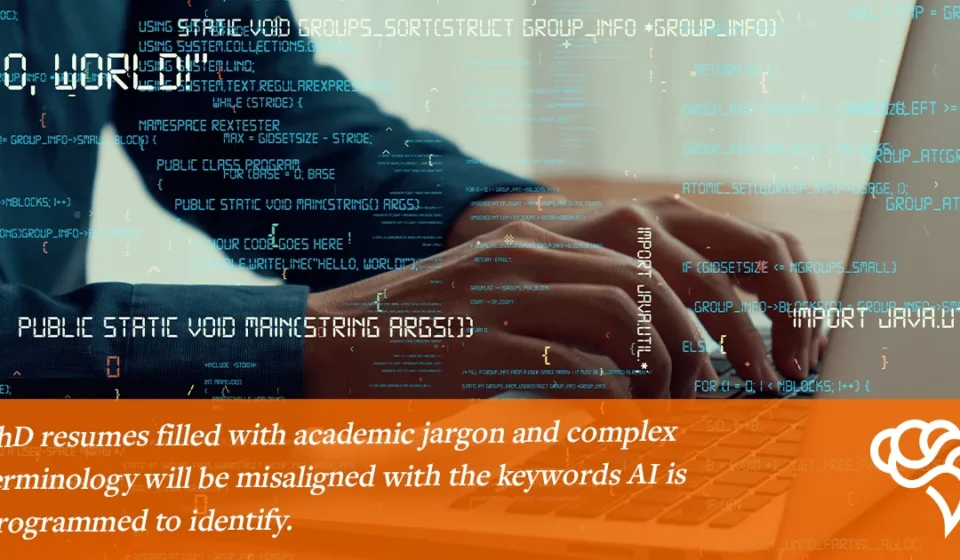
While AI offers significant benefits to recruiters, it simultaneously introduces new complexities for job seekers, particularly for PhDs. The fundamental challenge lies in the way these AI systems operate. ATS and similar platforms are typically programmed to prioritize specific keywords and adhere to particular formatting conventions. Traditional academic CVs, often lengthy and laden with specialized jargon, rarely align with these requirements. This mismatch can inadvertently lead to the disqualification of highly qualified candidates, not due to a lack of skill or experience, but because their application documents fail to meet the narrow criteria of AI algorithms. Consequently, understanding the internal mechanics of these AI gatekeepers has transitioned from a mere advantage to an absolute necessity for PhDs aiming for industry careers. The ability to navigate this modern job search landscape, ensuring resumes successfully pass AI screeners and reach human hiring managers, is paramount.

The AI Barrier: Deconstructing the PhD Resume
AI, specifically through Applicant Tracking Systems, represents the most significant hurdle for individuals transitioning from academia. Nearly all Fortune 500 companies now utilize AI and ATS in their recruitment processes. While these tools are ostensibly designed to enhance efficiency and mitigate human bias, research increasingly indicates their potential to inadvertently filter out qualified candidates. For PhDs who often submit CVs steeped in academic language and complex terminology, the risk of misalignment with AI’s keyword recognition capabilities is substantial. This disconnect is often rooted in a lack of awareness about current industry hiring practices, a common issue among academics accustomed to a different professional environment.
To overcome this AI barrier, a strategic re-evaluation of the resume is essential. The first and most foundational step is ensuring the resume is "machine-readable." This means opting for a clean, uncluttered template devoid of images, complex columns, or special characters that could confuse an ATS. Concise, declarative sentences are preferred, with a strong emphasis on quantifying achievements whenever possible. This straightforward approach facilitates efficient parsing by automated systems.
The second critical element is rigorous keyword matching. AI screening programs meticulously scan for exact keywords as they appear in the job description. Tools like Jobscan can be invaluable in comparing resumes against job postings and identifying missing keywords. However, simply including keywords is insufficient; appropriate keyword density is also crucial. This refers to the frequency with which a keyword appears within the document, typically within a specific percentage range. Over-optimization, known as keyword stuffing, can lead to disqualification, but more commonly, candidates fail to meet the minimum density. For example, a two-page resume of approximately 500-600 words might require a keyword like "project management" to appear twice to achieve a 0.7% density, and three times for a 1.3% density. When specific skills are not explicitly listed but are implied by experience, strategic phrasing is key. Instead of "Expertise in XYZ skill," consider "Ability to perform XYZ skill" or "Seven years of experience in ABC skills, which is directly relevant to XYZ skill." Using numerals when the job description does, and mirroring exact phrasing, are vital tactics.
The third key strategy involves prioritizing skills over education. Many companies are increasingly valuing demonstrable skills and practical experience over extensive academic credentials. While technical skills remain important, employers seek candidates who can readily adapt to new technologies, processes, and challenges. Soft skills, in particular, are highly transferable and resilient to technological obsolescence, ensuring a workforce capable of evolving with organizational needs. Emphasizing skills mentioned in the job description, concentrating them in the Professional Summary and Skills sections, and integrating them throughout the Experience section, makes it easier for AI to match candidates to roles.
Leveraging AI Beyond the Resume
While AI presents an initial obstacle, it also offers powerful tools for job seekers to enhance their candidacy. AI-driven job platforms personalize search results based on user activity, browsing history, and resume content. Understanding these prevailing technologies and trends is no longer optional; it’s essential for communicating effectively with potential employers.
Redefining Online Presence

In the digital age, an individual’s online presence is an extension of their resume. Job platforms and company websites meticulously track user activity, creating a digital footprint that can significantly influence candidacy. The misconception that avoiding personal social media accounts equates to a clean online presence is prevalent. However, every online interaction, from website visits to ad views, contributes to a digital profile. It is imperative to conduct a thorough audit of all online activity, scrubbing any controversial, unprofessional, or potentially damaging content. This includes reviewing social media profiles on platforms like Facebook, Twitter, Instagram, and TikTok, ensuring privacy settings are optimized, and actively working to remove or suppress negative information found through self-directed Google searches.
Optimizing LinkedIn is paramount. A professional profile picture, a compelling headline, and a concise, impactful summary are crucial. Listing relevant work experience and education with keywords aligned to target roles, and highlighting endorsed skills, are essential. Active engagement within relevant LinkedIn groups and participation in discussions demonstrate industry knowledge and networking capabilities, increasing visibility to both human recruiters and AI algorithms that track engagement. Sharing industry-related content and insights positions individuals as thought leaders and valuable contributors. Engaging in online forums and discussion boards related to one’s field further establishes expertise and fosters meaningful connections. Maintaining a professional tone and avoiding controversial discussions online are vital for safeguarding one’s professional image.
Utilizing Generative AI Strategically
Generative AI can be a powerful ally in the job search. Its applications extend beyond resume writing to include the development of impactful bullet points, keyword analysis for ATS optimization, crafting compelling resume summaries, and generating detailed descriptions of relevant experience. For cover letters, AI can create personalized templates tailored to specific job postings, saving considerable time and effort. Furthermore, AI can assist in curating relevant content for social media, enhancing personal branding and demonstrating expertise. AI-powered tools can analyze online profiles and suggest improvements to bolster an individual’s appeal to potential employers.
However, it is crucial to remember that AI is a tool, not a replacement for human judgment. AI-generated content should always be reviewed, revised, and edited to ensure it aligns with personal values and professional goals. ATS systems are becoming increasingly adept at detecting AI-generated text patterns. Content that sounds overtly robotic or lacks nuance and personality can lead to immediate disqualification. Large language models learn from vast datasets, and their output can often be predictable. Injecting one’s own voice, experiences, and unique perspectives is what truly differentiates an application.
The Indispensable Human Touch
As AI tools become more integrated into the hiring process, the importance of the human touch cannot be overstated. While AI can assist in polishing resumes, drafting cover letters, and optimizing online reputations, the ultimate responsibility for reviewing, revising, and editing this content lies with the individual. The nuances of personality and unique perspectives are what make an application stand out. AI, being an algorithm, generates predictable content. Large language models learn patterns in language by analyzing relationships between words and phrases in their training data, making AI-written content identifiable. Therefore, it is essential to infuse AI-generated text with one’s own voice and experiences to ensure a genuine and impactful application.
Additional Strategies for the AI-Driven Job Market

Beyond resume optimization and online presence management, several other strategies are critical for navigating the AI-driven job market. Networking remains a cornerstone of the job search, even in a technologically advanced environment. Platforms like LinkedIn are invaluable for connecting with recruiters, hiring managers, and industry professionals. Active engagement with admired companies—following their pages, interacting with their posts, and sharing relevant content—increases visibility to both human recruiters and AI algorithms. This demonstrates genuine interest and boosts the likelihood of appearing in search results and recommendations.
Building genuine relationships is the core of effective networking. Engaging in meaningful conversations, offering insights, and supporting others foster connections that can lead to job opportunities, referrals, and career advice. Recruiters actively use LinkedIn to source talent, and active participation in relevant groups and discussions makes candidates more visible and attractive.
Thorough employer research is also non-negotiable. Generic applications are a relic of the past. Tailoring application materials to each specific job description and company is essential. This involves aligning skills and experiences with role requirements, demonstrating an understanding of company values and mission, and articulating how one can uniquely contribute to organizational goals. This targeted approach not only impresses human recruiters but also satisfies the keyword-matching algorithms of ATS systems. Information for research is readily available through company websites, news articles, and social media. When questions remain, reaching out to current employees on LinkedIn or directly to the HR department is a proactive step.
Continuous tailoring of the resume for each application is imperative. Incorporating keywords parsed from the job description, prioritizing key requirements higher on the resume, and de-emphasizing or removing irrelevant skills or experiences ensures a focused and effective application. Using action words and quantifiable results in bullet points addresses specific company needs. For those new to industry, a "Professional Development" section can highlight workshops, conferences, and training programs that demonstrate a commitment to continuous learning. While PhDs possess extensive knowledge, demonstrating an ongoing willingness to learn is crucial for employers.
Exploring AI Tools for Job Search Enhancement
The rapidly evolving hiring landscape has seen the emergence of numerous AI-assisted job search tools. While the longevity of some platforms remains to be seen, several are proving particularly useful:
- Jobscan: This AI tool analyzes job descriptions and resumes, identifying missing keywords and suggesting relevant terms to ensure alignment with role requirements.
- RezScore: This platform employs AI to evaluate resume effectiveness, offering suggestions for optimization, including keyword integration and formatting adjustments.
- ChatGPT: A versatile language model, ChatGPT can generate personalized cover letter templates, suggest impactful phrasing, and assist in articulating skills and experiences in a manner that resonates with company values.
- Copy.ai: Offering various templates and prompts, Copy.ai aids in crafting compelling resumes, cover letters, and LinkedIn profiles, facilitating brainstorming and refining written content.
- Crayon: This AI-powered platform analyzes competitor websites, social media, and news to provide insights into company culture, values, and recent developments, which is invaluable for tailoring applications.
- Crystal Knows: Utilizing AI to analyze public data, this tool generates personality profiles of individuals, including hiring managers, offering insights into their communication styles and preferences for more effective interaction.
Concluding Remarks
The proliferation of AI in recruitment has irrevocably reshaped the job search terrain, presenting unique challenges for PhDs aiming to enter the industrial sector. By comprehending the operational mechanisms of AI-powered tools and adapting their strategies accordingly, individuals can harness these technologies to their advantage. Optimizing resumes and online presences for AI algorithms, meticulously tailoring applications, and actively engaging with companies on professional networking platforms are critical steps in navigating the AI-driven job market. Crucially, the human element remains indispensable. Personalizing applications, cultivating genuine professional relationships, and prominently showcasing unique skills and experiences are paramount. By embracing a strategic blend of AI capabilities and authentic human interaction, job seekers will significantly enhance their prospects of securing their desired industry roles.