
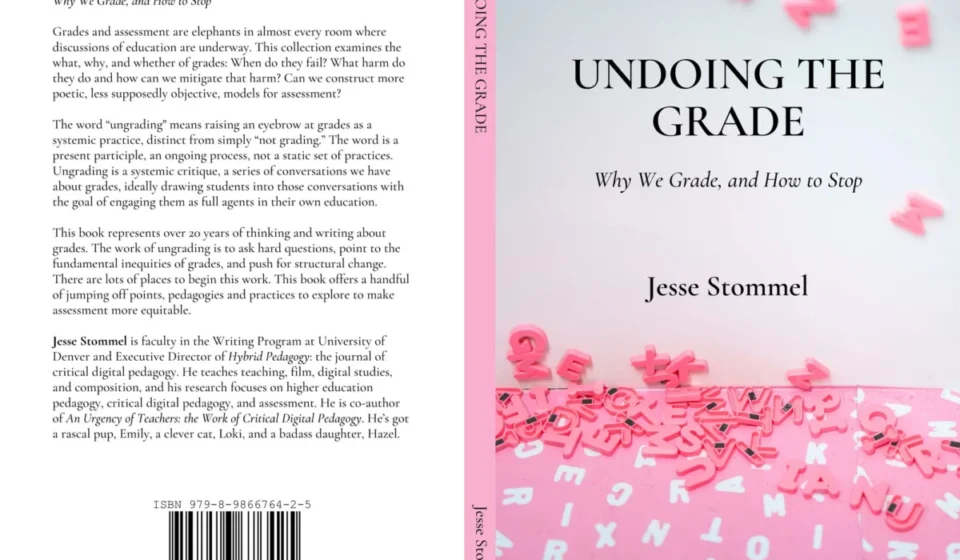

The publication of this comprehensive volume by Jesse Stommel, released through the 501(c)(3) non-profit Hybrid Pedagogy, marks the culmination of more than two decades of research, practice, and advocacy regarding the systemic nature of academic assessment. Stommel, a prominent voice in digital pedagogy and higher education, presents a detailed critique of traditional grading systems, arguing that they are not only pedagogically ineffective but also fundamentally inequitable. The work positions "ungrading" not as a simple cessation of evaluation, but as an ongoing, systemic process of questioning the structures that define modern education.
The Conceptual Framework of Ungrading
In the context of modern higher education, "ungrading" is defined as a critical interrogation of grades as a systemic practice. According to the research presented in the volume, the term serves as a present participle, signifying a continuous evolution rather than a static set of rules. The primary objective is to transition from a "banking model" of education—a term coined by Brazilian educator Paulo Freire—to a "problem-posing" model. In the banking model, students are treated as passive depositories for information provided by the teacher. Conversely, ungrading seeks to engage students as full agents in their own learning process, fostering an environment where cognition takes precedence over mere information retrieval.
The work argues that assessment and grading, while often conflated, are distinct concepts. While assessment is intended to measure and support learning, grading has become a standardized, quantitative mechanism that often obstructs the very learning it claims to measure. The book highlights that the current shape of academic labor and the structure of institutional syllabi are increasingly dictated by these quantitative metrics, necessitating a radical reimagining of how student progress is documented.
A Chronology of Assessment: From Industrialization to the Digital Pivot
The historical trajectory of grading reveals that the current system is a relatively recent development in the scope of human education. Research cited by Stommel, including studies by Schinske and Tanner, indicates that letter grades have approximately a 240-year history in North America. More significantly, they were not used with any degree of regularity until the last 75 years. Before this period, assessment was often more narrative and idiosyncratic. The standardization of grades was an industrial-era invention designed to rank students against one another, creating a veneer of objectivity that persists today.
The timeline of modern assessment faced a significant disruption in March 2020 during the global COVID-19 pandemic. This period, often referred to as the "pivot" to online learning, forced millions of educators to move their classrooms to digital environments overnight. Stommel and colleague Sean Michael Morris responded by launching "Open Online Office Hours," a series of weekly discussions that ran through the end of 2020. These sessions, which drew between 20 and 150 attendees per meeting, revealed a deep-seated friction between institutional bureaucratic requirements and the sudden need for pedagogical compassion.
While many institutions called for flexibility during the lockdowns, few were willing to dismantle the underlying grading bureaucracies. This era underscored a critical lack of formal preparation for teachers—particularly in higher education—to handle the complexities of online assessment, leading to a reliance on standardized tools that many critics argue are ill-suited for genuine learning.
Supporting Data: The Industrialization of Suspicion
One of the most significant developments in the assessment landscape is the rise of the remote proctoring industry. Data indicates that this market, which includes companies like ProctorU and Proctorio, grew from a $4 billion valuation in 2019 to an estimated $21 billion by 2023. This growth is predicated on the narrative that academic dishonesty is a rampant and increasing threat, particularly in online environments.
However, historical data suggests that cheating rates have remained remarkably stable for over half a century. A 1963 survey by Bowers of roughly 100 institutions found that 75% of students admitted to cheating at least once. Similarly, a 2012 study by McCabe, involving 150,000 students, showed that 60% to 70% of respondents admitted to cheating. Despite this relative stability, a 2020 Wiley survey found that 93% of instructors believe students are more likely to cheat online than in person.

This discrepancy highlights what the book describes as a "culture of suspicion." The author posits that cheating is a pedagogical issue rather than a technological one. By relying on surveillance software—which has been criticized for being racist, ableist, and invasive—institutions may be exacerbating the problem rather than addressing the root causes of student anxiety and disengagement.
Economic and Labor Implications
The debate over grading is inextricably linked to the socio-economic realities of the modern university. The majority of teachers in higher education now work in contingent, adjunct, or sessional positions. These educators often face extreme labor precarity, and the requirement to perform intensive grading adds a significant burden to their workload without a corresponding increase in compensation or student benefit.
Furthermore, grades are shown to have a disproportionately negative impact on marginalized students. When institutional technologies, such as Learning Management Systems (LMS), center quantitative metrics, they often reinforce existing social inequities. The book suggests that the move toward ungrading is a political and professional necessity to protect both students and the integrity of the teaching profession.
Analysis of Alternative Assessment Methodologies
To address the failures of traditional grading, the volume explores several alternative approaches that have been tested in various institutional settings. These methods prioritize intrinsic motivation over extrinsic rewards:
- Minimal Grading: This approach reduces the 100-point or 1,000-point scale to simpler demarcations, such as "Excellent," "Satisfactory," or "Needs Revision." Proponents like Peter Elbow argue this makes assessment clearer and fairer.
- Contract Grading: Students and teachers agree on a set of labor-based goals at the beginning of the term. If the student completes the agreed-upon work, they receive a specific grade. This method, advocated by researchers like Asao B. Inoue, emphasizes the labor of learning over subjective "quality" judgments.
- Authentic Assessment: This involves moving away from standardized tests toward projects that have real-world applications or audiences, encouraging students to see their work as having value beyond the classroom.
- Process Letters and Self-Evaluation: Students are asked to write metacognitive reflections on their own work. Stommel notes that in his 20 years of practice, he has found that students are often their own most rigorous critics when given the agency to evaluate their progress.
Broader Impact and Institutional Reactions
The implications of ungrading extend beyond the individual classroom to the very definition of academic integrity. Educational critics like Alfie Kohn have long argued that grades diminish interest in learning, encourage students to choose the easiest possible tasks, and reduce the quality of thinking. By decentering grades, educators can foster a "pedagogy of care" that prioritizes the human relationship between teacher and student.
Institutional reactions to these theories remain mixed. While some colleges, such as Evergreen State College and the University of California, Santa Cruz, have a history of using narrative evaluations instead of letter grades, most mainstream institutions remain tethered to the GPA system for administrative and accreditation purposes. However, the growing body of research suggests that the "bureaucratic ouroboros" of grading is increasingly under scrutiny by a new generation of educators who view traditional assessment as a barrier to equity.
Conclusion: The Future of Pedagogy
The work presented in the volume suggests that the path forward requires "pedagogical disobedience." This involves moving away from "hidden curricula" and "visible goalposts" that prioritize compliance over curiosity. By starting with simple human interactions—such as moving basic needs and mental health statements to the front of a syllabus—educators can begin to dismantle the culture of competition that grades foster.
Ultimately, the book serves as a call to action for the educational community to imagine a system that is less algorithmic and more human. It posits that the most authentic assessment approaches are those that engage students as experts in their own learning journey, transforming the classroom from a space of quantitative evaluation into a space of genuine epiphany and intellectual growth. The proceeds from the book support the ongoing efforts of Hybrid Pedagogy to provide open-access resources for teachers worldwide, ensuring that the conversation around ungrading continues to evolve alongside the changing landscape of global education.