
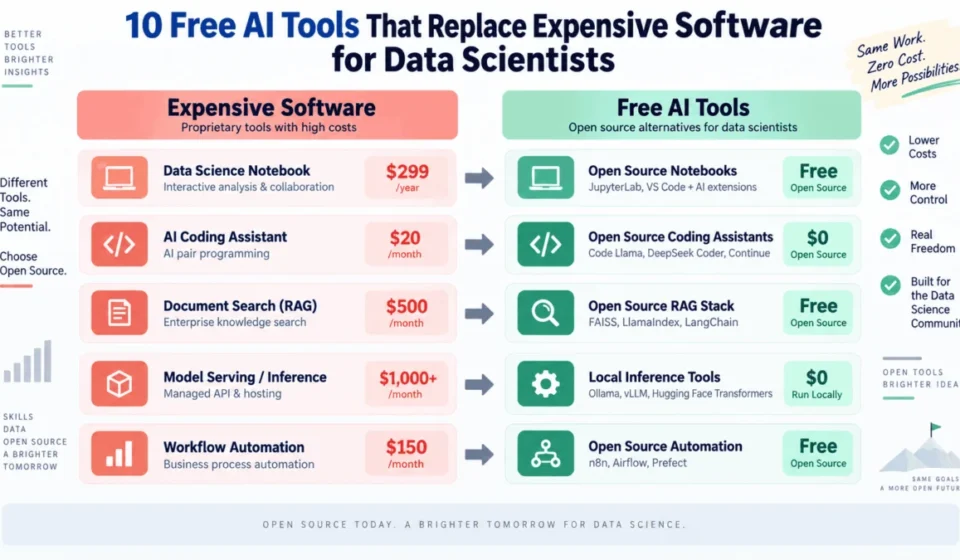
10 Free AI Tools That Can Replace Expensive Software for Data Scientists

The landscape of enterprise data science is undergoing a significant transformation, driven by the rapid maturation and widespread availability of open-source artificial intelligence tools. Historically, data science teams have relied on costly commercial software for critical functions, with single licenses for platforms like DataRobot potentially exceeding $50,000 annually, and even more accessible tools like Tableau Creator costing around $900 per user per year. The expense extends to cloud-based large language model (LLM) APIs, where per-token pricing for continuous data extraction or summarization can quickly escalate into thousands of dollars monthly, often with unpredictable ceilings. However, a recent surge in the quality and capability of open-source alternatives has dramatically narrowed the gap, effectively closing it for many professional workflows. These free counterparts now rival, and in some cases surpass, their paid commercial equivalents, offering state-of-the-art performance and the ability to run locally, thereby enhancing data privacy and cost-efficiency. This article explores ten such open-source tools, detailing how they can replace expensive software across the entire data science lifecycle, from local inference and AI-assisted coding to automated machine learning, natural language data exploration, retrieval-augmented generation (RAG), dataset annotation, visual analytics, experiment tracking, local analytics, and LLM observability.
The Shifting Paradigm: Open Source Meets Enterprise Needs
The increased accessibility and power of open-source AI have democratized advanced data science capabilities. This shift is not merely about cost savings; it represents a fundamental change in how data science teams can operate, offering greater control over data, increased flexibility, and the ability to innovate without budget constraints. The past few years have witnessed an unprecedented acceleration in the development of open-weight language models and specialized AI libraries, making them robust enough for production environments. This has led many organizations to re-evaluate their software procurement strategies, seeking cost-effective and privacy-preserving alternatives. The tools discussed below are not niche academic projects but mature solutions designed to integrate seamlessly into existing workflows, providing tangible benefits to data scientists and their organizations.
Replacing High-Cost LLM APIs with Localized Powerhouses
1. Replacing OpenAI and Anthropic APIs with Ollama + Open WebUI
The cost of commercial LLM APIs, often based on per-token usage, can become a substantial financial burden for teams engaged in data-intensive tasks like document extraction, text classification, or summarization. These costs can easily reach thousands of dollars per month for continuous processing, with little visibility into future expenses.
Ollama, an open-source platform, fundamentally alters this equation by enabling users to download and run a wide array of open-weight language models, including popular options like DeepSeek-R1, Llama 3.3, Mistral, and Phi-4, directly on local hardware. This eliminates the need for API keys, bypasses rate limits, and crucially, ensures that sensitive data never leaves the user’s machine. For data scientists running recurring data processing pipelines, this local inference capability translates into the freedom to execute workloads continuously without the pressure of escalating API fees.
Complementing Ollama, Open WebUI provides a user-friendly, browser-based chat interface that closely mimics the experience of platforms like ChatGPT and Claude. It supports multi-turn conversations, file uploads, and seamless model switching. This interface empowers even non-technical stakeholders to interact with local LLMs through a familiar and intuitive design, all while maintaining complete data privacy as no information is transmitted to external servers.
The implications for data privacy are profound. Organizations dealing with proprietary code, confidential documents, or sensitive datasets can now process this information using powerful LLMs without triggering compliance reviews or risking data exposure. This local execution model offers a significant advantage in regulated industries and for companies prioritizing data sovereignty.
2. Replacing GitHub Copilot Business and Tabnine with Tabby
Subscription-based AI coding assistants like GitHub Copilot Business ($19 per user per month) and Tabnine ($59 per user per month) offer valuable code completion features. However, they come with privacy concerns, as user code and context are sent to external servers for processing.
Tabby, a self-hosted AI coding assistant, addresses this by providing context-aware code completion within popular Integrated Development Environments (IDEs) such as VS Code, JetBrains IDEs, and Vim/NeoVim. Tabby supports any open-weight model as its backend and operates entirely on local or private infrastructure. It can integrate with Ollama for streamlined model management.
The critical advantage for data science teams lies in data sovereignty. With Tabby, the entire code completion pipeline remains within the organization’s infrastructure, ensuring that proprietary algorithms, client data, and sensitive code are never transmitted externally. This eliminates compliance risks associated with sending code to third-party servers. Furthermore, Tabby’s repository-level context indexing allows it to be trained on a team’s specific codebase, generating completions that adhere to internal coding standards, conventions, and the usage of internal libraries. This deep contextual understanding is often a challenge for paid tools to replicate at an organizational level.
Streamlining Machine Learning Workflows
3. Replacing DataRobot and H2O Driverless AI with AutoGluon
Enterprise AutoML platforms such as DataRobot and H2O Driverless AI are powerful but come with significant licensing costs, often ranging from $50,000 to over $250,000 annually. These platforms automate the machine learning lifecycle, but their cost can be prohibitive for many organizations.
AutoGluon, an open-source project developed by AWS, offers a comprehensive solution for automating the end-to-end machine learning workflow across various data types, including tabular, text, image, and multimodal data. It handles crucial steps such as data preprocessing, feature engineering, model selection, hyperparameter tuning, and ensemble stacking with minimal manual intervention.
AutoGluon consistently performs at or near the top in standard AutoML benchmarks, frequently outperforming manually tuned pipelines. Its advanced stacking approach, particularly for tabular data, combines gradient boosting, neural networks, and other learners into highly effective ensembles.
The practical advantage of AutoGluon is its seamless integration within a Python environment. This means no data needs to be uploaded to a cloud platform, and there are no per-row pricing models or dataset size limitations beyond the local compute capacity. Data science teams can conduct extensive hyperparameter searches, generate multiple model variants, and iterate rapidly without the financial constraints associated with commercial AutoML platforms. This open-source approach fosters experimentation and accelerates the development cycle.
4. Replacing ThoughtSpot and Alteryx with PandasAI
Tools like ThoughtSpot (starting at $25-$50 per user per month) and Alteryx Designer ($5,000 per year) provide capabilities for natural language querying and data workflow automation. However, their proprietary nature and associated costs can limit accessibility.
PandasAI introduces a natural language query layer directly on top of standard Pandas DataFrames. This allows users to describe their data analysis needs in plain English, which PandasAI then translates into the appropriate Pandas or Matplotlib operations. Instead of writing complex filtering, grouping, or plotting code, users can simply articulate their requirements.
For data scientists, PandasAI significantly accelerates exploratory data analysis (EDA). Describing a desired chart or aggregation and then inspecting or tweaking the generated code is often more efficient than writing it from scratch, especially for one-off analyses. Moreover, for non-technical collaborators, PandasAI removes the Python programming barrier entirely. Analysts and domain experts can interrogate datasets, generate summaries, and filter data independently, reducing reliance on engineering support. This self-service capability, a core value proposition of platforms like ThoughtSpot, is delivered within the familiar Jupyter environment. PandasAI also supports local LLMs via Ollama, allowing natural language processing to occur entirely offline, with no query data sent to external services.
Enhancing Data Management and Knowledge Access
5. Replacing Enterprise RAG Platforms with AnythingLLM
Enterprise RAG platforms and internal knowledge base tools can incur significant monthly costs, ranging from $500 to several thousand dollars, depending on document volume and user count. These platforms are designed to make vast amounts of information accessible through AI.
AnythingLLM provides a comprehensive, open-source RAG application that transforms local files, PDFs, code repositories, websites, and structured data into a queryable AI knowledge base. It operates locally, connects to Ollama for inference, and does not require cloud infrastructure or API keys.
The setup process is designed for simplicity. Users point AnythingLLM to a folder of documents, and it automatically handles chunking, embedding, vector storage, and retrieval. The resulting interface allows users to ask questions against their own data, complete with source citations, ensuring the origin of information is transparent and verifiable.
For data science teams, the applications are immediate. Internal documentation, research papers, historical reports, and codebase READMEs can be ingested and queried conversationally. This replicates the functionality of costly enterprise knowledge management and document search platforms at no financial cost, while maintaining complete control over sensitive data.
6. Replacing Scale AI and Labelbox with Autodistill
Data annotation platforms like Scale AI and Labelbox are essential for training computer vision models, but their per-labeled-item or per-seat pricing can lead to tens of thousands of dollars in costs for large annotation projects.
Autodistill leverages large foundation models, such as Grounding DINO and the Segment Anything Model (SAM), to automatically generate labels for computer vision datasets without the need for human annotators. Users define the classes they wish to detect in natural language, and Autodistill employs zero-shot detection models to label images accordingly.
The resulting labeled dataset can then be used to train a smaller, more efficient model optimized for specific deployment environments through a process called "distillation." This allows for the creation of custom object detection models entirely from unlabeled images, eliminating manual annotation efforts and subscription fees for annotation platforms. For teams building computer vision pipelines, the cost savings are substantial. Projects that would typically require hundreds of hours of human annotation can be bootstrapped automatically, with human review reserved for instances where the foundation model exhibits uncertainty. For common object classes, the annotation quality generated by Autodistill is often sufficient for most production use cases without manual correction.
Revolutionizing Data Visualization and Analytics
7. Replacing Tableau and Power BI Premium with PyGWalker
Commercial business intelligence tools like Tableau Creator ($75 per user per month) and Power BI Premium ($24 per user per month) are staples for data visualization and exploration. However, their licensing costs can add up quickly for teams.
PyGWalker transforms standard Pandas or Polars DataFrames into an interactive, drag-and-drop visual exploration interface directly within a Jupyter notebook. Its interface is modeled on Tableau’s user-friendly interaction model, allowing users to drag fields onto axes, switch chart types, apply filters, and layer dimensions without writing any visualization code.
A key advantage over standalone BI tools is PyGWalker’s integration within the analysis environment. There is no need for data export, separate connection configurations, or maintaining an additional application. Visualizations are created in the same notebook where data processing occurs, ensuring immediate reproducibility. For teams that primarily use Tableau for EDA and internal reporting, PyGWalker effectively covers these use cases without the associated license overhead. Its AI query feature also supports natural language chart generation, further reducing the friction between data analysis and visualization.
8. Replacing Snowflake and BigQuery for Local Analytics with DuckDB
Cloud data warehouses like Snowflake and BigQuery are powerful for large-scale analytics, but costs for small to mid-sized teams can easily range from $500 to $2,000+ per month for compute and storage.
DuckDB is an in-process analytical database that enables users to run SQL queries directly against Parquet files, CSV files, JSON, and Pandas DataFrames without the need to load data into a server or cloud platform. For datasets up to approximately 100GB, DuckDB’s query performance rivals that of managed cloud data warehouses, and it operates entirely on local hardware with no infrastructure to configure.
This represents a significant workflow shift for data scientists. Instead of uploading data to a cloud warehouse, writing queries, and incurring compute costs, users can query files directly from their filesystem at comparable speeds. DuckDB integrates natively with Pandas and Polars, meaning query results are returned as DataFrames, seamlessly fitting into existing analysis pipelines. For teams whose cloud data warehouse usage is primarily for exploratory analytics and feature generation rather than extensive multi-user reporting, DuckDB offers a zero-cost, lower-latency alternative, eliminating network round-trips.
Advanced LLM Observability and Experimentation
9. Replacing Weights and Biases Enterprise with MLflow
Machine learning experiment tracking and model registry platforms like Weights & Biases (Team plans start at $25 per user per month, with higher enterprise pricing) are crucial for managing the ML lifecycle.
MLflow stands as the open-source standard for machine learning experiment tracking, model registry management, and deployment tooling. It meticulously logs parameters, metrics, artifacts, and model versions across training runs, providing a browser-based UI for comparing experiments, visualizing learning curves, and managing models through staging and production environments.
MLflow’s recent enhancements include robust LLM support. It now tracks prompt versions, response quality scores, and token usage alongside traditional ML metrics, consolidating the tracking interface for teams developing both predictive models and LLM-based applications. The self-hosted deployment model ensures that all experiment data remains within the organization’s infrastructure, a critical consideration for teams working with sensitive training data. This approach avoids per-seat costs, data egress to external platforms, and feature limitations tied to higher pricing tiers.
10. Replacing LangSmith with Langfuse
LLM observability and evaluation platforms like LangSmith (Plus plans start at $39 per seat) are vital for debugging and monitoring LLM applications, but their proprietary nature and pricing can be a barrier.
Langfuse is an open-source platform for LLM observability and evaluation. It captures detailed traces of every LLM call within an application, including prompts, model responses, token counts, latency, and cost estimates. These traces are organized into a structured debugging interface, allowing teams to score outputs, tag failures, run evaluation datasets against prompt versions, and monitor production applications for quality regressions.
For data scientists building LLM pipelines, observability is often a missing piece. Inconsistent outputs from LLM pipelines can be difficult to debug without clear visibility into each model call’s inputs and outputs. Langfuse provides this critical visibility within a self-hosted environment, offering integrations for popular frameworks like LangChain and LlamaIndex, as well as direct API call support. Langfuse can be deployed via Docker in minutes, enabling teams to establish production-grade LLM monitoring capabilities locally or on private infrastructure without committing to managed platforms or per-trace pricing models.
Broader Impact and Future Implications
The widespread adoption of these open-source tools has several profound implications for the data science industry. Firstly, it significantly lowers the barrier to entry for startups and smaller organizations, allowing them to leverage advanced AI capabilities without substantial upfront investment. This can foster innovation and lead to a more diverse ecosystem of AI-powered products and services.
Secondly, the emphasis on local execution and data sovereignty addresses growing concerns about data privacy and security. As regulations surrounding data usage become more stringent, tools that enable on-premises processing become increasingly valuable. This trend is likely to accelerate the shift away from cloud-dependent proprietary solutions for many organizations.
Thirdly, the availability of sophisticated open-source alternatives empowers data scientists with greater flexibility and control over their tools and workflows. This can lead to more customized and efficient solutions tailored to specific organizational needs, rather than being constrained by the feature sets and pricing models of commercial vendors.
The trade-off, as noted, is often the initial configuration time. While paid platforms abstract away setup complexity, open-source tools require users to invest time in installation and configuration. However, for most of these tools, this investment is measured in hours rather than days, and the long-term savings in licensing fees and operational costs far outweigh the initial setup effort.
A practical approach for organizations looking to transition is to identify the single largest expense in their current data science software budget and focus on replacing that component first. By successfully implementing and stabilizing one open-source replacement, teams can build confidence and momentum for further adoption. Within a quarter, it is entirely feasible for many organizations to establish a robust, fully open-source data science stack without experiencing a meaningful loss in capability. This strategic adoption of open-source AI represents not just a cost-saving measure but a pathway to greater agility, enhanced data security, and accelerated innovation in the field of data science.