UK Reaches Halfway Point in Construction of Giant Neutrino Sensors for Groundbreaking Deep Underground Neutrino Experiment

The United Kingdom has achieved a significant milestone in its contribution to the Deep Underground Neutrino Experiment (DUNE), with half of the 137 colossal neutrino sensors, known as Anode Plane Assemblies (APAs), now complete. This achievement marks a pivotal moment in the ambitious international project, which aims to unravel some of the most profound mysteries of the universe, including the fundamental question of why matter, rather than antimatter, dominates the cosmos.
DUNE, a flagship initiative in particle physics, involves an international collaboration of scientists and engineers dedicated to understanding the enigmatic nature of neutrinos. These elusive subatomic particles, incredibly abundant yet notoriously difficult to detect, are believed to hold crucial clues to the universe’s asymmetry between matter and antimatter, as well as other fundamental questions about cosmic evolution and the very fabric of reality. The experiment involves sending a high-intensity neutrino beam 1,300 kilometers across the United States, from Fermilab in Illinois to the Sanford Underground Research Facility in South Dakota, where a massive detector will meticulously observe their interactions.
A Nationwide Engineering Endeavor
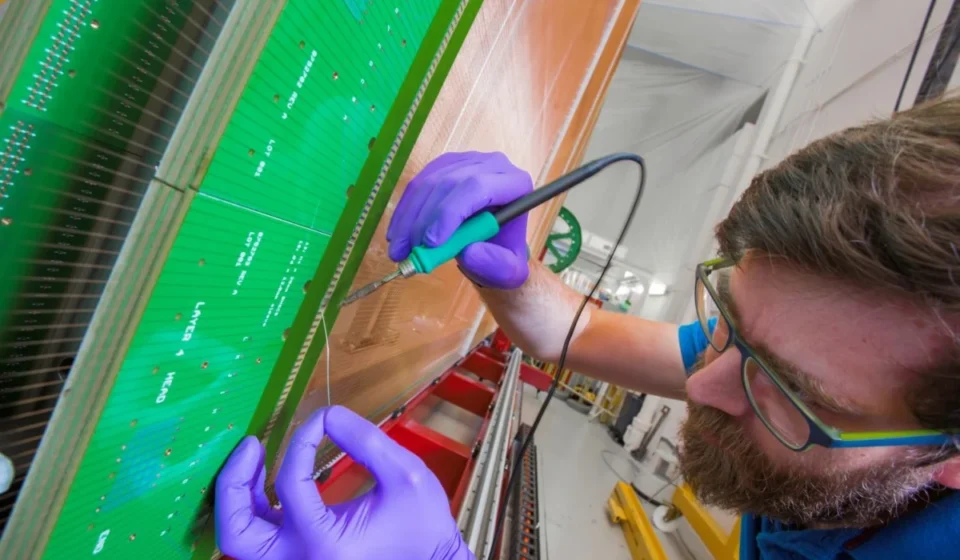
The APAs are the primary sensory components of DUNE’s Far Detector 1, playing a critical role in capturing the faint electrical signals generated when neutrinos interact with a vast volume of ultra-pure liquid argon. These gargantuan sensors, each standing approximately 6.3 meters tall and 2.3 meters wide – roughly the height of a two-story building – represent an extraordinary feat of precision engineering. Each APA is outfitted with an astonishing 24 kilometers of hair-thin copper-beryllium wire, meticulously arranged and secured by thousands of precise connections across its expansive frame.
The manufacturing of these complex instruments is being undertaken by a dedicated team of 25 skilled technicians at the Science and Technology Facilities Council’s (STFC) Daresbury Laboratory, located within the Sci-Tech Daresbury innovation campus. This central production hub operates in close synergy with a network of universities spread across the UK. These academic partners are contributing vital components, providing rigorous quality assurance, and offering essential scientific leadership, underscoring the collaborative spirit of the DUNE-UK initiative. The universities involved in this crucial aspect of the project include the University of Manchester, Imperial College London, the University of Liverpool, the University of Oxford, and the University of Sheffield.
This extensive network forms part of the broader DUNE-UK collaboration, a formidable consortium comprising 14 universities and two national laboratories. Beyond the APA production, UK scientists and engineers are making substantial contributions to other vital areas of the experiment, including the design and development of detector systems, sophisticated software, high-performance computing infrastructure, and the accelerator systems required to generate the neutrino beam.
Flagship Instrumentation for a Global Experiment
DUNE stands as one of the most ambitious particle physics experiments ever conceived, pushing the boundaries of scientific inquiry and technological innovation. The APAs are not merely components; they are the UK’s flagship instrumentation contribution to the DUNE project, a testament to the nation’s scientific prowess and engineering capabilities. The UK is responsible for producing 137 out of the total 150 APAs required for the experiment, a significant portion that highlights the trust and importance placed on British expertise.
The sheer scale and complexity of each APA demand exceptional engineering. When a neutrino traverses the liquid argon, it can occasionally interact, producing charged particles that leave behind subtle electrical trails. The intricate network of wires on the APAs acts as a vast antenna, detecting these fleeting signals. By meticulously analyzing these signals, scientists can reconstruct the trajectory, energy, and other properties of the particles produced, thereby illuminating the behavior of neutrinos and their role in the universe. The completed APAs will eventually be transported and installed nearly a mile underground at the Sanford Underground Research Facility, where they will become integral parts of a detector designed to contain tens of thousands of tons of liquid argon.
Addressing Fundamental Cosmic Questions
Neutrinos, despite being one of the most ubiquitous particles in the universe, are notoriously elusive due to their minimal interaction with ordinary matter. This characteristic makes their detection a formidable scientific challenge, yet it is precisely their subtle interactions that offer a unique window into fundamental physics. DUNE’s core mission is to leverage the power of observation to compare the behavior of neutrinos and their antiparticle counterparts, antineutrinos, as they journey from their source to the far detector. This comparison is expected to shed light on critical questions that have puzzled physicists for decades.
The experiment is poised to investigate several paramount scientific objectives:
- The Matter-Antimatter Asymmetry: Understanding why the universe is predominantly composed of matter, when the Big Bang should have produced equal amounts of matter and antimatter, leading to mutual annihilation.
- Neutrino Oscillation Properties: Precisely measuring how neutrinos change from one "flavor" to another as they travel, and determining the precise mass ordering of these flavors.
- Proton Decay: Searching for evidence of proton decay, a theoretical process predicted by some Grand Unified Theories that would signal a breakdown of fundamental symmetries in nature.
- Supernova Neutrino Observations: Detecting neutrinos emitted from distant supernova explosions, providing unprecedented insights into the explosive deaths of massive stars and the processes that forge heavy elements.
The extreme depth of the Sanford Underground Research Facility, situated nearly a mile beneath the surface, is crucial. This subterranean location provides an essential natural shield against cosmic rays and other forms of background radiation that would otherwise overwhelm the exceedingly faint signals that DUNE is designed to detect, ensuring the integrity of the scientific measurements.
Collaboration in Action: Voices from the Project
The achievement of completing half of the APAs has been met with widespread enthusiasm and recognition from the project leaders. Ian Lazarus, Head of Technology at STFC’s Daresbury Laboratory, articulated the significance of this milestone: "Reaching the halfway point on APA production is a fantastic milestone for everyone involved. These are exceptionally large and technically demanding detector components, and getting to this stage reflects the skill, care and teamwork that has gone into every part of the programme. From the engineers building the APAs at Daresbury Laboratory, to the university teams supplying components, carrying out testing and providing scientific expertise, this has been a genuinely UK-wide effort. It’s exciting to see this work taking shape as part of DUNE, and to know that these detector panels will ultimately help scientists investigate some of the biggest questions about our Universe."
Professor Dave Newbold, formerly executive director of National Laboratories at STFC and senior responsible officer for DUNE UK, who now serves as a co-spokesperson for the DUNE collaboration, echoed this sentiment. He stated, "The APA team have accomplished a huge milestone by reaching the halfway point in their production. The unique and complex components that are now making their way from the UK to the USA are a central component of the DUNE neutrino detector, and vital to address the ambitious scientific goals of the experiment. It’s great to know that profound questions about the universe are soon going to be answered through the efforts of workers across the UK, in industry, laboratories, and universities."
Justin Evans, Project lead of the DUNE-UK APA project from The University of Manchester, emphasized the project’s broader scientific implications: "This is a major step towards realising DUNE. We are building a detector with the potential to answer some of the deepest questions in particle physics: why our Universe is dominated by matter, how neutrinos fit into our understanding of fundamental physics, and what we can learn from neutrinos produced by a supernova. DUNE will be one of the world’s leading neutrino experiments, and it is enormously exciting to see the detector that will enable this science now taking shape."
Revealing the Invisible: The Mechanics of Detection
The collective work of thousands of wires within each APA is what enables scientists to meticulously reconstruct the precise position and three-dimensional movement of particles generated by neutrino interactions. This intricate data forms the foundation for understanding neutrino behavior. To date, eight completed APAs have successfully arrived at Fermilab in Illinois. There, they undergo rigorous final testing and calibration procedures before their eventual journey to South Dakota for installation in the cavernous underground detector.
Timeline and Future Outlook
The production of the UK’s 137 APAs is a carefully orchestrated process with a clear timeline. With half of the assemblies now complete, the focus shifts to accelerating the production of the remaining units. The final APAs are scheduled to be completed by May 2029. Following their completion and extensive quality checks, the deliveries for installation in South Dakota are anticipated to commence in November 2029, progressing through subsequent years as the DUNE detector is progressively assembled. This phased approach ensures that components are ready for installation as construction progresses deep underground.
The DUNE experiment represents a significant investment in fundamental scientific research, with contributions from numerous countries worldwide. The UK’s role in producing the critical Anode Plane Assemblies underscores its commitment to advancing global scientific understanding and its capacity for delivering cutting-edge technological solutions for complex scientific endeavors. As work continues towards the full completion of the APAs and the eventual assembly of the DUNE detector, the scientific community eagerly anticipates the groundbreaking discoveries that lie ahead in unlocking the profound mysteries of neutrinos and the universe they inhabit.