New York City’s Canine Census: Exploring the Spatial and Socioeconomic Factors Influencing Dog Sizes Across Boroughs

The vibrant tapestry of New York City, a metropolis characterized by its diverse neighborhoods and bustling urban landscape, is also home to a significant canine population. A recent deep dive into the city’s dog licensing data, building upon earlier explorations of New York’s dog demographics, has unveiled intriguing correlations between a dog’s size and its geographical location, as well as the socioeconomic characteristics of its neighborhood. This comprehensive analysis, initially published on Kieran Healy’s blog and contributed to R-bloggers, has prompted further investigation into the intricate relationship between urban living and canine companionship.
The inquiry was sparked by a thoughtful observation from William Kornblum, an emeritus sociologist at CUNY and a former researcher for the Central Park Conservancy. Kornblum, who conducted studies on Central Park users in the 1980s, including an analysis of dog walkers, posed a pertinent question: "Is there a size gradient perhaps? Larger dogs out on the periphery where there is more room? Smaller dogs in the dense apartment neighborhoods?" This hypothesis, grounded in observations of urban park usage, set the stage for a more granular examination of the city’s dog population.
Data Collection and Methodological Approach

The core of this analysis relies on the nycdogs dataset, a compilation of New York City dog license records. While this dataset provides invaluable information, it notably lacks direct measurements of dog size or weight. Instead, the size attribution is inferred from the breed information reported by dog owners during the licensing process. This approach, however, is immediately met with a significant caveat: a substantial portion of dog owners, approximately 40%, report their dog’s breed as "Unknown," a finding consistent with previous analyses of the dataset.
To bridge this data gap, the research leveraged breed-specific weight standards published by the American Kennel Club (AKC). These standards, representing ideal breed characteristics for show dogs, were adapted to estimate a "typical weight" for each breed by taking the midpoint of the officially recognized weight range. In cases where standards provided a single upper limit (e.g., "not more than 6 pounds" for a Chihuahua), that figure was used. Adjustments were made for breeds with varying sizes within a single listing, such as Dachshunds, by assigning weights based on reported variations (e.g., "Miniature" Dachshunds). Additionally, given the popularity of Pit Bulls in the city and their absence from AKC registration, weight standards from the United Kennel Club’s American Pit Bull Terrier were incorporated.
It is crucial to acknowledge the limitations of using breed standards as a proxy for actual dog weights. Breed standards describe an idealized specimen, and individual dogs within a breed can vary considerably in size and weight due to genetics, diet, and health. However, for the purpose of broad comparative analysis, the relative differences between breeds are considered reliable indicators.
The analysis further stratified breeds into five size classes, loosely based on common dog food packaging categories: Toy (up to 9 pounds), Small (9-22 pounds), Medium (22-55 pounds), Large (55-99 pounds), and Giant (over 99 pounds). This classification, while somewhat arbitrary, provides a useful framework for understanding the distribution of dog sizes across the city.

Geographic Distribution of Dog Sizes
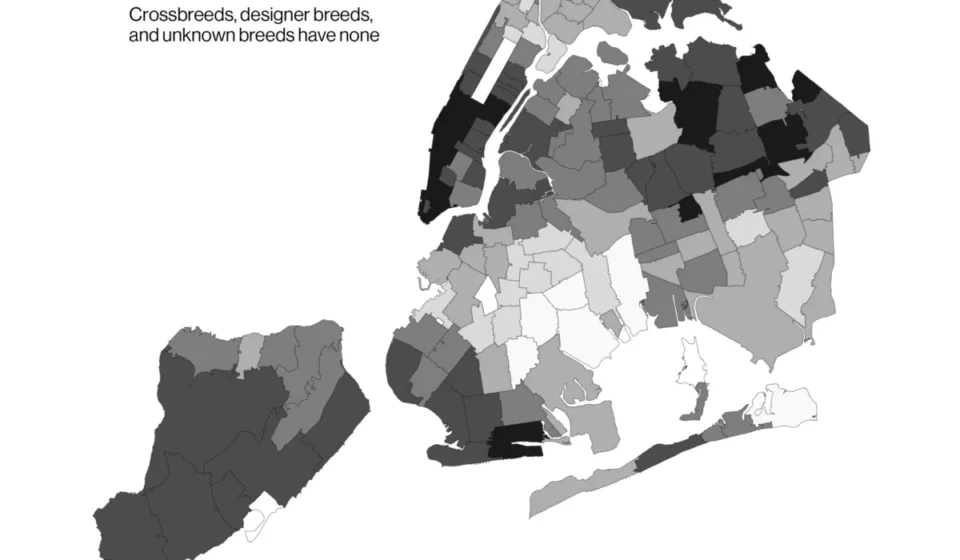
The initial mapping of dog size coverage revealed that the proportion of dogs with identifiable breeds varied across New York City’s ZIP codes. Coverage ranged from approximately 50% to 67%, with higher proportions observed on the West Side of Manhattan and parts of eastern Queens, and lower proportions in central Brooklyn. This uneven distribution indicates that the data is not "Missing Completely At Random" (MCAR), meaning the analysis of dog sizes is inherently restricted to the subset of dogs with known breeds.
Despite this limitation, a discernible pattern emerged when examining the median typical breed weight by ZIP code. ZIP codes with a higher median dog weight were concentrated in areas such as lower Manhattan, brownstone Brooklyn, Woodlawn and City Island in the Bronx, and the Rockaways in Queens. Conversely, ZIP codes with the smallest median dog weights were predominantly found in most of the Bronx, southeast Queens, and East New York and Brownsville in Brooklyn, where the median dog weighed approximately 12.5 pounds, largely driven by the prevalence of Shih Tzus.
A more granular look at the distribution of dog size classes by ZIP code revealed further distinctions. Toy dogs were found to be most prevalent in the Bronx, as well as in certain areas of Brooklyn and Queens. Medium-sized dogs tended to cluster in more affluent neighborhoods of Brooklyn and lower Manhattan. Larger breeds were most common on Staten Island, the Rockaways, and some parts of Manhattan. Giant breeds, as expected, remained rare across all urban areas.

When aggregated to the borough level, the data presented a clearer comparative picture. While small dogs constituted roughly one-third of all licensed dogs in every borough, significant variations were observed at the extremes. The Bronx exhibited the highest proportion of Toy dogs (around 33%), compared to approximately 20% in Manhattan. Conversely, Staten Island, the least densely populated borough, displayed the largest share of large dogs (17%), followed by Manhattan (16%).
Socioeconomic Influences on Dog Size
The analysis then delved into the potential influence of socioeconomic factors on the prevalence of larger dogs, hypothesizing that income and housing characteristics might play a significant role. Leveraging data from NYC OpenData and the U.S. Census Bureau, researchers constructed measures for median household income, median home floor area, median number of rooms per home, share of homes in one- or two-family houses, and the share of owner-occupied homes for each ZIP code.
A regression analysis was conducted with the average logged typical weight of dogs in each ZIP code as the outcome variable. This approach, using logged weights, transforms the analysis to examine percentage differences in weight, accounting for the skewed distribution of breed weights. The predictors included the five socioeconomic measures and the borough.

The findings strongly indicated that income was the most significant predictor of dog size. ZIP codes with higher median household incomes exhibited a clear tendency towards larger dogs. Specifically, an increase in median household income was associated with a substantial rise in the average dog’s weight. This suggests a robust correlation: as income levels rise, so does the propensity for owning larger breeds.
Interestingly, the housing-related measures showed less consistent or significant effects. While the initial hypothesis suggested that more spacious living environments might correlate with larger dogs, the data presented a more nuanced picture. Floor area per home, for instance, displayed a small but statistically significant negative effect, implying that ZIP codes with slightly larger homes (while controlling for income) tended to have slightly smaller dogs. This finding challenges the straightforward "more space, bigger dog" assumption. The number of rooms per home showed a small positive effect, but its confidence interval included zero, indicating a less certain relationship. The proportion of single-family homes and owner-occupied units also had minimal impact on dog size once income was factored in.
Borough-Level Disparities and the Role of Space
Among the boroughs, Staten Island stood out as having a higher proportion of larger dogs compared to Manhattan, even after accounting for income and housing characteristics. This observation aligns somewhat with the initial hypothesis about peripheral areas offering more space. However, the analysis underscored that this spatial advantage, if present, was largely overshadowed by the pervasive influence of income.

The regression model revealed that income alone accounted for a significant portion of the variation in typical dog size across ZIP codes. When housing measures and borough were added, the explanatory power increased, but income remained the dominant factor. The partial regression plot, which isolates the relationship between income and dog size by controlling for other variables, demonstrated a clear upward trend: higher median household incomes were consistently associated with larger average dog weights.
This suggests that the "size gradient" observed by Kornblum is more a reflection of economic capacity than pure geographical space. Wealthier neighborhoods, whether dense or sprawling, tend to be associated with larger dog ownership. The ability to afford the higher costs associated with larger breeds – including food, veterinary care, and potentially specialized pet-friendly housing or dog-walking services – appears to be a primary driver.
Implications and Future Research
The findings of this analysis offer a compelling glimpse into the complex interplay of urban life, socioeconomic status, and pet ownership in New York City. While the initial hypothesis regarding space and dog size received partial validation through the Staten Island data, the overwhelming influence of income suggests that financial resources are a more potent determinant of canine size preferences in the city.

The fact that larger dogs are prevalent in some of the most densely populated and expensive neighborhoods, such as Park Slope, SoHo, and the West Village, challenges simplistic notions of space dictating breed choice. Instead, it points to a scenario where affluent residents, capable of managing the practicalities and costs associated with larger dogs, can accommodate them even within smaller living spaces. This could involve strategic use of local parks, access to professional dog-walking services, or simply the financial capacity to ensure their large companions receive adequate exercise and care.
However, the analysis is not without its limitations. The reliance on breed standards rather than actual dog weights, the significant number of dogs with unknown breeds, and the potential for income-related biases in dog licensing rates all warrant careful consideration. Future research could aim to collect direct measurements of dog weights, explore the impact of pet-friendly building regulations, and investigate the motivations behind breed selection more deeply.
Ultimately, this study provides a data-driven narrative of New York City’s canine population, revealing that while urban density and the availability of green spaces play a role, the economic landscape of its residents appears to be the most significant factor shaping the sizes of the dogs that call this metropolis home.