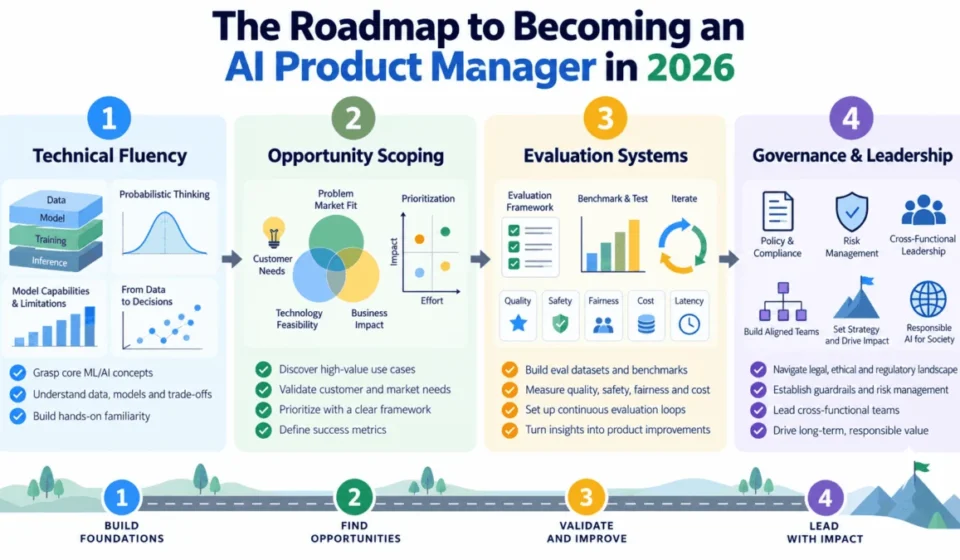

The landscape of product development is undergoing a profound transformation, driven by the pervasive integration of Artificial Intelligence (AI). As AI moves from experimental prototypes to core product functionalities, a new breed of product manager is emerging to bridge the gap between cutting-edge technology and user trust. This specialized role, the AI Product Manager (AI PM), requires a unique blend of technical acumen, strategic thinking, and communication prowess to navigate the complexities of probabilistic systems. A detailed roadmap, recently outlined by AI and data science educator Vinod Chugani, provides a four-phase progression for professionals aspiring to excel in this burgeoning field by 2026.
The fundamental challenge for AI PMs lies in managing systems that do not behave deterministically. Unlike traditional software where predictable inputs yield consistent outputs, AI systems produce results that are inherently variable, context-dependent, and prone to occasional inaccuracies or "hallucinations." This necessitates a paradigm shift from deterministic to probabilistic thinking, where understanding and managing uncertainty becomes paramount. This evolution is not merely a technical adjustment but a fundamental mindset change that underpins the entire journey of becoming an effective AI PM.
Phase 1: Developing Technical Fluency and the Probabilistic Mindset
The initial and most critical step for aspiring AI PMs is cultivating a deep understanding of AI’s underlying technical principles and embracing a probabilistic mindset. This involves grasping the core trade-offs inherent in AI architectures, even without needing to implement them directly. Familiarity with major architectural choices, such as transformer models, diffusion models, and graph neural networks, is essential for engaging in informed discussions during product scoping and planning.
Key technical considerations include the constant balancing act between latency, cost, and accuracy. Metrics like token consumption, time-to-first-token (TTFT), and context-window sizing are central to nearly every AI product discussion. Understanding these trade-offs allows AI PMs to effectively question engineering assumptions and guide development towards efficient and scalable solutions. For instance, a faster response time (lower latency) might require more computational resources, thus increasing cost, while a larger context window could enhance accuracy but also elevate processing expenses.
Recommended resources for this foundational phase include "Hands-On Large Language Models" by Jay Alammar and Maarten Grootendorst, which provides practical insights into LLM architectures, and the fast.ai Practical Deep Learning course, offering a hands-on approach to building intuition around AI architectures without demanding heavy mathematical prerequisites.
A practical exercise to solidify these concepts involves building a comparison matrix for different architectural choices applied to a single business problem, such as automating customer support. This exercise would necessitate documenting the reasoning behind trade-off decisions, forcing a deeper engagement with the practical implications of technical choices.
Phase 2: AI Opportunity Discovery and Feasibility Scoping
With a foundational technical understanding, the next phase focuses on identifying and validating AI opportunities that hold genuine business value. This stage emphasizes discerning which AI applications are truly worth pursuing, recognizing that not all AI-driven ideas translate into viable products.
The "AI Product Canvas" serves as a valuable framework for this evaluation. This tool maps potential AI tasks along two axes: the value derived from successful performance and the risk associated with failure. High-leverage, low-risk tasks like classification, summarization, and document extraction often represent strong early candidates for AI integration. Conversely, high-risk tasks involving safety, compliance, or irreversible actions demand significantly more robust evaluation infrastructure before they can be considered for deployment.
A critical decision point in this phase is the "build vs. buy vs. assemble" analysis. This strategic choice involves evaluating whether to develop AI capabilities in-house, leverage third-party solutions, or combine existing components. This decision is informed by both technical feasibility and financial considerations.
A core component of this financial assessment is modeling the unit economics of compute. AI PMs must understand how gross margins are affected by scaling token consumption, compare GPU hosting costs against per-call API fees at projected volumes, and analyze the cost implications of vector database queries in relation to retrieval depth. This granular understanding of inference layer costs is what distinguishes AI PMs who deliver sustainable products from those who produce impressive but ultimately unscalable demonstrations.
Supporting resources for this phase include Teresa Torres’s "Continuous Discovery Habits" for opportunity framing, the a16z AI Canon for market context, and public pricing documentation from AI providers like Anthropic and OpenAI to build cost intuition.
A portfolio exercise here would involve drafting a one-page recommendation for a build vs. buy decision for a specific AI use case within a familiar industry, including a projected token cost analysis.
Phase 3: AI User Experience, Evaluation Systems, and Iteration
This phase marks the most significant departure from traditional product management practices, as it directly addresses the challenges posed by probabilistic AI outputs. Instead of relying on binary pass/fail testing, AI PMs must develop robust evaluation infrastructure to assess performance.
Designing user experiences for non-deterministic interfaces introduces unique challenges. Communicating uncertainty to users without undermining trust, creating graceful degradation states for model inaccuracies, and strategically integrating human-in-the-loop (HITL) checkpoints are all critical considerations. Furthermore, effective feedback mechanisms – encompassing both explicit ratings and implicit behavioral signals – are essential for continuous system improvement.
The concept of "eval-driven development" becomes central. This approach emphasizes defining success metrics early and building systems to continuously measure progress against these benchmarks. This includes establishing automated evaluation pipelines for tasks like response relevance, factual accuracy, and adherence to safety guidelines.
Red-teaming, a structured form of adversarial testing, is non-negotiable. Before launching any user-facing AI feature, rigorous testing for prompt injection attempts, boundary probing, and worst-case scenario simulations must be conducted. Integrating red-teaming into pre-launch checklists from the outset is crucial for mitigating potential risks.
Recommended resources for this stage include Chip Huyen’s "Designing Machine Learning Systems," documentation for RAGAS for RAG evaluation pipelines, and platforms like Braintrust and PromptFoo for eval infrastructure.
A portfolio exercise for this phase would involve designing an evaluation rubric for a specific AI product feature, detailing at least three automated metrics and a plan for human evaluation.
Phase 4: AI Governance, Compliance, and Organizational Leadership
The final phase of the AI PM roadmap shifts focus from individual contribution to organizational influence and scaling. AI products operating at scale encounter significant regulatory, legal, and cultural challenges, necessitating the AI PM to act as a crucial liaison between technical, legal, and business stakeholders.
Regulatory literacy is no longer optional. AI PMs must be aware of evolving legislation such as the EU AI Act, U.S. executive orders on AI, and sector-specific regulations in healthcare and finance. Understanding data residency laws across different jurisdictions is also critical for determining deployment strategies and documentation requirements. While not expected to be legal experts, AI PMs need sufficient knowledge to identify potential exposures early and collaborate effectively with legal counsel.
Data lineage and privacy remain persistent operational concerns. Questions regarding the type of customer data shared with external model providers, the effectiveness of data sanitization pipelines, and the clarity of opt-out policies are paramount. In enterprise environments, compliance standards like SOC 2 and HIPAA significantly influence architectural decisions.
Perhaps the most underappreciated skill at this level is cross-functional orchestration. AI PMs must adeptly align the perspectives of research engineers focused on benchmarks, legal teams concerned with liability, and non-technical executives driven by revenue and risk. The ability to maintain clarity and fidelity in communication across these diverse groups is essential for successful product development and deployment.
Key resources for this phase include summaries of the EU AI Act from organizations like the Future of Life Institute, "Trustworthy Machine Learning" by Kush R. Varshney, and an organization’s existing compliance documentation to identify current gaps.
A culminating portfolio exercise would involve drafting a one-page AI risk assessment for a familiar product, identifying at least one regulatory concern, one data privacy concern, and one user experience risk.
Broader Implications and the Evolving Role of the AI PM
The emergence of the AI Product Manager signifies a critical evolution in the tech industry. As AI capabilities become more sophisticated and integrated into daily life, the demand for professionals who can expertly guide their development and deployment will only intensify. Companies that effectively cultivate AI PM talent will be better positioned to navigate the complexities of AI, mitigate risks, and unlock the full potential of these transformative technologies.
The path outlined by Vinod Chugani underscores that the AI PM role is still in its formative stages, presenting a unique opportunity for early practitioners to shape its future. While the four phases offer a structured approach, the reality of AI product development involves constant iteration and cycling between these stages.
A hallmark of successful AI PMs is their intellectual honesty regarding uncertainty. They avoid overstating model capabilities, prioritize building robust fallback systems, and treat evaluation as a fundamental aspect of product infrastructure rather than an afterthought. The rapid evolution of the AI landscape necessitates continuous learning and adaptation. However, the underlying discipline of understanding trade-offs, rigorous scoping, meaningful measurement, and fostering trust across all stakeholders will remain constant.
The journey to becoming an AI PM by 2026 is an ambitious but achievable goal for professionals willing to invest in the necessary technical fluency, strategic thinking, and leadership skills. The growing reliance on AI across industries ensures that this role will be not only in high demand but also instrumental in shaping the future of products and services.