A Strategic Summer in Unprecedented Times: An Academic’s Blueprint for Productivity and Well-being

The summer of 2020 presented an unprecedented landscape for academics worldwide, characterized by the profound disruptions of the global COVID-19 pandemic. With universities transitioning rapidly to remote operations, international travel grinding to a halt, and daily routines upended, faculty members faced the unique challenge of sustaining research productivity while navigating new personal and professional realities. This period necessitated innovative approaches to work-life balance, as exemplified by a Merced, California-based professor who meticulously crafted a strategic summer plan designed to foster both rigorous academic output and essential personal rejuvenation.
The Unforeseen Impact of Global Disruptions on Academic Life
As the spring semester concluded in 2020, the academic community found itself grappling with a radically altered environment. Lockdowns, travel restrictions, and the imperative of social distancing transformed traditional work models overnight. For many, including the professor in Merced, this meant a complete overhaul of long-standing summer plans. The professor, accustomed to escaping the intense Central Valley heat for at least a month each summer, confronted the reality of remaining grounded for the first time in over two decades. This unexpected confinement underscored a broader sentiment among academics, many of whom saw their customary summer research trips, conference attendance, and international collaborations canceled or indefinitely postponed.
A particularly poignant casualty of these restrictions was the professor’s planned writing retreat on a private island in Belize, initially slated for 2021 but requiring advance planning and commitment. Such retreats are often vital for academics, offering dedicated, distraction-free environments crucial for intensive writing and conceptual development. The cancellation of such opportunities highlighted the direct impact of the pandemic on critical aspects of scholarly work. Despite the personal disappointment, the professor articulated an acceptance of this "new reality," signaling a pragmatic shift towards adaptation rather than lament. This adaptive mindset became a common thread among resilient academics striving to maintain momentum amidst the global crisis.
Beyond personal travel, the pandemic significantly complicated ongoing research endeavors. The professor, for instance, had grant-funded research (specifically, NSF Award ID 1917867) that required progress over the summer months. This situation was not unique; researchers across disciplines faced challenges ranging from laboratory closures and restricted access to field sites to the inability to conduct in-person interviews or collect essential data. The pressure to meet grant deliverables, coupled with increased domestic responsibilities (such as managing a household and caring for children or dependents now at home), created a complex matrix of demands on faculty time and mental energy. The need to emerge from the summer "feeling relaxed and rejuvenated and ready to take on whatever the fall semester may bring" became a universal aspiration, albeit one requiring deliberate and strategic planning.
Embracing the "Deep Work" Paradigm for Academic Excellence
At the core of the professor’s strategic summer plan was the concept of "deep work," a term popularized by Georgetown University computer science professor Cal Newport. Newport defines deep work as "professional activities performed in a state of distraction-free concentration that push your cognitive capacities to their limit." This stands in stark contrast to "shallow work," which encompasses non-cognitively demanding tasks often performed while distracted. For academic writers and researchers, the ability to engage in deep work is not merely a preference but a necessity. The very nature of academic inquiry demands sustained, intense focus to generate new knowledge, develop complex theories, and synthesize vast amounts of information. Publishing impactful research requires not only a profound understanding of the current state of a field but also the creativity and ingenuity to push its boundaries. This process is inherently non-mundane and relies heavily on deep cognitive engagement.
Research consistently supports the efficacy of deep work. Studies in cognitive psychology and productivity demonstrate that prolonged, uninterrupted focus leads to higher quality output, faster learning, and enhanced problem-solving abilities. In an increasingly interconnected and notification-driven world, cultivating an environment conducive to deep work has become a significant challenge. The average professional’s attention is fragmented by constant emails, instant messages, and social media alerts, making it difficult to achieve the sustained concentration required for complex intellectual tasks. For academics, whose careers are often defined by their intellectual contributions, mastering deep work is paramount.
While some knowledge-creators might have the luxury of extended retreats in isolated settings—a "monastic strategy" as Newport describes—where they can achieve a state of flow for weeks or months, this is largely unattainable for the majority of faculty. Even for single individuals living alone, completely cutting oneself off from the world for an extended period is often impractical. The pandemic further underscored these limitations, as external circumstances imposed restrictions that made even short-term isolation difficult to achieve voluntarily. Fortunately, as the professor’s plan illustrates, there are alternative, more accessible ways to cultivate distraction-free concentration, primarily through scheduled, rhythmic application of deep work principles.
Strategies for Cultivating Concentrated Effort and Sustained Productivity
The professor’s approach to deep work exemplifies a "rhythmic philosophy," where deep work is scheduled into regular, fixed-schedule blocks. For over a decade, the professor has committed to carving out two hours each morning specifically for deep work. This commitment is not arbitrary; it is backed by extensive personal data tracking, which has consistently shown that this duration is optimal for achieving high levels of productivity. The professor confidently asserts that approximately two hours of focused writing per weekday over the past 13 years has resulted in the publication of "several books and dozens of journal articles," with deviations beyond this two-hour mark being "very rare occasions." This empirical evidence from personal experience provides a powerful testament to the effectiveness of consistent, focused effort over sporadic, marathon sessions.
To maximize the impact of these deep work blocks, the professor integrates several preparatory and post-work routines. Recognizing that sitting for two hours can be physically demanding, especially on the back, the schedule incorporates yoga immediately following meditation and preceding the writing session. This sequence—meditation to sharpen focus, followed by physical preparation through yoga—creates an optimal state for cognitive demanding work. The conscious scheduling of "shallow work" tasks such as email management and household chores for later in the day is also a critical component. This prevents these less demanding activities from encroaching on the precious morning hours reserved for peak cognitive performance, a common pitfall for many professionals. As the professor notes, explicitly calendaring these tasks makes it "easier for me to not get lost in email when I should be writing or decide that I really need to dust the ceiling fans during times I have set aside for writing." This intentional separation of deep and shallow work is a cornerstone of Newport’s philosophy, emphasizing that context-switching is a major impediment to cognitive flow.
Integrating Productivity with Holistic Well-being

While deep work forms the bedrock of academic output, the professor’s summer plan highlights an equally crucial component: holistic well-being. Recognizing that sustained productivity is impossible without adequate self-care, the schedule deliberately allocates time for physical activity, mindfulness, and personal restoration. This approach aligns with a growing body of research demonstrating the inextricable link between physical and mental health and cognitive performance.
The daily routine begins with a strong emphasis on physical activity. As an early riser, the professor capitalizes on the cooler morning temperatures in Merced, California, to incorporate a 30-minute jog four days a week. This early morning exercise not only provides physical benefits but also sets a positive tone for the day, boosting energy levels and mental clarity. Following the jog, a meditation session is scheduled just before writing. This practice, known for its ability to improve focus, reduce stress, and enhance cognitive function, helps the professor transition into the mindset required for deep work. The inclusion of yoga after meditation further underscores the commitment to physical well-being, addressing the postural challenges associated with prolonged periods of sitting.
Beyond these daily rituals, the professor’s schedule integrates broader elements of self-care and work-life balance. After the morning deep work and self-care block, a break is taken for lunch and some housework, ensuring that domestic responsibilities are managed without encroaching on focused work time. The afternoon is then dedicated to "shallow work" and managerial tasks, including two to three hours for responding to emails, meeting with students, and managing a team of "a dozen or so employees" involved in the grant-funded research. This structured approach ensures that administrative duties, while necessary, do not derail the primary goal of deep intellectual labor.
Crucially, the latter part of the day is intentionally dedicated to personal time, allowing the professor to "hang out with my partner and our three teenage daughters." This commitment to family time is vital for preventing burnout and fostering overall well-being. Furthermore, one day a week, the routine is intentionally broken for a long morning hike, again chosen for the cooler temperatures, providing a refreshing change of pace and an opportunity to connect with nature. This periodic deviation from the daily rhythm prevents monotony and supports mental freshness.
This comprehensive approach to well-being is not merely anecdotal; it is supported by extensive research. Studies have consistently shown that regular exercise, mindfulness practices, adequate sleep, and strong social connections are critical determinants of mental health, stress resilience, and cognitive function. For academics, who often face high-pressure environments and the constant demand for intellectual output, integrating these self-care practices is not a luxury but a strategic necessity for long-term career sustainability.
The Weekly Template: A Practical Implementation for Academic Resilience
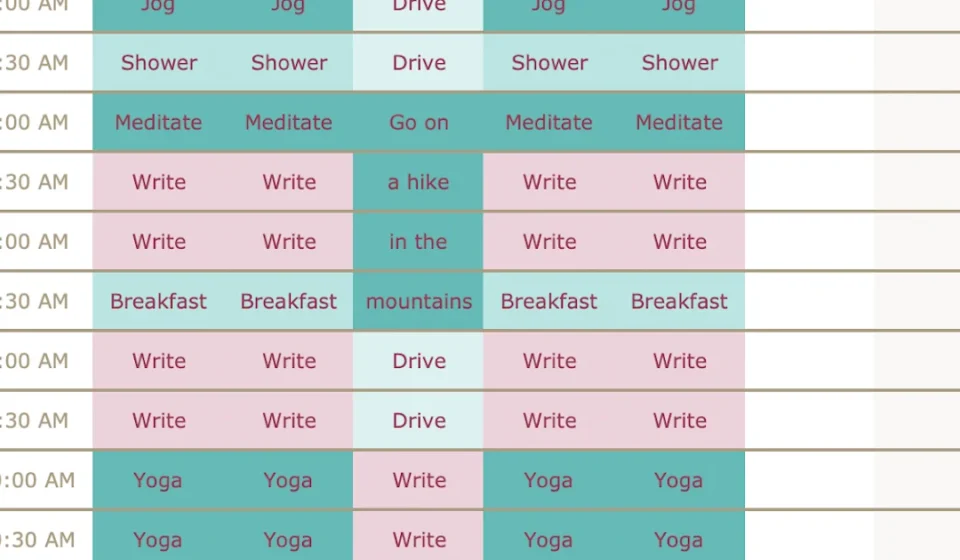
The professor’s summer plan culminates in a clear, actionable weekly template, a practical manifestation of these principles. This template serves as a visual guide, allocating specific blocks of time for deep work, administrative tasks, exercise, self-care, and family time. The intentionality behind each time slot is a key takeaway. By proactively scheduling these activities, the professor minimizes decision fatigue and prevents less critical tasks from consuming time meant for high-value work or personal restoration.
The template highlights:
- Early Mornings: Dedicated to physical activity (jogging/hiking), meditation, and yoga, leveraging the coolest hours of the day in Merced.
- Mid-Mornings: The protected two-hour block for "deep work" (writing, research), the cornerstone of academic productivity.
- Mid-day: Breaks for lunch and essential housework, consciously separating them from focused work.
- Afternoons: Allocation for "shallow work" – email management, team meetings, research troubleshooting, and supervision of employees.
- Late Afternoons/Evenings: Dedicated family time, crucial for work-life balance and personal rejuvenation.
- Weekly Variation: A designated day for a longer hike, breaking the routine and offering varied physical activity and mental break.
The logic underpinning this template is robust: by clearly delineating time for each type of activity, the professor creates boundaries that protect deep work from distractions and ensures that self-care and personal life are not neglected. This proactive calendaring, including even routine tasks like email and housework, acts as a defense mechanism against procrastination and task-switching, reinforcing the commitment to focused effort.
Broader Implications for Academic Work and Remote Paradigms
The experience of Summer 2020, as encapsulated by this professor’s plan, offered profound lessons for the broader academic community and the future of work. The pandemic forced an unprecedented period of adaptation, demonstrating the resilience of faculty members in innovating their work habits. Universities, in turn, were compelled to re-evaluate their support systems, recognizing the increased strain on faculty working remotely, managing childcare, and navigating blurred home-work boundaries. Discussions around mental health resources, flexible research timelines, and the provision of technology support gained new urgency.
The shift to remote work also prompted a re-evaluation of traditional academic gatherings and collaborations. While the cancellation of retreats like the one planned for Belize was a disappointment, it also spurred innovations in virtual conferencing and digital collaboration. The long-term impact may lead to hybrid models, where virtual components complement in-person interactions, making academic exchange more accessible and sustainable.
Ultimately, the professor’s strategic summer plan stands as a micro-example of a macro trend: the imperative for sustainable academic careers demands a deliberate integration of structured productivity and holistic well-being. Whether facing a global pandemic or the everyday pressures of academic life, the principles of deep work, disciplined time management, and prioritized self-care are not merely optional enhancements but essential components for fostering intellectual growth, maintaining mental health, and achieving sustained success in the demanding world of academia. The lesson is clear: in times of stability and crisis alike, a well-structured approach to work and life is the most reliable path to both accomplishment and contentment.