Julia 1.12 Release Introduces Advanced Binary Trimming Multi-Threading Enhancements and Performance Optimizations for High-Performance Computing

The Julia programming language community has officially announced the release of Julia version 1.12, a significant update that brings a suite of features aimed at improving binary efficiency, execution speed, and developer productivity. This release, which follows months of testing and community contributions, represents a major milestone in Julia’s evolution as a leading language for high-performance computing, data science, and general-purpose systems programming. The core of the 1.12 update focuses on three primary pillars: reducing the footprint of compiled applications, refining the multi-threading model for better responsiveness, and providing deeper introspection tools for performance tuning.
Advancing Binary Efficiency through Experimental Trimming
One of the most anticipated features in Julia 1.12 is the introduction of the experimental --trim flag. Historically, Julia applications have been criticized for their large binary sizes, often due to the inclusion of the entire system image and unreachable code paths. The new trimming feature, developed by Jeff Bezanson, Cody Tapscott, and Gabriel Baraldi, addresses this by statically identifying and removing unreachable code during the compilation of a system image.
When utilized alongside the --experimental flag, the trimming mechanism can lead to significantly reduced binary sizes and faster compile times. However, the feature requires a disciplined approach to coding; the entry points of the application must avoid dynamic dispatches. If the compiler detects a dynamic dispatch that makes trimming unsafe, it will trigger an error during the compilation process. To streamline this workflow, the community has introduced the JuliaC.jl package, which provides both a command-line interface (CLI) and a programmatic API for building trimmed, standalone executables. Early benchmarks suggest that simple applications can now be compiled into binaries as small as 1.1 MB, a drastic improvement over previous versions.
Enhancing Developer Productivity with Dynamic Binding Redefinition
Julia 1.12 addresses a long-standing pain point for developers: the inability to redefine constants and structs without restarting the REPL (Read-Eval-Print Loop). Through the work of Keno Fischer and Tim Holy, bindings now participate in the "world age" mechanism. This system, which Julia has used for method dispatching for years, now extends to structs and constants.
This change allows developers to redefine a struct and immediately use the new definition in the current session. While existing functions must still be updated to recognize the new types, the "world age" syntax now allows for more graceful transitions between code iterations. Furthermore, integration with Revise.jl is currently underway to automate these redefinitions, which is expected to eliminate the need for frequent session restarts, thereby accelerating the development cycle for complex library authors.
A New Era of Multi-threading and Resource Management
The multi-threading capabilities of Julia have received substantial upgrades in version 1.12, focusing on both user experience and hardware efficiency. By default, Julia now starts with one interactive thread in addition to the standard default thread pool. This architectural shift ensures that the REPL remains responsive—handling tasks like autocompletion and UI updates—even when the main worker threads are saturated with heavy computational workloads.
Key behaviors of this new threading model include:
- Automatic allocation of one interactive thread unless the user explicitly specifies otherwise via the
--threadsflag. - Preservation of single-threaded behavior if
--threads=1is explicitly set. - Improved parallel processing of interactive queries, leading to a smoother "out-of-the-box" experience for new users.
Furthermore, Julia 1.12 introduces better awareness of CPU affinity, a critical feature for modern cloud and High-Performance Computing (HPC) environments. Previously, when running Julia inside a Docker container or a shared cluster, the language might attempt to use all available cores on the physical host, regardless of the limits set by the container or scheduler. With version 1.12, Threads.nthreads() and BLAS thread counts now respect settings from cpuset, taskset, and cgroups. This prevents oversubscription and ensures that Julia behaves as a "good citizen" in multi-tenant environments.
Performance Gains through BOLT and Low-Level Optimizations
Under the hood, Julia 1.12 leverages cutting-edge LLVM technology to squeeze more performance out of the hardware. The language now supports BOLT (Binary Optimization and Layout Tool), a post-link optimizer that reorders basic blocks and functions based on execution profiles. By optimizing the layout of libLLVM and Julia’s internal libraries, developers have observed performance gains of up to 23% when BOLT is combined with Profile-Guided Optimization (PGO) and Link-Time Optimization (LTO). These improvements are particularly noticeable in compilation-heavy workloads and inference benchmarks.
Additionally, the way Julia handles memory at the LLVM IR (Intermediate Representation) level has been modernized. The PtrT type now lowers to actual LLVM pointer types rather than integers. This change simplifies low-level interoperability with C and C++, as llvmcall no longer requires complex shims. It also unlocks subtle optimization opportunities, as the compiler no longer needs to cast pointers back and forth between integer types.
Advanced Diagnostic and Profiling Tools
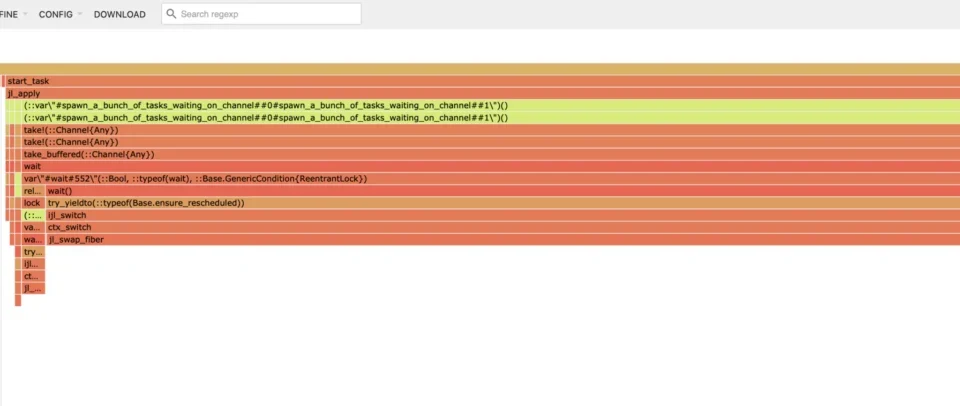
To assist developers in identifying bottlenecks, Julia 1.12 introduces a new wall-time task profiler. Unlike traditional CPU profilers that sample active threads, the wall-time profiler samples tasks regardless of their state. This makes it an invaluable tool for identifying I/O-bound issues or synchronization contention, such as tasks blocked on a lock or a channel.
Complementing this is the new --task-metrics=yes flag, which allows for the collection of per-task timing information. Developers can now track precisely how much time a task spends in a "scheduled" state versus how much time it actually spends executing on a CPU. This level of granularity is essential for tuning high-concurrency applications and web servers.
The release also adds new tracing flags, such as --trace-compile-timing, and macros like @trace_compile and @trace_dispatch. These tools provide real-time feedback on what the Julia compiler is doing, allowing developers to see exactly which methods are being compiled and how long each compilation takes without needing to restart the environment.

Pkg Improvements: Workspaces and Standalone Apps
The Julia package manager (Pkg) has introduced two major features: Workspaces and Apps. Workspaces allow developers to manage multiple related projects within a single manifest. This is particularly useful for monorepo structures or for keeping documentation and benchmarks in sync with the main library without cluttering the library’s primary dependencies.
The "Apps" feature allows Julia packages to be installed as standalone executables. By defining an [apps] section in the Project.toml and an @main entry point in the code, a package can be installed into .julia/bin. This allows Julia-based tools to be invoked directly from the terminal like any other binary, facilitating the creation of CLI tools and user-facing applications.
Reliability and Reproducibility in Testing
In a move to improve the reliability of package ecosystems, Julia 1.12 enhances the Test standard library. A frequent issue in software development is the "flaky test"—a test that fails sporadically due to random data generation. When a test failure occurs within a @testset, Julia 1.12 now prints the state of the random number generator (RNG) used during that run. Developers can then copy this RNG state and use it to perfectly reproduce the failing conditions, significantly reducing the time spent debugging intermittent issues.
Broader Impact and Industry Implications
The release of Julia 1.12 signals a shift in the language’s trajectory toward production-readiness and deployment efficiency. By tackling the "binary size" and "responsiveness" issues, Julia is positioning itself as a viable alternative to C++ and Rust in systems where performance is paramount but developer velocity is also critical.
The enhancements to CPU affinity and multi-threading make Julia a more formidable tool for the enterprise cloud, where resource management and cost efficiency are tied directly to how well a language interacts with containerized environments. The support for BOLT and advanced LLVM features further cements Julia’s reputation in the scientific computing community, where even a 10% gain in execution speed can save thousands of hours of compute time on supercomputers.
The preparation of this release was supported in part by NASA under award 80NSSC22K1740, highlighting the language’s continued importance in mission-critical aerospace and scientific research. As the community moves forward, the features introduced in 1.12 are expected to serve as the foundation for the upcoming Julia 1.13 and the eventual transition toward the 2.0 roadmap.
The Julia 1.12 binaries are now available for download on the official Julia website for Linux, macOS, Windows, and FreeBSD. Developers are encouraged to consult the full NEWS file for a comprehensive list of all changes, deprecations, and bug fixes included in this version.