Leveraging Large Language Models for Efficient Named Entity Recognition with Scikit-LLM

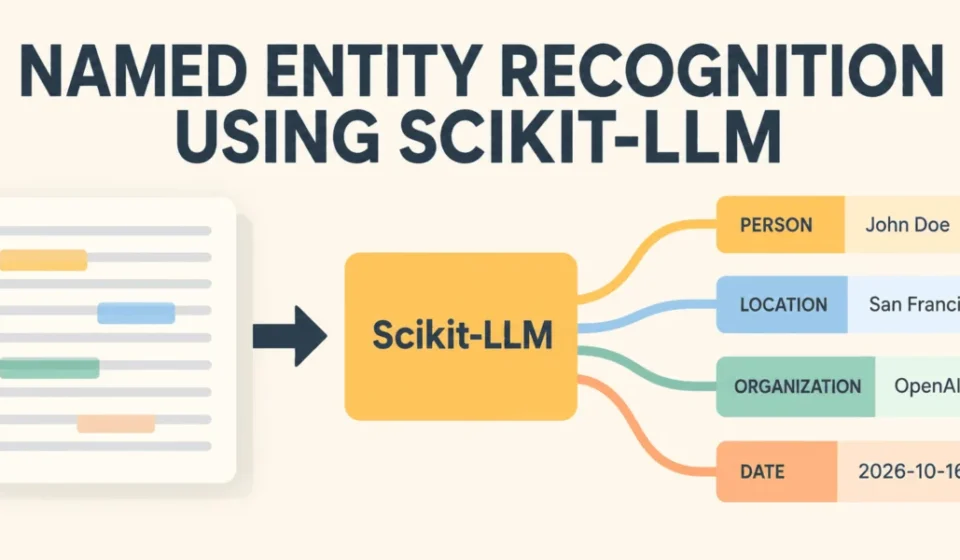
Structured data extraction from unstructured text is a cornerstone of modern data analysis, powering everything from predictive machine learning models to sophisticated business intelligence tools. Among the most critical tasks in this domain is Named Entity Recognition (NER), a process that transforms raw, often messy, textual data into organized, categorized information by identifying and extracting specific entities like names of people, organizations, locations, and products. Traditionally, NER has relied on conventional Natural Language Processing (NLP) libraries, which frequently demand extensive training datasets and laborious fine-tuning to recognize custom entities tailored to specific domains. However, the emergence of Large Language Models (LLMs) has revolutionized this landscape, offering unprecedented reasoning capabilities that can be integrated into streamlined machine learning pipelines. Scikit-LLM, a novel framework, is at the forefront of this evolution, enabling developers to harness LLM power for tasks like custom NER with remarkable ease and efficiency.
This article explores the practical application of Scikit-LLM for Named Entity Recognition, demonstrating how to implement a robust NER pipeline using readily available, free LLM resources. The example detailed here can be executed within a Google Colab notebook, leveraging the high-speed and cost-effective API provided by Groq. Groq’s platform offers access to powerful LLMs that are compatible with the OpenAI API standard, making them ideal for integration with libraries like Scikit-LLM, especially for developers looking to experiment without incurring significant costs.
Setting Up the Environment and API Access
To embark on this practical demonstration, users will need to establish an account on the Groq website and generate an API key. This key is essential for authenticating requests to Groq’s LLM services. For enhanced security and convenience within the Google Colab environment, it is recommended to store this API key as a "Secret" variable. Upon generating the key on the Groq platform, users should carefully copy it and then navigate to the "Secrets" section in Google Colab, typically accessible via a key icon on the left-hand sidebar. Here, they can create a new secret variable, naming it GROQ_API_KEY and pasting their copied API key. This secure storage method prevents the API key from being exposed in the notebook code itself, which is a crucial security practice.
The first step in setting up the Python environment involves installing the Scikit-LLM library. This can be accomplished with a single command in the Colab notebook:
!pip install scikit-llm -qThis command ensures that all necessary components of the Scikit-LLM library are downloaded and installed, preparing the environment for subsequent code execution.
Configuring Scikit-LLM for Custom API Endpoints
Scikit-LLM is designed with an architecture that mirrors the OpenAI API standards, providing a familiar interface for users experienced with OpenAI’s ecosystem. However, a key advantage of Scikit-LLM is its flexibility in overriding default API endpoints. This capability is particularly valuable when utilizing providers like Groq, which offer their own distinct API endpoints. The SKLLMConfig.set_gpt_url() method allows developers to redirect Scikit-LLM’s requests to a custom URL.
In this specific implementation, the configuration process involves retrieving the securely stored Groq API key and then setting both the API key and the custom endpoint URL. The google.colab.userdata.get('GROQ_API_KEY') function fetches the API key from the Colab Secrets, while SKLLMConfig.set_gpt_url("https://api.groq.com/openai/v1") directs the library to Groq’s OpenAI-compatible API endpoint. Finally, SKLLMConfig.set_openai_key(groq_key) authorizes the requests with the provided API key.
from google.colab import userdata
from skllm.config import SKLLMConfig

# Securely retrieving the Groq API key from Colab Secrets
groq_key = userdata.get('GROQ_API_KEY')

# Redirecting scikit-LLM to Groq's high-speed, free-tier compatible endpoint
SKLLMConfig.set_gpt_url("https://api.groq.com/openai/v1")
SKLLMConfig.set_openai_key(groq_key)
This configuration ensures that Scikit-LLM will communicate with Groq’s infrastructure, benefiting from their optimized LLM serving capabilities.
Defining Entities and Unstructured Data
The core of LLM-driven NER lies in the definition of the entities to be extracted. Unlike traditional supervised learning approaches where labeled datasets are paramount, LLM-based NER leverages descriptive prompts to guide the model’s reasoning. In Scikit-LLM, this is achieved through an "entity dictionary." This dictionary is a collection of key-value pairs, where each key represents a specific entity category (e.g., "EXECUTIVE," "CORPORATION"), and its corresponding value is a clear, concise description of what constitutes that entity. These descriptions serve as explicit instructions to the LLM, helping it to accurately identify and classify entities within the text.
For this example, we define a set of entities relevant to the technology and business domain:
- EXECUTIVE: The full name of a company leader or individual.
- CORPORATION: The name of a technology company or business.
- PRODUCT: A specific hardware device, software, or technology feature.
- CITY: A geographical location or municipality.
Alongside the entity definitions, a small corpus of unstructured text is prepared. These example texts are intentionally aligned with the defined entity types to provide a clear test case for the NER pipeline.
# Defining the domain-specific entity set to extract, including a clear description that serves as instruction for the LLM
entities =
    "EXECUTIVE": "The full name of a company leader or individual.",
    "CORPORATION": "The name of a technology company or business.",
    "PRODUCT": "A specific hardware device, software, or technology feature.",
    "CITY": "A geographical location or municipality."


# Unstructured text data to parse
X_unstructured = [
    "Satya Nadella announced Copilot integrations for Microsoft at the summit in Seattle.",
    "Elon Musk supervised the rollout of the Cybertruck at the Texas facility.",
    "Jensen Huang showcased the new Blackwell architecture for Nvidia in San Jose."
]
The clarity and precision of these entity descriptions are critical for the LLM’s performance. Well-defined prompts reduce ambiguity and improve the accuracy of the extracted information.
Implementing the NER Pipeline with GPTExplainableNER
The pivotal component in Scikit-LLM for performing NER is the GPTExplainableNER class. This class acts as a wrapper around compatible pre-trained LLMs, allowing them to perform NER tasks according to the defined entity schema. In this demonstration, we utilize a model available through Groq’s API that is compatible with GPTExplainableNER. As of the current development, openai/gpt-oss-20b is a suitable free-tier model that can be used.
The initialization of the GPTExplainableNER object involves passing the entities dictionary and specifying the model to be used. The model="custom_url::openai/gpt-oss-20b" parameter is crucial here, indicating that the library should use the openai/gpt-oss-20b model accessed via the custom URL configured earlier.
The fit_transform() method is then invoked on the GPTExplainableNER object, passing the X_unstructured list of texts. This method triggers the LLM’s reasoning process. The LLM analyzes each text, identifies entities based on the provided descriptions, and outputs the extracted information in a structured format.
from skllm.models.gpt.tagging.ner import GPTExplainableNER

# Initializing the NER estimator using a tool-compatible model
ner = GPTExplainableNER(
    entities=entities,
    model="custom_url::openai/gpt-oss-20b"
)

# fit_transform processes the text and extracts the structured entities
extracted_data = ner.fit_transform(X_unstructured)
This step encapsulates the complex LLM inference process into a single, straightforward function call, embodying Scikit-LLM’s goal of simplifying machine learning pipelines.
Visualizing and Refining Extracted Data
The output from the fit_transform() method, while containing the extracted entities, is initially presented in a raw format that may include the LLM’s reasoning or meta-tags. To present this information in a more readable and actionable manner, the following Python code iterates through the original texts and the corresponding extracted data.
A crucial aspect of handling the LLM’s output is its potential serialization. The LLM might return the structured data as a string representation of a Python dictionary. The ast.literal_eval() function is used to safely evaluate such strings, converting them back into actual Python dictionaries. This allows for easy iteration through the extracted entity types and their corresponding values.
import ast

# Displaying the extracted entities and handle the string-serialized output
for text, data in zip(X_unstructured, extracted_data):
    print(f"Original: 'text'")

    # If the model returned a string representation of the dict, evaluate it
    if isinstance(data, str):
        try:
            data = ast.literal_eval(data)
        except (ValueError, SyntaxError):
            # Fallback just in case the LLM hallucinated the formatting
            print(f"  Raw unstructured output: datan" + "-" * 50)
            continue

    # Data is a Python dictionary, allowing iteration through .items()
    for entity_type, extractions in data.items():
        print(f"  entity_type: extractions")
    print("-" * 50)
The initial output from this loop showcases the raw results, which, while accurate, might be verbose. The article then introduces a post-processing step to refine this output into a cleaner, more easily digestible format.
Post-Processing for Enhanced Readability
To present the extracted entities in a truly structured and user-friendly manner, a helper function employing regular expressions is introduced. This function, parse_extracted_data, is designed to parse the raw output strings generated by the LLM, specifically targeting the <entity> tags and extracting the <tag> and <value> components. By employing regular expressions, the function systematically identifies and extracts each named entity, categorizes it according to its tag, and compiles this information into a Python dictionary where entity types are keys and lists of extracted values are the corresponding elements.
This refined output is then presented, offering a clear and concise summary of the named entities identified in each original text. The cleaned output demonstrates the efficacy of the LLM-driven NER pipeline, presenting the structured data in a format directly usable for subsequent analysis or integration into applications.
import re

def parse_extracted_data(raw_data):
    parsed_entities =
    # Find all entity blocks
    entity_blocks = re.findall(r"<entity>(.*?)</entity>", raw_data, re.DOTALL)
    for block in entity_blocks:
        tag_match = re.search(r"<tag>(.*?)</tag>", block)
        value_match = re.search(r"<value>(.*?)</value>", block)
        if tag_match and value_match:
            entity_type = tag_match.group(1)
            entity_value = value_match.group(1)
            if entity_type not in parsed_entities:
                parsed_entities[entity_type] = []
            parsed_entities[entity_type].append(entity_value)
    return parsed_entities

# Displaying the extracted entities in a cleaner format
print("n--- Cleaned Extracted Entities ---")
for i, (text, raw_output) in enumerate(zip(X_unstructured, extracted_data)):
    print(f"Original Text i+1: 'text'")
    cleaned_data = parse_extracted_data(raw_output)
    if cleaned_data:
        for entity_type, extractions in cleaned_data.items():
            print(f"  entity_type: ', '.join(extractions)")
    else:
        print("  No entities found.")
    print("-" * 50)
The results from this refined output clearly delineate the extracted executives, corporations, products, and cities from each sentence, showcasing a high degree of accuracy and organization.
Broader Implications and Future Directions
The demonstration highlights the significant potential of Scikit-LLM in democratizing access to advanced NLP capabilities. By abstracting away the complexities of LLM integration and fine-tuning, libraries like Scikit-LLM enable a wider range of developers and data scientists to implement sophisticated NLP tasks, such as custom NER, with minimal effort. This is particularly impactful for small and medium-sized businesses or research teams that may not have the extensive resources required for traditional model training.
The use of free-tier LLMs through providers like Groq further reduces the barrier to entry. This approach allows for rapid prototyping, experimentation, and the development of proof-of-concept applications without upfront investment in proprietary models or expensive cloud computing. The ability to define custom entities and extract them accurately means that LLMs can be tailored to specific industry needs, unlocking new avenues for data analysis and automation.
The implications of efficient and accessible NER are far-reaching. In finance, it can be used to extract company names, executive appointments, and regulatory mentions from news articles. In healthcare, it can identify patient conditions, medications, and treatment protocols from clinical notes. In e-commerce, it can extract product names, brands, and customer feedback from reviews. The structured data generated by NER pipelines can fuel recommendation engines, improve search functionality, enhance sentiment analysis, and form the basis of many other data-driven applications.
As LLMs continue to evolve in terms of capability and accessibility, frameworks like Scikit-LLM will play an increasingly vital role in bridging the gap between cutting-edge AI research and practical real-world implementation. The trend towards more interpretable and explainable AI is also noteworthy, as seen with GPTExplainableNER, which can provide reasoning behind its extractions, adding a layer of trust and transparency to the process. This move towards explainability is crucial for adoption in regulated industries and for building user confidence in AI-driven systems.
The future of NER, powered by LLMs and facilitated by libraries like Scikit-LLM, points towards even greater automation, customization, and integration into everyday data workflows. The ability to adapt quickly to new domains and entity types without extensive retraining signifies a paradigm shift in how we interact with and extract value from textual data.