Finding Value and Meaning in a World with AI: Reflections on Marc Watkins’ Keynote at Harvey Mudd College

The intersection of liberal arts and STEM education has reached a critical juncture as generative artificial intelligence (GenAI) moves from a novel technological disruption to a foundational element of academic life. At the recent (Re)Imagining Liberal Arts & STEM Education in the Age of GenAI Conference hosted by Harvey Mudd College, Marc Watkins, a prominent voice in pedagogical innovation from the University of Mississippi, delivered a keynote address titled "Finding Value and Meaning in a World with AI." Watkins’ presentation provided a comprehensive examination of the ethical, practical, and philosophical challenges facing higher education as it grapples with the rapid proliferation of large language models (LLMs) and autonomous agents.
The conference, which brought together educators, technologists, and administrators, served as a forum for navigating what Watkins describes as a landscape of "nuance." As academia navigates the tension between skepticism and curiosity, the keynote emphasized that the "promise and peril" of GenAI are nowhere more visible than in the classroom. This sentiment was echoed by Molly Roberts of The Washington Post, who identified Watkins’ home institution, the University of Mississippi (Ole Miss), as a primary laboratory for observing how universities handle the explosion of ChatGPT and its competitors.
The Rapid Proliferation of AI and the Equity Gap
The scale of AI integration into daily life provides a stark backdrop for Watkins’ warnings. According to data released in February 2026, OpenAI’s ChatGPT reached a milestone of 900 million weekly active users. While ChatGPT remains the dominant player, other platforms such as Google’s Gemini and Anthropic’s Claude are seeing steady growth, though Claude’s user base remains a significant minority in the current market.
Watkins highlighted a burgeoning ethical crisis regarding access to these tools. While companies like Google and OpenAI have occasionally offered students free access to premium versions of their AI models, these programs are often temporary or region-specific. This creates a "tiered" educational environment where students with the financial means to afford premium subscriptions have access to significantly more capable, faster, and more accurate models than those relying on free versions. Watkins argued that these disparities in tool quality—often unnoticed by the users themselves—represent a profound ethical consideration for institutions committed to equitable education.
Chronology of AI Integration in Higher Education
The evolution of AI in academia has moved through several distinct phases over the last four years, a timeline that Watkins used to frame the current state of the field:
- Late 2022 – Mid 2023: The Panic Phase. Following the release of ChatGPT, institutions focused heavily on detection and banning, often resulting in high-profile cases of false accusations regarding academic integrity.
- Late 2023 – 2024: The Integration Phase. Educators began developing "AI-aware" syllabi. Frameworks like the "Two-Lane Approach" from the University of Sydney and the "AI Assessment Scale" gained traction, moving away from bans toward managed use.
- 2025: The Faculty-Use Controversy. As reported by the New York Times and various academic podcasts, the focus shifted toward professors using AI for course design and grading, leading to significant student pushback regarding the value of human instruction.
- 2026 – Present: The Agentic Phase. The rise of AI "agents"—tools capable of performing multi-step tasks autonomously—has begun to redefine the nature of cognitive labor and collaboration.
Reimagining Assessment and the "Two-Lane Approach"
A central pillar of Watkins’ keynote was the necessity of evolving assessment strategies. He pointed to the "Two-Lane Approach" pioneered by the University of Sydney as a viable path forward. This model suggests that some assessments (Lane 1) should be conducted in highly controlled environments to ensure human-only output, while others (Lane 2) should explicitly incorporate AI to teach students how to use these tools responsibly and critically.
However, Watkins cautioned against the "expensive and heavy lift" of traditional high-stakes testing environments. Modern testing centers have increasingly adopted stringent measures, including checking students’ eyewear for hidden cameras and requiring the removal of all electronic gadgets. Watkins argued that while these measures provide security, they are often inaccessible to students in online learning environments and fail to accommodate the diverse needs of the modern student body.
Instead of relying solely on surveillance, the keynote suggested that faculty must be supported in large-scale course redesigns. This shift requires institutional funding and the creation of "communities of practice" where educators can share strategies. Watkins emphasized that expecting faculty to navigate these changes in isolation is unsustainable and unfair.
The "Cyborg" Reality and Cognitive Exhaustion
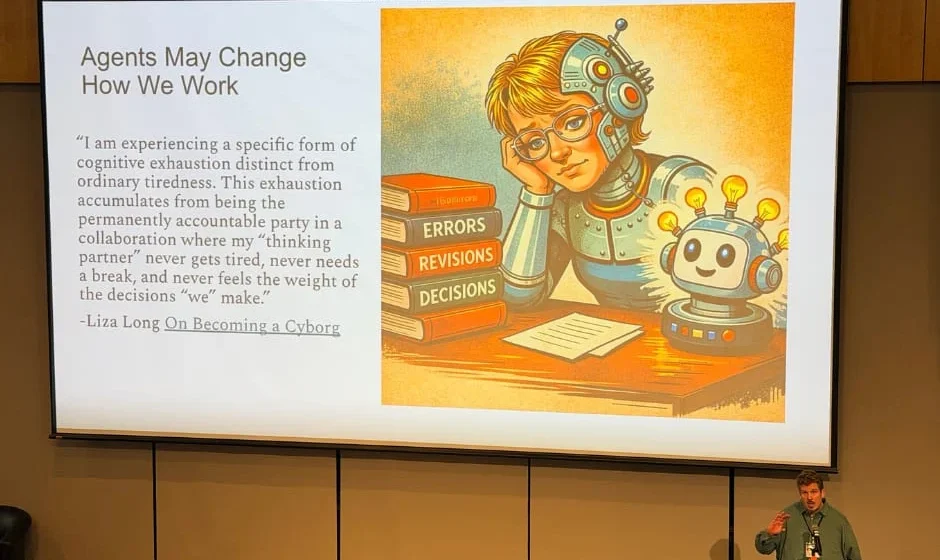
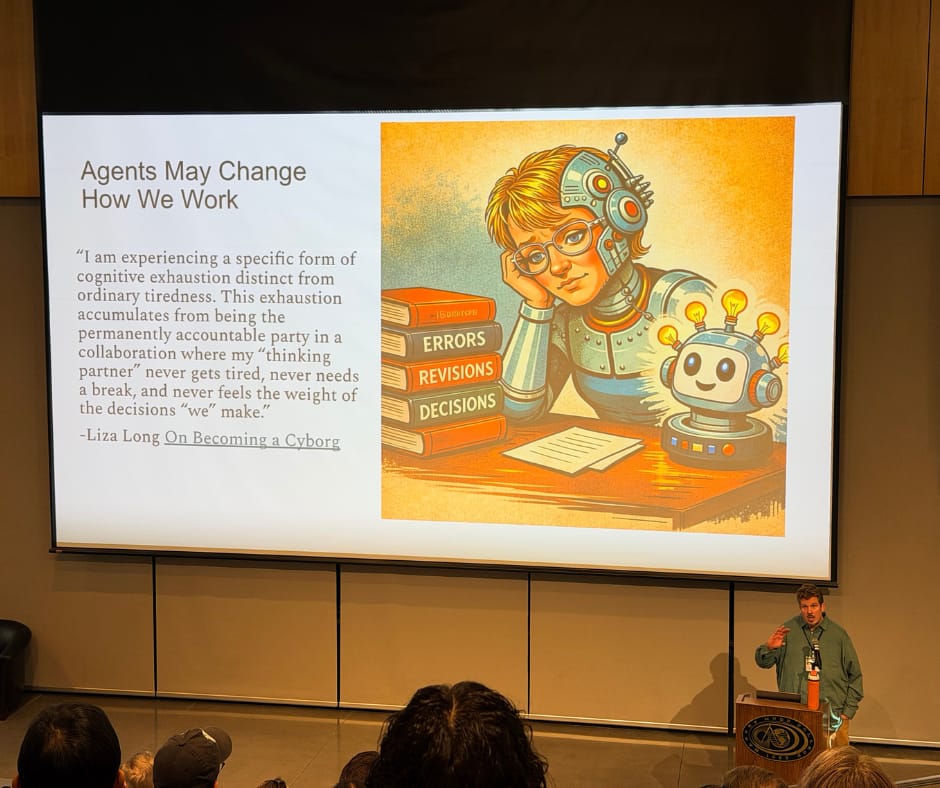
Drawing on the work of Liza Long in her essay "On Becoming a Cyborg," Watkins explored the psychological impact of working alongside AI agents. Long describes a specific form of "cognitive exhaustion" that arises from collaborating with an entity that never tires. As AI agents begin to take over more tasks, the human collaborator becomes the "permanently accountable party," bearing the full weight of decisions made in tandem with a machine that feels no responsibility.
This shift changes the nature of academic work for both students and faculty. Watkins noted that as AI handles more of the "beautification" and organization of information, the human role shifts toward discernment and ethical oversight. This was illustrated by Watkins’ own use of Google’s "Nano Banana" (an AI feature in Google Slides) to design parts of his presentation. While the AI could "beautify" a slide, Watkins noted that the result often lacks the soul or specific intent of a human-designed deck, suggesting that human creativity remains a distinct and necessary value.
Student Reactions and the Demand for Human Instruction
The ethics of AI use are not limited to student submissions; they extend to how faculty utilize the technology. Watkins referenced the case of Ella Stapleton, a student at Northeastern University whose story was featured in the New York Times in May 2025. Stapleton and her peers expressed frustration upon discovering that their professors were using ChatGPT to generate course materials and feedback.
The core of the student grievance centers on the value of tuition. If a student is paying for an elite education, they expect to be taught and evaluated by a human expert, not an algorithm. Watkins advocated for radical transparency and disclosure as a solution. In his own practice, Watkins includes detailed labels on his slides and materials, specifying exactly which AI tools were used and for what purpose. This "modeling of discernment" allows faculty to demonstrate responsible use while maintaining the integrity of the human-student relationship.
Analysis of Implications: The Path to "AI-Aware" Teaching
The broader impact of Watkins’ keynote lies in its call for "AI-aware teaching." This framework, detailed in the newly released Norton Guide to AI-Aware Teaching (co-authored by Watkins, Annette Vee, and Derek Bruff), moves beyond the binary of "pro-AI" or "anti-AI."
Fact-based analysis suggests that the future of higher education will be defined by three key pillars:
- Discernment over Mastery: Students must learn not just how to prompt an AI, but how to judge the accuracy, bias, and ethical implications of its output.
- Institutional Responsibility: Universities must provide the infrastructure and funding for faculty training, rather than leaving individual instructors to fend for themselves.
- Human-Centric Value: Institutions must double down on the elements of education that AI cannot replicate: mentorship, community, and the lived experience of learning.
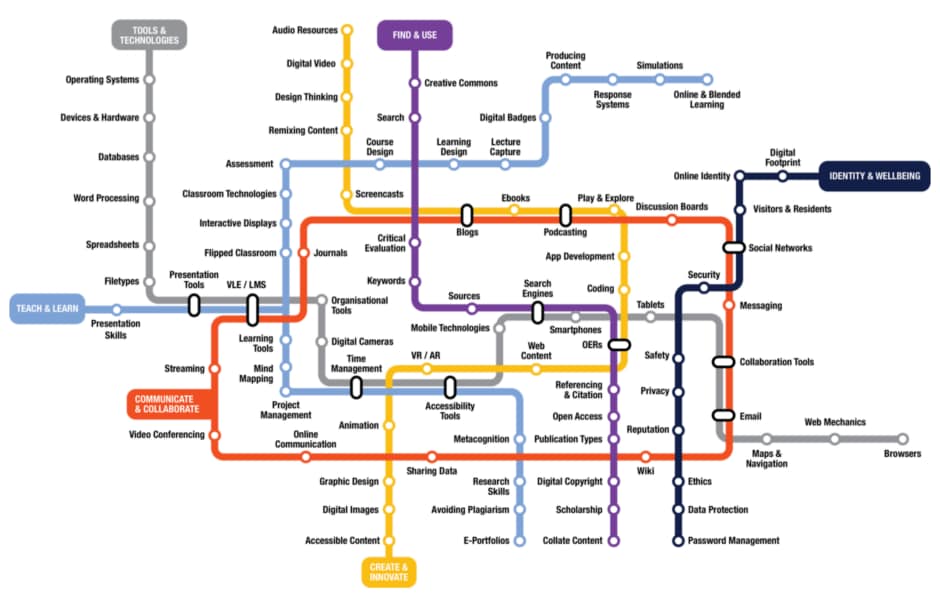
Watkins concluded by referencing the "All Aboard: Digital Skills in Higher Education" map from Ireland, which provides a metaphorical subway map of digital literacies. He argued that while the destination of the AI revolution remains unclear, the one thing academia cannot afford to do is stay in the same place.
The keynote at Harvey Mudd served as a reminder that while the machines may not tire, the humans who guide them must remain vigilant, empathetic, and committed to the values that define the liberal arts and STEM disciplines. As Watkins noted, the goal is not to win a "shouting match over the machines," but to ensure that the human element of education remains the primary driver of value and meaning in a digital age.