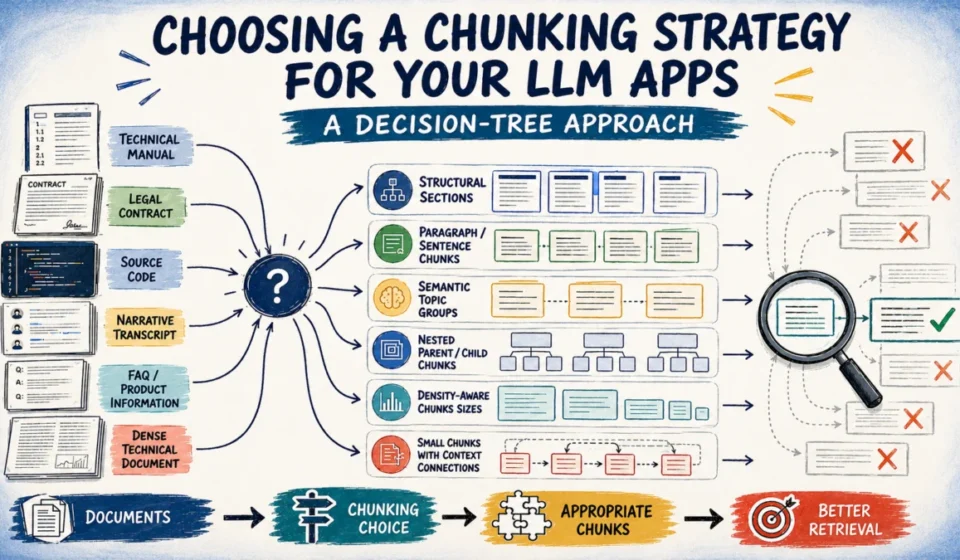
Choosing a Chunking Strategy for Your LLM Apps: A Decision-Tree Approach

The rapid proliferation of Large Language Models (LLMs) has transitioned from a phase of awe-inspired experimentation to one of rigorous engineering. Central to this transition is Retrieval-Augmented Generation (RAG), a framework that allows AI models to access external, private, or real-time data to provide more accurate and context-aware responses. However, as developers scale these systems from simple prototypes to enterprise-grade applications, they encounter a critical technical bottleneck: the art and science of "chunking."
Chunking is the process of breaking down large documents into smaller, digestible segments that can be processed by embedding models and stored in vector databases. While it may appear to be a minor preprocessing step, the strategy chosen to divide this data determines the ultimate efficacy of the AI. A poorly partitioned document can lead to "hallucinations" or contextually irrelevant answers, while a well-structured chunking strategy ensures that the most pertinent information is surfaced during the retrieval phase.
The Technical Necessity of Chunking in RAG Systems
To understand why a structured approach to chunking is necessary, one must look at the constraints of modern transformer architectures. Every LLM and embedding model operates within a finite "context window"—a limit on the number of tokens it can process at once. While context windows have expanded significantly—with models like Google’s Gemini 1.5 Pro handling millions of tokens—embedding models, which are used to convert text into mathematical vectors for search, often remain constrained to smaller windows, typically between 512 and 8,192 tokens.
When a document exceeds these limits, it must be split. However, the challenge is not merely physical space but semantic integrity. If a paragraph describing a critical legal clause is split exactly in the middle, the resulting vector embeddings may fail to capture the full meaning of the clause. Consequently, when a user asks a question related to that clause, the retrieval system might bypass the fragmented chunks entirely.
A Chronology of Chunking Evolution
The methodologies for data partitioning have evolved rapidly alongside the AI industry:
- Phase 1: Fixed-Size Partitioning (Early 2023): Developers used simple character or token counts to split text. This was fast but often "blind" to the meaning of the content.
- Phase 2: Recursive and Structural Awareness (Mid-2023): Tools like LangChain and LlamaIndex popularized recursive splitters that prioritized paragraph and sentence boundaries.
- Phase 3: Semantic and Contextual Innovation (2024): The emergence of "Late Chunking" and "Semantic Chunking" introduced methods that use the model’s own understanding of the text to determine where one topic ends and another begins.
- Phase 4: Agentic and Adaptive Logic (Present): Modern systems now use "Agentic Chunking," where an AI agent inspects the document type and dynamically selects the best strategy for that specific file.
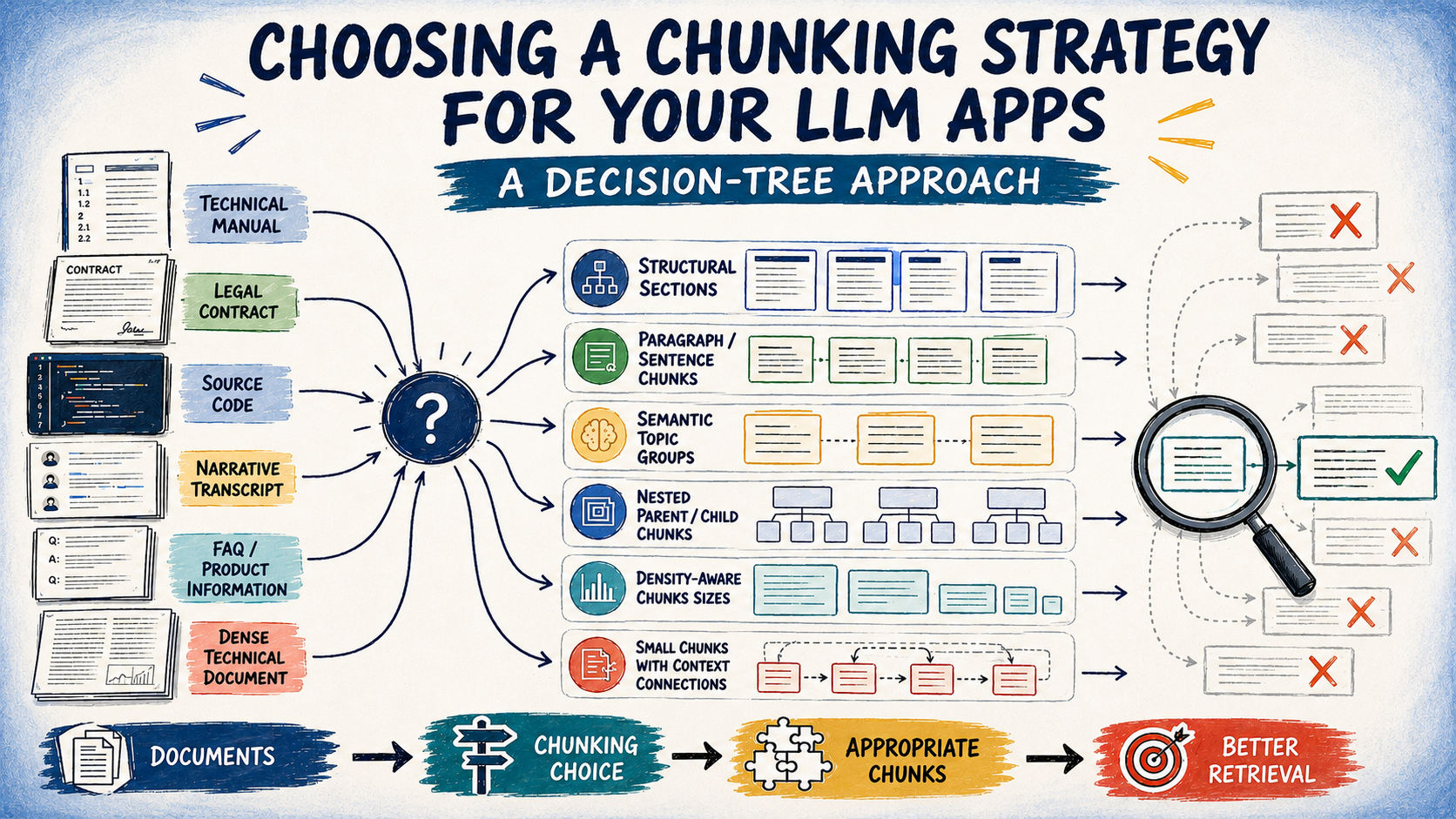
The Decision-Tree Framework: Six Critical Questions
To assist developers in navigating this complex landscape, a structured decision-tree approach is now recommended. This framework moves away from "one-size-fits-all" defaults and toward a strategy based on document properties and retrieval tasks.
1. The Threshold of Necessity
The first question is whether chunking is required at all. For short, self-contained documents such as FAQ entries, product descriptions, or individual customer service tickets, splitting the content can actually be detrimental. If a document fits comfortably within the embedding model’s context window and covers only one specific topic, it should be embedded as a single unit. This preserves the total context and reduces the complexity of the vector database.
2. Structural Reliability
Many documents come with built-in organizational logic. Markdown files use headers; HTML uses tags; Python code uses classes and functions; and PDFs often contain clearly defined sections. If a document possesses a reliable structure that maps to its logical content, document-based chunking is the optimal choice. By parsing the document according to its format, developers can ensure that a "table" remains a "table" and a "function" remains a "function," preventing the fragmentation of logically grouped data.
3. Cross-Sectional Dependencies
In complex documents like legal contracts, technical manuals, or scientific papers, information in one section often depends on definitions or context provided elsewhere. For these scenarios, late chunking has emerged as a high-performance solution. In this method, the entire document is passed through a long-context embedding model first. Chunk-level embeddings are then derived from the full document’s hidden states. This ensures that every chunk, no matter how small, carries the "DNA" or global context of the entire document.
4. Information Density and Granularity
Not all text is created equal. Some sections of a report may be dense with data, while others are narrative and wordy.
- Adaptive Chunking is used when information density varies sharply. It adjusts the size of the chunk based on the amount of information present.
- Hierarchical Chunking is preferred when the system must answer both broad, high-level questions ("What is the summary of this project?") and specific, granular questions ("What was the budget for line item X?"). This involves creating "parent" chunks for broad context and "child" chunks for specific details, linking them in the database.
5. The Quality vs. Cost Tradeoff
As retrieval tasks become more high-stakes—such as in medical or financial applications—the cost of a model call becomes secondary to the accuracy of the result.
- LLM-based Chunking: This involves using a model like GPT-4o to read the text and identify "atomic propositions" or logical breakpoints. It is the most expensive and slowest method but yields the highest retrieval precision.
- Semantic Chunking: A middle-ground approach that uses sentence-embedding distance to detect topic shifts. It is faster than an LLM pass but more "aware" than simple recursive splitting.
6. Collection Heterogeneity
If a database contains a mix of spreadsheets, transcripts, codebases, and narrative essays, a single rule will inevitably fail. Agentic Chunking utilizes an AI agent to perform a preliminary analysis of each document. The agent identifies the file type and purpose, then assigns the most appropriate strategy from the options above.
Comparative Analysis of Strategies and Tradeoffs
| Strategy | Ideal Use Case | Primary Drawback |
|---|---|---|
| No Chunking | FAQs, short snippets | Not applicable to long docs |
| Document-based | Structured code, Markdown | Fails if headers are missing |
| Late Chunking | Contracts, technical specs | Requires long-context models |
| Recursive | General-purpose text | Less semantically precise |
| LLM-based | High-stakes, complex data | High latency and API costs |
| Fixed-size | Rapid prototyping | Low quality; breaks sentences |
Industry Implications and Expert Analysis
The shift toward sophisticated chunking reflects a broader trend in the AI industry: the "Data-Centric AI" movement. Experts argue that we have reached a point of diminishing returns with model size alone. Instead, the next frontier of performance lies in how data is curated and presented to the model.
"Retrieval is the foundation of RAG," says one industry analyst. "If your retrieval returns garbage because your chunking strategy cut a sentence in half, even the most powerful LLM in the world cannot provide a correct answer. We are seeing a massive shift in engineering hours being moved from prompt engineering to data engineering."
Furthermore, the choice of chunking strategy has direct financial implications. High-density, high-quality chunks reduce the number of tokens that need to be sent to an LLM during the generation phase. By providing the model with exactly what it needs and nothing more, companies can significantly reduce their operational costs while simultaneously lowering latency.
Recognizing and Mitigating Common Pitfalls
Even with a decision tree, implementation can encounter hurdles. Developers should watch for the following symptoms:
- The "Mid-Sentence Cut": If chunks consistently end abruptly, the system is likely using a structure-blind method. The fix is to switch to recursive or semantic chunking.
- Inconsistent Retrieval: If similar questions yield wildly different results, the semantic similarity threshold may be miscalibrated, causing the system to create too many or too few chunks.
- The "Lost Context" Problem: If the retrieved chunk is technically relevant but the LLM cannot answer the question, the chunk is too small. Implementing hierarchical chunking or increasing the "overlap" between chunks can provide the necessary surrounding context.
Conclusion
Selecting a chunking strategy is no longer a matter of choosing a default character count. It is a strategic decision that requires an understanding of document structure, the nuances of the retrieval task, and the economic constraints of the project. By following a structured decision tree—evaluating necessity, structure, dependency, density, cost, and heterogeneity—developers can build RAG systems that are not only more accurate but also more efficient. As the AI landscape continues to evolve, the ability to effectively bridge the gap between massive data repositories and constrained model windows will remain a hallmark of successful AI engineering.