A Month in the Trenches: Evaluating Five Leading AI Coding Assistants Reveals Diverse Philosophies and Practical Realities

The promise of artificial intelligence in software development is seductive: describe your desired functionality, and watch the code materialize, accelerating the path from concept to deployment. However, a rigorous, month-long evaluation of five prominent AI coding assistants—Cursor, GitHub Copilot, Claude Code, Windsurf (Devin Desktop), and Replit Agent—reveals a more nuanced reality. Far from a monolithic solution, each tool embodies a distinct philosophical approach to how software will be written in the coming years, presenting unique strengths and limitations when subjected to real-world development scenarios, including legacy refactoring, greenfield API construction, and the inevitable debugging sessions.
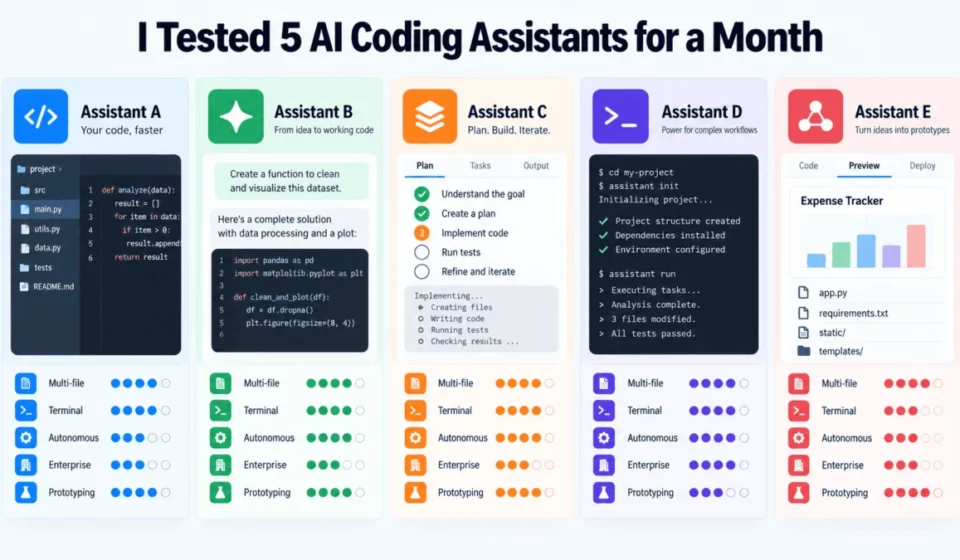
The core divergence lies in how these assistants integrate into the developer’s workflow and their fundamental vision for AI’s role. Cursor aims to reimagine the entire Integrated Development Environment (IDE) around AI. GitHub Copilot seeks to enhance the existing editor developers already use. Claude Code positions itself as a terminal-based collaborator. Windsurf (now Devin Desktop) strives for autonomous operation over extended periods, while Replit Agent offers an end-to-end browser-based experience from initial idea to deployed application. These are not minor implementation details; they represent fundamentally different bets on the future of software engineering.
Cursor: The AI-Native IDE Reimagined
Cursor’s foundational principle is that the development environment itself should be fundamentally rebuilt with AI at its core, rather than retrofitting AI into existing structures. Built upon the familiar architecture of VS Code, Cursor’s user interface offers an immediate sense of recognition, but its true differentiation emerges through its Composer and Agent modes.
A key differentiator for Cursor is its sophisticated multi-file awareness. In testing, when tasked with renaming a data model within a moderately complex Django project and ensuring this change propagated accurately across associated views, serializers, tests, and migrations, Cursor demonstrated remarkable coherence. It navigated the intricate web of dependencies without losing track of the overall scope, a crucial capability that elevates it beyond simple code completion tools.
The Agent mode, which empowers Cursor to modify files, execute terminal commands, and iteratively refine its output, proved to be a double-edged sword. For well-defined, scoped tasks, Cursor exhibited impressive speed and efficiency. However, when presented with more open-ended requests within large codebases, it occasionally introduced changes that were locally correct but globally inconsistent. This sometimes manifested as silent modifications to parts of the codebase not explicitly included in the prompt, necessitating diligent review.
Priced at approximately $20 per month for its Pro tier, with additional usage-based billing for intensive agentic sessions, Cursor presents a compelling value proposition for developers heavily engaged in substantial refactoring or complex code manipulation. For individuals primarily seeking inline code suggestions, the cost-benefit analysis may lean towards more economical alternatives.
Cursor’s Strengths:
- Complex Multi-File Refactoring: Excels at understanding and modifying code across multiple files, crucial for large-scale changes.
- Large Codebase Navigation: Maintains context and coherence in extensive projects where interdependencies are significant.
- Opinionated AI-First Environment: Appeals to developers who desire a deeply integrated AI experience and are willing to invest time in learning its unique workflow.
Cursor’s Limitations:
- Autonomy Risk: The very autonomy that makes it effective on clear tasks can introduce risks with vague or ambiguous prompts, demanding careful prompt engineering and rigorous code review.
- Steeper Learning Curve: Its AI-centric design may require a period of adaptation for developers accustomed to traditional IDEs.
GitHub Copilot: The Enterprise Incumbent’s Evolution
GitHub Copilot has undeniably played a pivotal role in normalizing the concept of AI-generated code within the developer community. With a significant head start in production environments and at scale, its maturity is evident. The inline code suggestion experience remains exceptionally robust, characterized by low latency, contextually relevant completions, and seamless integration across popular IDEs like VS Code and JetBrains.
Recent enhancements, particularly within Copilot Chat, have introduced "Ask," "Plan," and "Agent" modes, allowing for more interactive and directive AI assistance. "Ask" facilitates conversational querying of the codebase, "Plan" enables Copilot to outline a multi-step approach before execution, and "Agent" mode permits actions across multiple files.
While these features perform admirably within well-defined parameters, they can feel slightly less cohesive than their counterparts in purpose-built AI editors like Cursor or Windsurf. However, for teams deeply embedded in the Microsoft and GitHub ecosystem, Copilot’s integration with GitHub Actions, Codespaces, and repository data (including pull request history and issues) offers a significant advantage in reducing friction. This holistic context awareness is a distinct benefit that standalone tools struggle to replicate.
The individual subscription tier begins at $10 per month, positioning it as one of the most accessible paid options. Enterprise pricing introduces essential security features and policy controls, making it a strong contender for larger engineering organizations prioritizing compliance and governance.
GitHub Copilot’s Strengths:
- Seamless Editor Integration: Works within developers’ existing IDEs, minimizing workflow disruption.
- GitHub Ecosystem Synergy: Deep integration with GitHub Actions, Codespaces, and repository data provides unique contextual advantages.
- Enterprise Readiness: Offers robust security and policy controls suitable for large organizations.
GitHub Copilot’s Limitations:
- Agentic Features as Additions: While functional, the more advanced agentic capabilities feel like extensions rather than core design elements, potentially offering less sophisticated autonomous operation compared to tools built around this paradigm from inception.
- Less Integrated Autonomous Workflow: May not provide the same level of seamless autonomous multi-step coding as specialized platforms.
Claude Code: The Terminal-Centric Reasoning Engine
Claude Code operates on a fundamentally different premise, eschewing a graphical interface for a direct terminal-based interaction. Its workflow mirrors that of a meticulous developer: write code, execute, observe the output and errors, and iteratively refine. This loop involves reading files, running commands, parsing test failures, and making adjustments.
Anthropic’s emphasis on reasoning as a core design principle for Claude is particularly evident in Claude Code’s ability to manage multiple constraints simultaneously. In testing, an extension of a REST API to support a new resource type, including the generation of associated tests and verification of existing test integrity, was handled effectively. Claude Code progressed through the task in distinct stages, even identifying and rectifying a dependency issue it introduced in an earlier pass without explicit prompting.
The absence of a visual interface is a deliberate design choice that seamlessly integrates Claude Code into terminal-centric workflows. This makes it particularly effective for development on remote machines via SSH. However, it also necessitates a greater degree of comfort from the user in interpreting terminal output and intervening when the AI’s execution deviates from expectations.
As Claude Code utilizes Anthropic’s API, its cost structure is consumption-based rather than a fixed monthly subscription. This can make budgeting more challenging for teams with variable usage patterns, potentially leading to higher costs for intensive development sessions compared to flat-fee models.
Claude Code’s Strengths:
- Multi-Step Logical Tasks: Excels at complex problem-solving requiring the management of multiple interrelated constraints.
- Terminal-Native Workflow: Fits naturally into developer workflows that primarily operate within the command line.
- Reasoning and Constraint Handling: Demonstrates strong capabilities in understanding and adhering to intricate requirements and potential failure modes.
Claude Code’s Limitations:
- Steeper Onboarding: The lack of a visual interface can present a higher barrier to entry for some developers.
- Cost Predictability: Consumption-based pricing requires careful monitoring to manage expenses effectively.
Windsurf (Devin Desktop): The Autonomous Workspace Advocate
Originally developed by Codeium and now part of Cognition, Windsurf (now Devin Desktop) is built around its proprietary "Cascade" feature. This technology enables the AI to maintain continuous awareness of the development workspace across extended sessions, eliminating the need for repeated context re-establishment. The AI "remembers" the codebase and previous interactions without explicit re-prompting.
The primary benefit of Cascade becomes apparent during feature development that spans an extended period, rather than discrete, short-term tasks. Windsurf adeptly tracked manual code changes alongside its own autonomous modifications, integrating both into subsequent suggestions seamlessly.
However, this extended autonomy introduces the risk of "drift." Over long development sessions, Windsurf occasionally made structural decisions that, while logical in isolation, diverged from earlier architectural choices. While not a constant or critical issue, it underscores the continued necessity for careful human review of its output.
A genuinely useful free tier is available for evaluation purposes, with paid tiers commencing around $15 per month. For developers engaged in prolonged, focused feature development who value an AI that consistently maintains workspace awareness, Windsurf offers one of the most coherent implementations of this vision.
Windsurf’s Strengths:
- Extended Feature Development: Ideal for ongoing development tasks where maintaining context is paramount.
- Persistent Workspace Awareness: Eliminates the need for constant re-prompting by remembering the project’s state.
- Lower Entry Cost: Offers a capable alternative to Cursor with a potentially more accessible initial price point.
Windsurf’s Limitations:
- Architectural Drift: Extended autonomous operation carries the risk of subtle architectural inconsistencies developing over time.
- Active Review Required: Despite its autonomy, diligent human oversight remains essential.
Replit Agent: The End-to-End Prototyping Powerhouse
Replit Agent stands out for its ambitious scope, aiming to guide users from a conceptual description of an application to a fully deployed URL, all within a single browser tab. It integrates the code editor, runtime environment, AI assistance, and hosting into a unified platform.
This integrated approach proves remarkably effective for rapid prototyping. In testing, a simple expense-tracking application was built and deployed in under an hour, with persistent data storage and immediate shareability. For individuals lacking a configured local development environment or founders needing to quickly validate an idea, this capability is genuinely transformative.
The limitations of Replit Agent become apparent when considering production readiness for complex applications. The generated code is typically architecturally straightforward, suitable for initial use cases but potentially restrictive as requirements evolve. Customizing code beyond the agent’s workflow necessitates direct engagement with Replit’s editor, and migrating a Replit Agent-generated application to a more mature production environment often requires significant refactoring.
A free tier supports basic usage, with the "Core" plan starting around $25 per month. Replit Agent excels in educational settings, rapid prototyping, and early-stage product validation. For professional engineering work, it is best viewed as a powerful starting point rather than a complete production workflow solution.
Replit Agent’s Strengths:
- Rapid Prototyping and Validation: Unmatched speed in taking an idea from concept to a deployed application.
- No Environment Setup Required: Ideal for developers or founders who want to bypass local development environment configuration.
- Educational Use Cases: Provides an accessible platform for learning and experimenting with application development.
Replit Agent’s Limitations:
- Production Complexity Ceiling: The agentic paradigm may struggle to gracefully handle the complexities of large-scale production applications.
- Long-Term Maintainability: Applications generated by the agent may require substantial investment for long-term maintenance and scaling.
A Month of Testing: Diverse Solutions for Diverse Needs
The overarching conclusion from this month-long evaluation is that no single AI coding assistant reigns supreme across all development tasks. The profound differences observed stem from distinct philosophical underpinnings, making the optimal choice contingent upon the nature of an individual’s or team’s primary work.
For those whose work predominantly involves intricate modifications to existing codebases, Cursor’s multi-file awareness and Windsurf’s persistent session continuity offer compelling solutions. Cursor adopts a more aggressive approach to change, while Windsurf prioritizes sustained contextual awareness. Developers prioritizing continuity within their existing editor and established enterprise workflows will find GitHub Copilot’s deep integration unparalleled. Individuals who think and operate primarily within the terminal and value meticulous reasoning over raw generation speed will find Claude Code aligns closely with their modus operandi. Finally, for scenarios demanding the fastest possible transition from a nascent idea to a deployed prototype, Replit Agent remains without a direct competitor.
The crucial question for developers and organizations contemplating the adoption of AI coding assistants is not "Which is the best overall?" but rather, "Which philosophy best aligns with the shape of my actual work?" After a month of hands-on experience, this question becomes significantly more answerable, though the answer will undoubtedly vary for each individual.
Conclusion: Matching Tool to Task
The landscape of AI coding assistants has evolved beyond mere demonstration; these are now robust tools with tangible trade-offs. The developers deriving the most significant benefits are those who have strategically matched the assistant to their specific workflows, rather than defaulting to the most widely publicized options. The ultimate test, as always, lies in practical application. Trying out these tools within one’s own development environment, on familiar codebases, and for everyday tasks will provide the most insightful understanding, far beyond any comparative analysis.
The ongoing evolution of these AI coding assistants suggests a future where development processes are increasingly augmented and transformed. As these tools mature, the emphasis will likely shift towards greater customization, deeper integration, and more sophisticated autonomous capabilities, further blurring the lines between human and artificial intelligence in the creation of software.