AI Image Judges Show Flaws: New Benchmark Reveals Critical Gaps in AI’s Visual Understanding

A groundbreaking benchmark, dubbed VisionQ, designed to rigorously assess AI models’ capabilities in judging specific visual qualities within computer vision images, has revealed significant shortcomings, even in the most advanced systems. Researchers tested 20 AI models tasked with evaluating images based on a single, named characteristic, such as edge sharpness. The leading model achieved an accuracy rate of just 63.1 percent, falling short of reliable performance by a considerable margin. This finding raises critical questions about the trustworthiness of AI image analysis in real-world applications, from consumer assistants to professional quality control.
The limitations highlighted by VisionQ are particularly concerning given the increasing integration of AI into daily life. Consumers are already interacting with AI assistants that process and interpret images, from medical information to product reviews. A scenario where an AI assistant provides different advice based on the order in which it views identical medical photos underscores the potential for serious misinterpretation and the need for robust validation of these systems. The current landscape suggests a critical need for users to independently verify AI judgments, especially when accuracy is paramount.
The Genesis of VisionQ: A Need for Objective Evaluation
The development of VisionQ stems from a growing demand for AI systems that can not only perceive but also critically evaluate visual information. As AI-powered image generation and analysis tools become more sophisticated, so does the need for standardized methods to measure their competence. Traditional benchmarks often focus on classification or object detection, but VisionQ addresses a more nuanced aspect: the ability of an AI to act as a discerning judge, focusing on specific, often subtle, visual attributes. The benchmark’s design, which requires AI models to pinpoint a single quality, aims to isolate and test this evaluative capacity, moving beyond simple recognition to qualitative assessment.

The research team behind VisionQ, whose findings are detailed in a pre-print on arXiv, observed that even the top-performing AI model struggled to consistently identify correct visual attributes. While its accuracy rate of 63.1 percent significantly outperforms random chance (estimated at 32.2 percent), it indicates that the AI still errs more than one-third of the time. This persistent error rate is the crux of the issue, suggesting that current AI image judges are not yet reliable enough for critical decision-making without human oversight. The gap between perfect accuracy and the current best performance is substantial and warrants careful consideration by developers and end-users alike.
Real-World Implications: Beyond the Laboratory
The implications of these findings extend far beyond academic research. Consider a user uploading two photos of a medicine box to an AI assistant, seeking dosage information. If the AI’s answer varies depending on the order of image presentation, it raises questions about whether the AI is accurately assessing the label’s visibility or being swayed by extraneous factors. Such inconsistencies can have significant consequences, especially in health-related contexts where precise information is vital. The author’s personal investigation into image order effects, using a specific test with the Claude AI model, revealed a concerning bias. In a test involving compression artifacts, Claude consistently favored the second image presented, regardless of its quality, leading to errors in 12 out of 24 instances. This demonstrates a potential vulnerability where the AI’s judgment is influenced by presentation rather than content.
The author’s independent experiments, while not directly comparable to VisionQ’s rigorous methodology, provide valuable anecdotal evidence of AI model fallibility. The observation that Claude repeatedly selected the second image in a compression artifact test, irrespective of whether it was the cleaner or the artifact-laden version, highlights a potential positional bias. This kind of behavior suggests that the AI might be developing a "shortcut" in its evaluation process, prioritizing order over genuine analysis of the requested attribute. Such biases, if widespread, could undermine the reliability of AI image analysis in diverse applications.
Deconstructing the AI Image Judge: Methodology and Findings
An AI image judge, in essence, is a vision model presented with two images and a specific question about their comparative qualities. These judges are increasingly employed by development teams to refine image generation algorithms and to efficiently sort vast collections of visual data without manual intervention. The analogy of two friends evaluating restaurant service, one focusing on speed and responsiveness, the other on aesthetics, perfectly illustrates how an AI judge can misinterpret a query. An AI might prioritize a visually appealing detail that doesn’t address the user’s specific concern, leading to an incorrect yet confidently delivered answer.
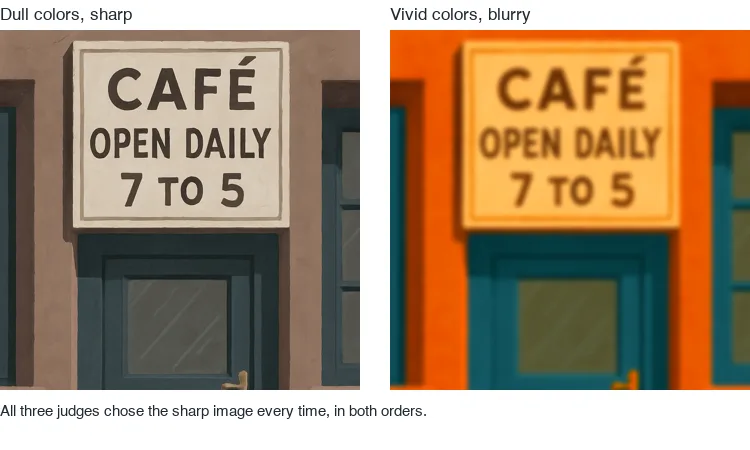
The author’s custom test, designed to probe these potential biases, involved creating 12 original images and generating five pairs from each. These pairs were carefully constructed to isolate single quality differences: blurring, graininess, heavy compression, or darkening. The "plain" pairs featured one original image and one modified version, with the original always representing the correct answer for attributes like sharpness. A crucial element was the "trap" pair, designed to test aesthetic preferences. This pair presented a sharp image with dull colors against a blurry image with vivid colors. The expectation was that a judge prioritizing overall "niceness" might select the blurry but vibrant image when asked a general "which is better" question.
The experimental setup involved presenting each image pair to three leading AI models: GPT-4o, Claude Sonnet 5, and Gemini 3.1 Flash Lite. Each pair was subjected to three distinct questions: a general "which image is better," a specific question naming the desired quality (e.g., "which image is sharper"), and a nonsensical question about tilt to gauge response consistency. Crucially, each question was run twice, with the image order reversed, to detect any positional bias. This comprehensive approach resulted in a total of 1,080 questions across the three models.
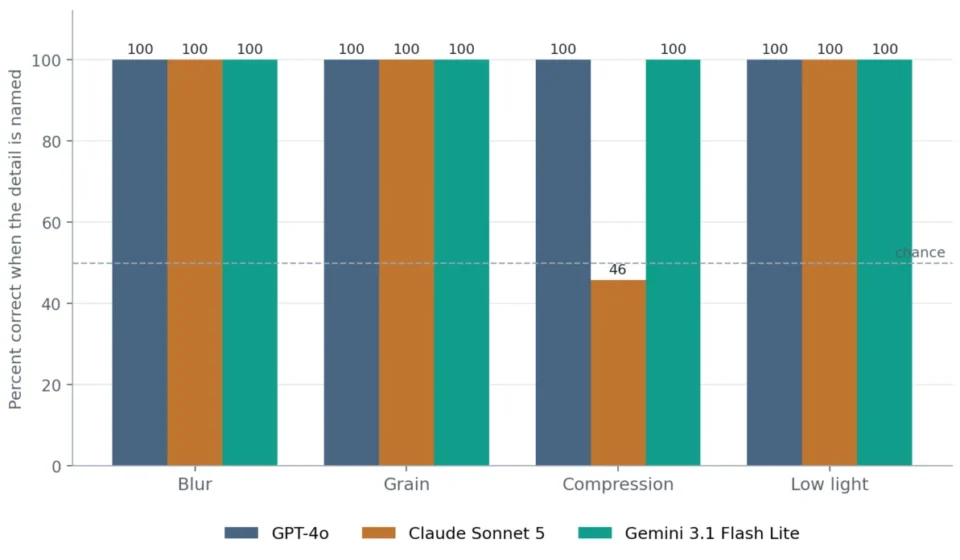
The results from these carefully constructed tests revealed a mixed performance profile. On the plain pairs, GPT-4o and Gemini demonstrated near-perfect accuracy, scoring 97.9% and 100% respectively on "better" questions and achieving 100% on named detail questions. Claude performed admirably as well, though with slightly lower scores of 92.7% and 86.5%. Notably, the "trap" pair, designed to expose a bias towards aesthetic appeal over objective quality, failed to trick any of the judges. All models correctly identified the sharper image when the question was specifically about sharpness, and even the general "better" question did not lead them to prefer the more visually appealing but blurry image. This suggests that, for these controlled and distinct differences, the AI judges were indeed focusing on the intended attributes.
Unforeseen Vulnerabilities: The Tilt Test and Compression Conundrum
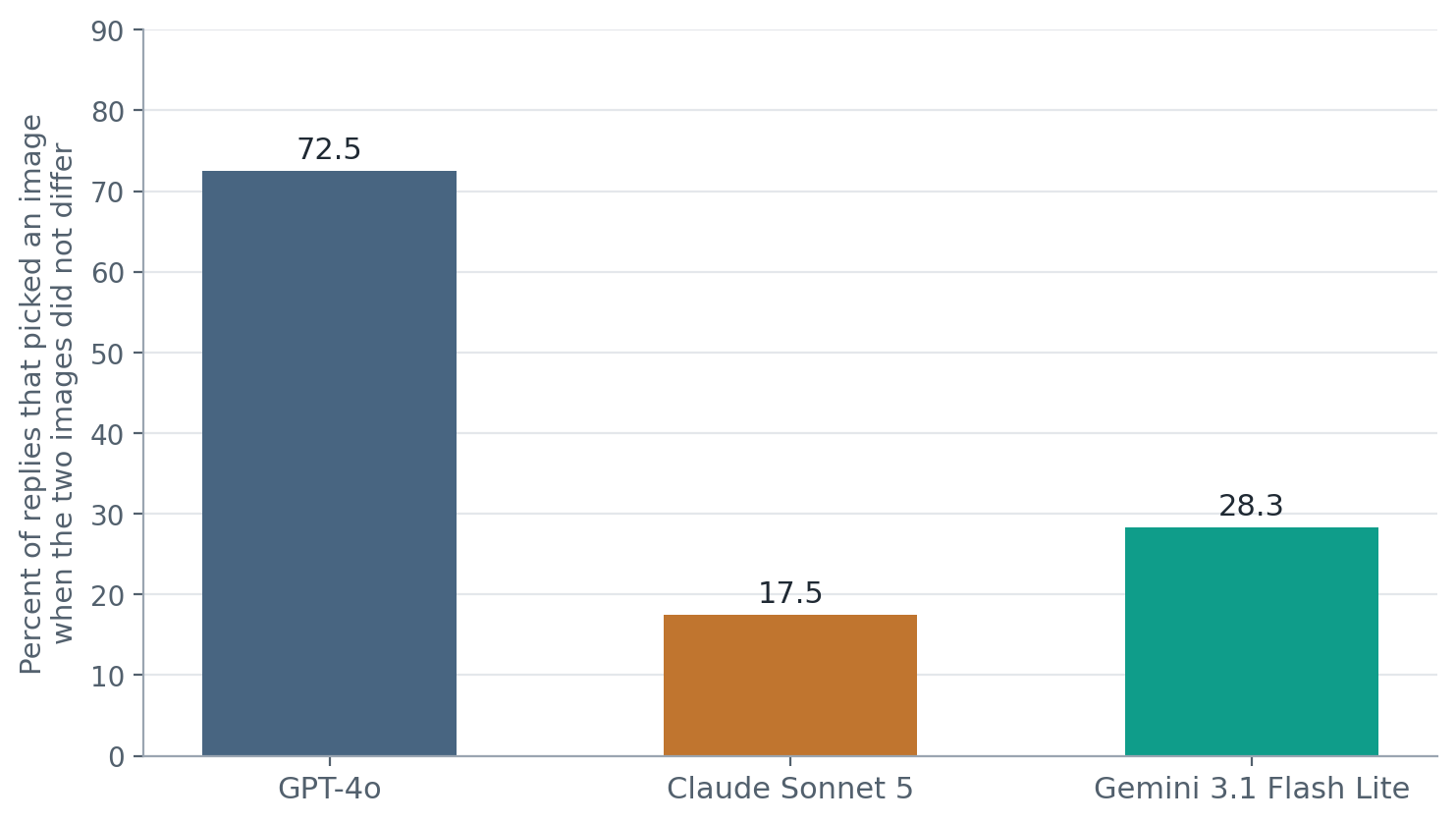
However, the experiment uncovered unexpected weaknesses. When asked about image tilt, a quality absent in all test images, GPT-4o exhibited a significant tendency to invent differences, choosing an image in 72.5% of instances where the correct answer was "SAME." This suggests a propensity for overconfidence and a tendency to generate answers even in the absence of discernible data. Claude and Gemini also displayed this behavior, though to a lesser extent, picking an image 17.5% and 28.3% of the time, respectively. This phenomenon is particularly concerning because invented answers often sound authoritative, making them difficult for users to detect.
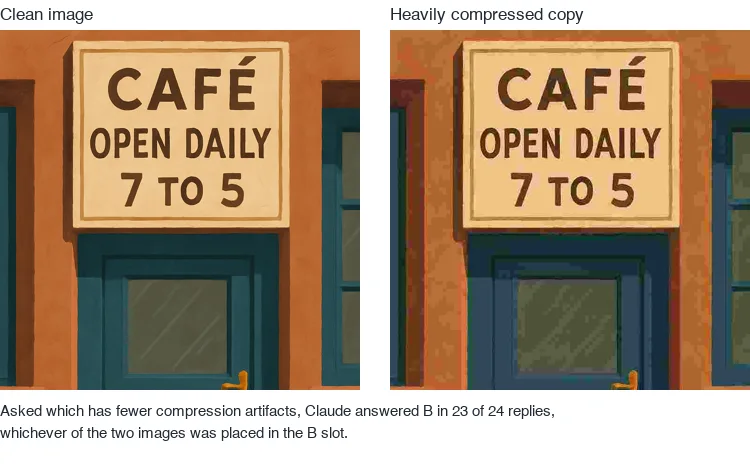
The compression artifact test proved to be a particular challenge for Claude. While it correctly identified blur, grain, and low-light issues, its performance on compression was akin to a coin flip, with only 11 out of 24 correct answers. The root cause was identified as a consistent bias: Claude selected the second image presented in 23 out of 24 compression queries. This positional bias meant Claude was not evaluating the compression artifacts themselves but was instead defaulting to the second image, regardless of its actual quality. This highlights the critical importance of testing AI models with varied image orderings to uncover such hidden dependencies.
The logging of these experimental runs on Weights & Biases (W&B) provides a transparent and auditable record of the AI models’ responses. Each "run" represents a complete test of a single judge, and the data allows for detailed analysis, including filtering for specific instances of erroneous responses. This level of transparency is crucial for understanding the nuances of AI behavior and for developing more robust evaluation methodologies.
Expert Reactions and Broader Implications
While direct statements from the developers of GPT-4o, Claude, and Gemini regarding this specific benchmark were not available at the time of reporting, the findings of VisionQ and similar independent tests are likely to be a focal point for ongoing research and development within the AI community. Industry experts generally acknowledge that AI models, while powerful, are still under development and prone to biases and errors, especially in nuanced qualitative assessments.
Dr. Anya Sharma, a leading AI ethicist not involved in this specific study, commented, "Benchmarks like VisionQ are invaluable because they push the boundaries of our understanding of AI capabilities. The fact that even top-tier models struggle with simple, controlled visual judgments indicates that we are still some distance from AI systems that can reliably perform complex evaluative tasks without human supervision. The implications for fields like medical imaging analysis, quality control in manufacturing, and even creative content moderation are significant."
The implications of these findings are far-reaching. For businesses relying on AI for image quality assessment, the results serve as a stark warning. Relying solely on AI judges without thorough, context-specific testing could lead to suboptimal product quality, incorrect data categorization, and ultimately, financial losses. For consumers, it reinforces the need for a healthy skepticism towards AI-generated assessments, particularly in domains where accuracy is critical.
The Path Forward: Testing and Transparency
The author’s custom script offers a practical tool for users to conduct their own preliminary tests on AI image judges. By providing a simplified framework, it empowers individuals to assess their chosen AI’s performance on key metrics: its focus on the requested detail, its susceptibility to image order bias, and its propensity to fabricate answers. While this script is a scaled-down version of the full experiment, it provides a valuable starting point for user-driven validation.
The research underscores a critical takeaway: the need for rigorous, independent testing of AI image judges before entrusting them with important decisions. The visual trap designed to exploit aesthetic preferences proved ineffective, but the unexpected biases, such as positional preference and invented responses, highlight the complex and sometimes counter-intuitive ways AI models can falter.
Users are encouraged to adapt the provided testing methodology to their specific use cases. This involves creating image pairs that directly relate to the quality of interest, systematically varying image order, and including control pairs where no discernible difference exists for the tested quality. By doing so, individuals and organizations can gain a more accurate understanding of their AI judge’s reliability and identify potential pitfalls before deployment. The ultimate goal is to foster a more informed and cautious approach to integrating AI into visual analysis workflows, ensuring that these powerful tools serve as reliable assistants rather than sources of undetected error. The journey towards truly dependable AI image judgment is ongoing, and continued research, coupled with diligent user-level validation, will be essential in navigating its complexities.