
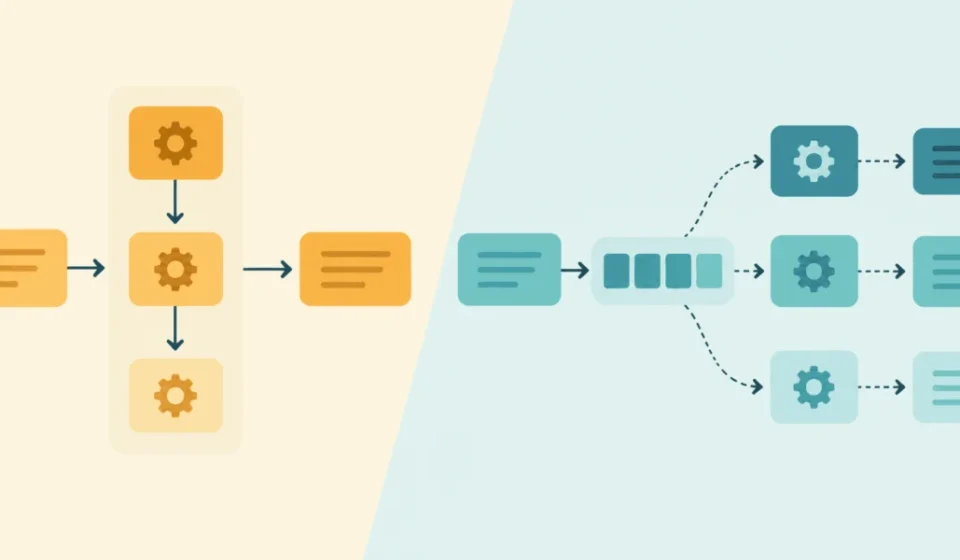
Synchronous vs. Asynchronous Agent Execution: Architecture Patterns for Production

The rapid evolution of Large Language Model (LLM) agents has transitioned from experimental Python scripts to the cornerstone of modern enterprise automation, yet this shift has revealed a significant "deployment gap" that threatens the stability of production-grade applications. As developers move beyond simple chat interfaces toward autonomous agents capable of multi-step reasoning and tool manipulation, the choice between synchronous and asynchronous execution patterns has become the most critical architectural decision in the development lifecycle. While high-level libraries make it trivial to loop an LLM through various tools locally, the transition to a distributed production environment introduces complexities such as API latency, system timeouts, and state management that simple scripts cannot handle. This analysis explores the architectural nuances of these two patterns, providing a roadmap for engineering teams to bridge the gap between prototype and scalable AI services.
The Architectural Divide in Agentic AI
The current landscape of agentic AI is defined by the "reasoning loop"—a process where an LLM evaluates a prompt, decides on a tool to use, executes that tool, and observes the result before continuing. In a local environment, this loop feels seamless. However, in a production environment, each "thought" in that loop is a network call subject to the volatilities of the internet and the varying response times of third-party APIs.
The deployment gap arises when developers attempt to treat these complex, long-running reasoning loops as standard HTTP requests. Real-world agent workflows often involve intricate dependencies and multi-step reasoning that can take anywhere from a few seconds to several minutes. Failure to account for this duration leads to system-level failures, including dropped user requests, memory leaks, and "zombie" processes that consume expensive tokens without delivering a final response to the user. To mitigate these risks, architects must choose between the immediate feedback of synchronous execution and the resilient, decoupled nature of asynchronous systems.
Synchronous Agent Execution: The Wait and See Approach
Synchronous agent execution is the architectural equivalent of a classic HTTP request-response cycle. In this model, the client—whether it is a web browser or another microservice—submits a prompt and holds the connection open until the agent completes its entire chain of thought. This pattern is often referred to as "blocking" because the execution thread is occupied for the duration of the task.
Mechanism and Use Cases
In a synchronous flow, the sequence is linear: the caller sends a request, the agent processes the logic (including any necessary tool calls), and the final result is returned in the same transaction. This pattern is best suited for low-latency scenarios where immediate feedback is paramount. Common applications include:
- Standard RAG (Retrieval-Augmented Generation) Pipelines: Where the agent simply retrieves a document and summarizes it.
- Simple Question-Answering: Where the reasoning steps are minimal and predictable.
- Sequential Dependencies: Where the user cannot proceed without the immediate output of the agent.
The 29-Second Wall
Despite its simplicity, the synchronous pattern is remarkably fragile when applied to advanced agents. A primary constraint is the infrastructure timeout. Major cloud providers, such as Amazon Web Services (AWS), impose a default 29-second timeout on their API Gateway. If an agent requires 45 seconds to perform a web search, analyze the results, and format a report, a synchronous pipeline will drop the connection at the 29-second mark.
From an economic perspective, this is disastrous. The agent continues to run on the backend, consuming expensive LLM tokens and compute resources, but the client never receives the data. This leads to "wasted tokens" and a poor user experience characterized by "Request Timed Out" errors. Furthermore, synchronous systems are difficult to scale under heavy load, as each active request ties up a thread or a process, leading to rapid resource exhaustion.
Asynchronous Event-Driven Execution: Fire and Forget
To solve the limitations of the synchronous model, enterprise architects are increasingly turning to asynchronous, event-driven patterns. This approach decouples task submission from task completion, allowing the system to handle long-running processes that might take minutes or even hours.
The Decoupling Logic
Under the asynchronous pattern, the interaction is split into two distinct phases. First, the client triggers the agent and immediately receives a unique job_id or task_token. The connection is then closed, freeing up the client and the API gateway. Second, the task is placed into a message queue (such as Redis or RabbitMQ), where background workers—independent of the API layer—pick up the task and execute the reasoning loop.
This "fire and forget" mechanism allows the agent to run as long as necessary. The state of the agent is frequently checkpointed in a persistent database like PostgreSQL or MongoDB. This means that if a worker node crashes during a complex 10-step reasoning process, the system can detect the failure and resume the agent from step 6 instead of restarting from scratch.
Requirements for Asynchronous Scaling
Implementing an asynchronous architecture requires a more robust infrastructure stack than its synchronous counterpart. Key components include:
- Message Brokers: To manage the queue of pending agent tasks.
- Worker Fleets: Scalable clusters of compute nodes that process the agent logic.
- State Stores: Databases to track the progress and "memory" of each agent job.
- Polling or Webhooks: Mechanisms for the client to eventually receive the result, either by checking the
job_idperiodically or by receiving a push notification when the task is complete.
Chronology of an LLM Request: Sync vs. Async
To understand the practical implications, one must look at the timeline of a single complex request, such as "Research the latest trends in AI agents and write a report."
Synchronous Timeline:
- 0s: User submits request.
- 1s-10s: Agent performs initial search. Connection remains open.
- 11s-25s: Agent reads three different articles. Connection remains open.
- 29s: API Gateway timeout reached. Connection severed.
- 30s-45s: Agent finishes report in the background, but the user has already seen an error message. Tokens are billed; value is zero.
Asynchronous Timeline:
- 0s: User submits request.
- 0.1s: System returns
job_id: 46f0c47a. User sees "Processing" animation. - 1s: Worker picks up the job.
- 30s: Agent is still working. The user’s frontend polls the API and sees "Status: Step 2/5 – Analyzing Articles."
- 60s: Agent finishes. The final report is saved to the database.
- 61s: The next user poll retrieves the completed report. No connections were dropped, and no tokens were wasted.
Supporting Data and Technical Analysis
The move toward asynchronicity is supported by performance data regarding LLM latency. As of 2024, the average "Time to First Token" (TTFT) for high-end models like GPT-4 or Claude 3.5 Sonnet ranges from 0.5 to 2 seconds. However, for "agentic" workflows involving multiple tool calls, the "Total Request Latency" can easily exceed 30 to 60 seconds.
Research into distributed systems suggests that synchronous systems experience exponential failure rates as the number of internal dependencies (tool calls) increases. In a system where an agent must call three external APIs, each with a 99% reliability rate, the cumulative reliability of the synchronous chain is 97%. In an asynchronous system with persistent state, the reliability approaches 99.9% because the system can retry individual failed tool calls without failing the entire user request.
Industry Implications and Strategic Recommendations
The choice between these patterns has broader implications for the "Human-in-the-Loop" (HITL) workflows that are becoming standard in enterprise AI. Asynchronous systems are the only viable path for agents that require human approval. For instance, an agent refactoring a codebase might need a developer to approve a specific change before proceeding. A synchronous connection cannot stay open for the minutes or hours it might take for a human to review a pull request.
Strategic Roadmap for Developers:
- Start Synchronous for Prototypes: When the goal is rapid iteration and the tasks are simple Q&A, the overhead of queues and workers is unnecessary.
- Pivot to Async for Multi-Tool Agents: As soon as an agent is required to perform more than two external tool calls or web searches, the risk of timeout makes asynchronicity a requirement.
- Implement Checkpointing: Regardless of the pattern, saving the agent’s state at each step ensures resilience against node failures.
- Monitor "Wasted Token" Metrics: Organizations should track how many LLM calls are made for requests that ultimately time out or fail, as this is a direct indicator of architectural inefficiency.
Conclusion
The transition from synchronous to asynchronous execution marks the professionalization of the AI agent field. While synchronous patterns offer simplicity and immediate gratification for simple tasks, they are insufficient for the complex, long-running workflows that define the next generation of autonomous AI. By adopting asynchronous, event-driven architectures, organizations can build agents that are not only more capable but also more resilient, scalable, and cost-effective. As the "deployment gap" closes, the ability to manage these execution patterns will distinguish successful AI products from those that remain stuck in the laboratory phase.