
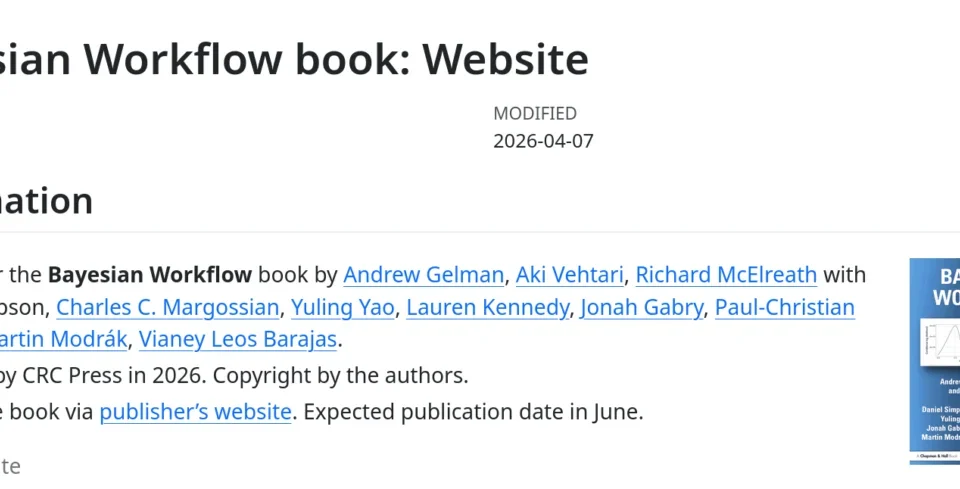
Bayesian Workflow: A Comprehensive Guide for Applied Statistical Modeling

A groundbreaking new book, "Bayesian Workflow: Modeling, Checking, Robustness, Prediction, and Model Selection," by Andrew Gelman, Aki Vehtari, and Daniel Simpson, offers a transformative approach to applied Bayesian statistical modeling. This seminal work moves beyond the traditional "cookbook" or checklist method, providing a practical and iterative framework for building, evaluating, and refining statistical models in real-world scenarios. The book, first reviewed on R-bloggers.com via Xi’an’s Og, aims to demystify the complex process of Bayesian analysis, making it more accessible and robust for a wide range of researchers and practitioners.
The authors, renowned figures in the field of statistics, present a philosophy that emphasizes the dynamic and evolutionary nature of statistical modeling. As stated in the book’s opening, their own conceptions of statistical practice and Bayesian statistics have evolved over years of research and application. This evolution is reflected in the book’s core tenets: the fitting of multiple models, the repeated application of analytical methods, and the crucial role of simulated-data experiments. This approach, they argue, is essential for navigating the complexities of realistic data analysis, where models are not pre-determined but are rather developed and refined through a rigorous, bottom-up process.
The Core Principles of Bayesian Workflow
"Bayesian Workflow" (BaWoFlo, as it’s playfully acronymized by some readers) is structured to guide users through the entire lifecycle of a Bayesian modeling project. The book is divided into four key parts, although the specific chapter breakdown isn’t fully detailed in the initial review. However, the overarching narrative focuses on an iterative process that includes:
- Iterative Model Building: Rather than assuming a single "correct" model, the book encourages the exploration of various model specifications. This involves progressively adding complexity, refining assumptions, and testing different functional forms based on the data and prior knowledge.
- Model Checking: A significant portion of the book is dedicated to robust methods for checking the adequacy of a model. This includes diagnostic plots, posterior predictive checks, and various goodness-of-fit statistics designed to identify discrepancies between the model and the observed data.
- Computational Troubleshooting: Bayesian modeling often involves complex computations, particularly with Markov Chain Monte Carlo (MCMC) methods. The book provides practical advice and strategies for identifying and resolving common computational issues, ensuring the reliability of model fitting.
- Simulated-Data Experimentation: A cornerstone of the BaWoFlo methodology is the extensive use of simulated data. By generating data from proposed models, researchers can gain a deeper understanding of their model’s behavior, assess its sensitivity to different assumptions, and evaluate its performance under various scenarios. This proactive approach helps to uncover potential problems before they manifest in real-data analysis.
The book is particularly geared towards users and developers of Stan, a powerful platform for statistical modeling and high-performance statistical computation. Code excerpts in both R and Stan are provided throughout the text, facilitating direct application of the concepts discussed.
A Shift from Traditional Methodologies
The authors explicitly contrast their approach with more rigid, checklist-based methodologies. They acknowledge that there are no universal rules that guarantee a foolproof analysis. Instead, they advocate for a flexible and adaptive strategy that embraces the inherent uncertainties in statistical modeling. This aligns with a philosophy of "M-open" or agnostic Bayesianism, recognizing that even Bayesian methods have limitations and that a humble acknowledgment of these challenges is crucial for sound statistical practice.
One of the book’s significant contributions is its emphasis on the detailed exposition of modeling and computational choices. The authors meticulously comment on successive decisions, providing readers with a transparent and in-depth understanding of the reasoning behind each step. This approach is exemplified in early chapters, such as Chapter 4, which features a multiple-choice exam example, illustrating the practical application of these principles.
Key Methodological Advancements and Discussions
The book delves into several critical aspects of Bayesian modeling:
- Choosing Priors: Chapter 5.6 offers detailed guidance on the selection of prior distributions. This is a notoriously sensitive aspect of Bayesian analysis, and the authors provide practical advice for making informed choices that reflect existing knowledge without unduly influencing the posterior inference.
- Model Assessment and Comparison: The authors champion the use of Leave-One-Out (LOO) cross-validation and model stacking for model comparison, continuing their earlier work in this area. They present rich graphical tools, particularly in Chapter 8, to assess the impact of prior and likelihood choices, as well as for conducting predictive checks. This emphasis on predictive performance over simple model fit is a key differentiator.
- MCMC Diagnostics: The book covers standard MCMC diagnostics, with a particular focus on the $hat R$ statistic, a key indicator of convergence in MCMC chains. Chapter 12 offers insights into using rapid simulations to detect fitting or computational issues, a valuable tool for ensuring the reliability of model estimates.
While the book covers a vast array of topics, some readers note that certain sections, such as those on approximate solutions (Chapter 13), calibration, and software development, are comparatively brief. This might suggest areas for future expansion or more specialized treatments.
Context and Scope of the Work
The "Bayesian Workflow" book builds upon the extensive body of work produced by its authors over several decades. Andrew Gelman, in particular, is known for his prolific research in statistics, political science, and psychology, and his previous seminal work, "Bayesian Data Analysis" (BDA), is often referenced as a foundational text. The new book can be seen as a practical companion and extension to BDA, providing a workflow that operationalizes the principles discussed in the earlier text.
The book’s examples are diverse, spanning various domains. While some sections are noted to be "US-centric," reflecting Gelman’s academic focus, the authors endeavor to present relatable and engaging case studies. These include analyses of political science data, reanalyses of classic datasets like birthdate data (previously featured on the cover of BDA), and even engaging, albeit unusual, examples involving dogs, cats, roaches, and sharks. The inclusion of a World Cup example, with team names in French, adds a touch of international flavor, originating from Gelman’s time in France during the 2014 World Cup.
Broader Implications and Future Directions
The "Bayesian Workflow" book is poised to have a significant impact on how statistical modeling is taught and practiced. By providing a clear, structured, yet flexible framework, it demystifies complex Bayesian concepts and empowers researchers to build more reliable and interpretable models. The emphasis on iterative refinement and rigorous checking is crucial in an era of Big Data, where the potential for spurious correlations and model misspecification is high.
The book’s open and inclusive approach to Bayesianism, coupled with its practical guidance and extensive examples, makes it an invaluable resource for graduate students, researchers, and data scientists across various disciplines. It offers a much-needed bridge between theoretical Bayesian statistics and the messy realities of applied data analysis, fostering a culture of critical thinking and continuous improvement in statistical modeling. The authors’ humble acknowledgment of the challenges inherent in Bayesian workflows further enhances the book’s credibility and appeal.
The inclusion of an appendix guiding readers through BDA to better understand BaWoFlo underscores the interconnectedness of these foundational concepts and suggests that the book is intended to be part of a broader learning ecosystem. The book’s publication marks a significant step forward in making sophisticated Bayesian modeling techniques accessible and actionable for a wider audience, promising to elevate the rigor and transparency of statistical research across the globe.