
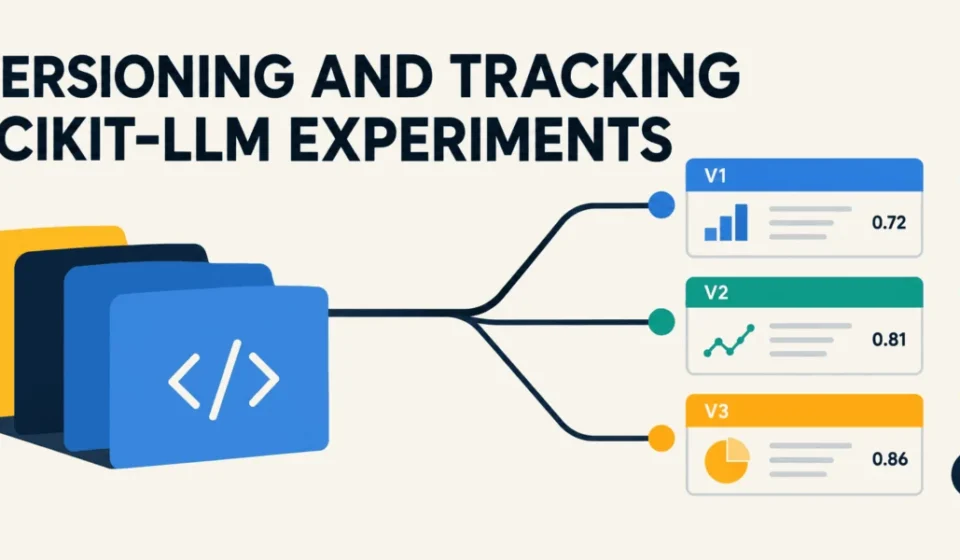
Mastering the Lifecycle of Scikit-LLM Pipelines with MLflow for Enhanced Model Tracking and Versioning

The rapid evolution of generative artificial intelligence has necessitated a shift in how developers approach machine learning workflows, moving away from ad-hoc prompting toward structured, reproducible, and version-controlled pipelines. As enterprises increasingly integrate Large Language Models (LLMs) into their core software stacks, the challenge of maintaining model lineage and performance consistency has become a primary concern for data science teams. To address these complexities, the integration of Scikit-LLM—a library that bridges the gap between the familiar scikit-learn ecosystem and modern LLMs—with MLflow, the industry-standard platform for managing the machine learning lifecycle, offers a robust framework for building, tracking, and registering production-grade AI components. This technical exploration details the methodology for orchestrating these tools to ensure that LLM-driven classifiers are not only performant but also fully auditable and reproducible.
The Convergence of Traditional Machine Learning and Generative AI
For over a decade, scikit-learn has served as the backbone of the Python machine learning ecosystem, providing a standardized API for model training, evaluation, and deployment through its "fit-predict" paradigm. However, the rise of LLMs introduced a different operational model, often characterized by API calls to black-box systems and non-deterministic outputs. Scikit-LLM addresses this friction by wrapping LLMs in scikit-learn-compatible estimators, allowing developers to treat a massive language model as they would a traditional Random Forest or Support Vector Machine.
While Scikit-LLM simplifies the implementation, it does not inherently solve the problem of experimentation management. In a typical development cycle, a practitioner might test multiple LLM backends, varying temperatures, and different prompt templates. Without a systematic tracking mechanism, identifying which configuration led to a specific result becomes impossible. This is where MLflow becomes indispensable. By providing a centralized repository for parameters, metrics, and artifacts, MLflow allows teams to transition from "guessing" to "knowing" which model version is optimal for a given task, such as zero-shot text classification.
Establishing the Technical Foundation
The process of building a versioned LLM pipeline begins with environment configuration. Modern AI development often involves a mix of cloud-based APIs and local execution environments. For teams prioritizing data privacy or cost-efficiency, local execution of LLMs is becoming a preferred route. Utilizing the gpt4all backend through Scikit-LLM allows for the execution of quantized models on standard hardware, eliminating the need for expensive GPU clusters for inference tasks.
To initiate this workflow, the environment must be equipped with scikit-llm and mlflow. A critical nuance in the installation phase is the inclusion of the [gpt4all] extra, which ensures that the necessary C++ bindings and model-handling libraries are correctly configured for local inference. Once the libraries are in place, the configuration of Scikit-LLM requires the setting of placeholder credentials. Even when running models locally, the library maintains a consistent interface, requiring a dummy OpenAI key and organization ID to satisfy internal validation logic.
Concurrent with the LLM setup, the MLflow tracking environment must be initialized. For local development, a SQLite database serves as an efficient backend for the MLflow Model Registry. This setup ensures that model metadata—such as the specific model file used, the timestamp of the run, and the success or failure of the training process—is persisted in a structured format. The creation of a dedicated experiment, such as "Scikit-LLM-Versioning," provides a logical container for all subsequent iterations.
The Chronology of Pipeline Iteration: Baseline to Upgrade
The development of a robust classifier is rarely a single-step process. It follows a chronological path of iterative refinement. The first phase involves the creation of a baseline pipeline. In the context of zero-shot classification—where a model categorizes text into predefined labels without having seen specific training examples—the choice of the underlying LLM is the most significant variable.
Phase One: The Baseline Implementation
The initial iteration often utilizes a lightweight model to establish a performance floor. For example, the "Orca Mini" model, a 71-million parameter quantized GGUF file, offers a high-speed, low-memory footprint solution for basic classification tasks. By encapsulating this model within a scikit-learn Pipeline object, the developer can integrate it into existing data processing workflows.
The integration with MLflow occurs during the execution of this pipeline. By wrapping the fit and log_model commands within an MLflow "run," the system captures a snapshot of the entire environment. Key parameters, such as the llm_backend (gpt4all) and the specific llm_model_file, are logged explicitly. This ensures that if the "Orca Mini" model is updated or replaced in the future, the exact version used in this run remains documented.
Phase Two: The Backend Upgrade
As requirements for accuracy increase, a developer might transition to a more sophisticated architecture, such as the Falcon-based models. This shift represents a common real-world scenario where a "heavier" model is swapped into the pipeline to improve nuance and context window handling. In this second phase, a new MLflow run is initiated, titled "Upgraded_Falcon."
The pipeline structure remains identical, but the ZeroShotGPTClassifier is initialized with the Falcon binary. The power of this approach lies in the "plug-and-play" nature of the scikit-learn API; the code responsible for fitting the data and generating predictions does not need to change, even though the underlying neural architecture has been completely overhauled. MLflow logs this second run as a distinct entity, allowing for a side-by-side comparison of the two versions.
Auditing and Comparative Analysis
With multiple runs completed, the focus shifts from implementation to auditing. MLflow’s search API allows developers to programmatically extract the results of their experiments into a structured format, such as a pandas DataFrame. This "Experiment Tracking Audit" provides a high-level overview of the project’s history.
In a professional setting, this audit serves several purposes. First, it identifies the status of various attempts. It is common for LLM local executions to fail due to memory constraints or corrupted model downloads; the audit trail clearly distinguishes between "FINISHED" and "FAILED" runs, preventing the accidental use of incomplete artifacts. Second, it allows for the comparison of parameters. By viewing the llm_model_file column alongside performance metrics (like accuracy or latency), the team can objectively determine if the "Upgraded_Falcon" model actually outperformed the "Baseline_Orca_Mini."
Furthermore, the use of cloudpickle for model serialization is a critical technical choice highlighted in this workflow. Traditional pickling can be fragile when dealing with complex objects like LLM wrappers that rely on specific library versions. cloudpickle offers a more robust alternative, capturing the dependencies and internal state of the Scikit-LLM classifier more effectively, which is essential for long-term model viability in a production registry.
Formalizing the Model Registry and Production Readiness
The final stage of the lifecycle is the transition from a "logged" model to a "registered" model. While a logged model is simply an artifact of a specific experiment, a registered model is a versioned entity that has been vetted for production use.
The registration process involves selecting the "winning" run from the tracking audit. This selection can be manual—based on a developer’s qualitative assessment—or automated based on quantitative metrics. For instance, a script can be configured to search for the run with the highest accuracy metric and automatically promote it to the MLflow Model Registry under a name like "Production_ZeroShot_Classifier."
Once registered, the model receives a version number (e.g., Version 1). This versioning system is the cornerstone of LLMOps (Large Language Model Operations). It allows engineering teams to implement "canary deployments" or "blue-green deployments," where a new version of the classifier is tested against the current production version in a controlled environment. If the new Falcon-based model shows unexpected behavior in the field, the system can instantly roll back to the Orca Mini baseline by referencing its specific version in the registry.
Broader Impact and Strategic Implications
The methodology of combining Scikit-LLM and MLflow reflects a broader trend toward the "democratization" of LLM management. Historically, the infrastructure required to track and version massive models was restricted to organizations with bespoke, high-cost ML platforms. By leveraging open-source tools, even small teams can now achieve a level of rigor previously reserved for tech giants.
From a governance perspective, this workflow addresses the growing demand for AI transparency. Regulatory frameworks, such as the EU AI Act, increasingly require organizations to maintain detailed documentation of how AI models were trained, tested, and deployed. The MLflow tracking database provides an immutable log of these activities, serving as a "black box recorder" for the model’s development.
Economically, this approach facilitates a more nuanced "cost-per-accuracy" analysis. LLMs are expensive, whether in terms of API credits or local compute cycles. By systematically tracking different backends, companies can identify "sweet spots"—versions of the pipeline that provide 95% of the accuracy of a flagship model at 10% of the operational cost.
In conclusion, the integration of Scikit-LLM and MLflow represents a maturation of the AI field. It moves the conversation away from the "magic" of LLMs and toward the engineering discipline of software development. By treating LLM components as versioned, trackable, and swappable artifacts within a scikit-learn pipeline, developers can build AI systems that are not only intelligent but also stable, predictable, and ready for the rigors of enterprise deployment. As the ecosystem continues to evolve, those who master these lifecycle management techniques will be best positioned to lead the next wave of AI-driven innovation.