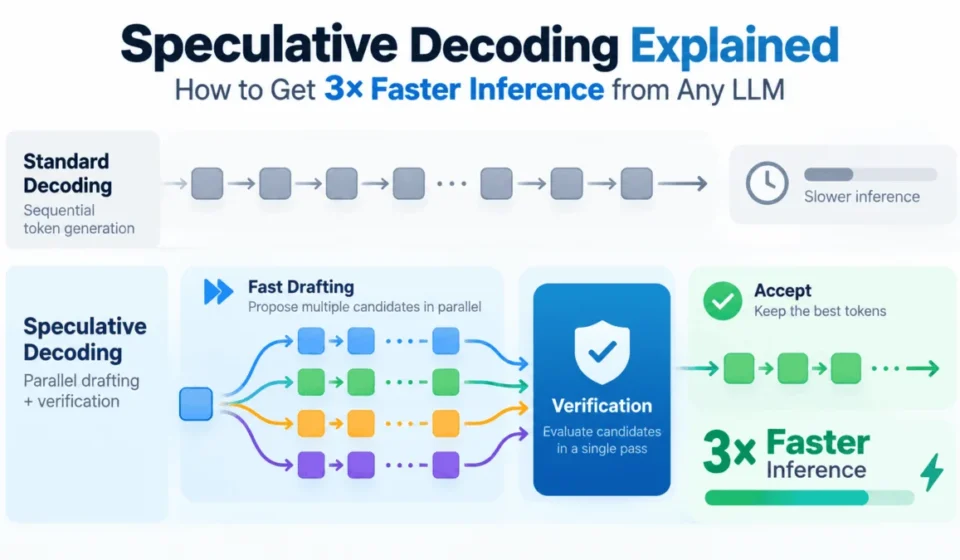
Speculative Decoding: The Architectural Breakthrough Accelerating Large Language Model Inference

The rapid proliferation of Large Language Models (LLMs) has revolutionized the tech landscape, yet a persistent technical bottleneck remains: the speed of text generation. As models like GPT-4, Claude, and Llama grow in complexity, the latency inherent in their autoregressive nature has become a primary hurdle for real-time applications. To address this, a technique known as speculative decoding has emerged as a transformative solution, offering a two-to-threefold increase in inference speed without compromising the mathematical integrity of the model’s output. By shifting the generative process from a sequential bottleneck to a parallel verification task, speculative decoding is fundamentally altering the economics and performance of AI deployment.
The Autoregressive Bottleneck and Hardware Constraints
To understand the necessity of speculative decoding, one must first analyze the traditional mechanism of LLM inference. Large language models operate on an autoregressive principle, meaning they generate text one "token"—roughly a word or part of a word—at a time. Each new token requires a complete pass through the model’s entire architecture, which may consist of hundreds of billions of parameters.
The industry’s struggle with speed is rarely a result of a lack of raw computational power. Modern hardware, such as the NVIDIA H100 Tensor Core GPU, is capable of performing quadrillions of operations per second. Instead, the bottleneck is "memory-bandwidth bound." In a standard inference cycle, the model’s weights must be moved from the GPU’s High Bandwidth Memory (HBM) to its on-chip processors to generate a single token. Because the amount of data being moved is massive compared to the relatively simple computation required for one token, the processor spends most of its time idling, waiting for data to arrive. This inefficiency scales with the size of the model; the larger the model, the more time is wasted in data transit for every individual token produced.
The Mechanics of Speculative Decoding
Speculative decoding introduces a "draft-and-verify" framework that bypasses this sequential dependency. The system utilizes two distinct models: a "target model," which is the large, high-quality LLM the user intends to use, and a "draft model," a much smaller, faster, and less accurate version of the target model.
The process begins with the draft model rapidly generating a short sequence of "speculative" tokens—usually between four and eight. Because the draft model has significantly fewer parameters, it can produce these guesses with minimal memory overhead and at high speeds. Once this sequence is generated, it is passed to the target model.
Unlike the draft model, which works sequentially, the target model evaluates the entire sequence of speculative tokens in a single parallel forward pass. Modern GPUs are designed for this exact type of parallelization; checking five tokens simultaneously takes nearly the same amount of time as generating one token from scratch. The target model then compares the draft model’s predictions against its own internal probability distributions.
If the target model’s logic aligns with the draft model’s guesses, those tokens are accepted and added to the final response. If a discrepancy is found, the system rejects the incorrect tokens, and the target model provides a corrected token to resume the process. Crucially, the system utilizes a "rejection sampling" algorithm that ensures the final output is statistically identical to what the target model would have produced on its own. This means there is no "quality tax" for the increased speed; the output remains as sophisticated as the original large model.
A Chronology of Development
The conceptual foundations of speculative decoding were established in late 2022 and early 2023, primarily through two seminal research papers. Researchers at Google Research published "Fast Inference from Transformers via Speculative Decoding" (Leviathan et al.), while a team at DeepMind concurrently released "Accelerating Large Language Model Decoding with Latent Attention" (Chen et al.).
By mid-2023, the technique moved from theoretical research into open-source implementation. Frameworks such as Hugging Face’s Text Generation Inference (TGI) and vLLM began integrating speculative decoding to help enterprises reduce the cost of serving models.
In 2024, the evolution of the technique branched into more sophisticated "self-speculative" methods. These methods, including Medusa and Eagle, sought to eliminate the need for a separate draft model entirely. Instead, they modified the architecture of the target model to allow it to "look ahead" and verify its own future tokens, further reducing the engineering complexity of maintaining two different models in memory.
Comparative Performance and Supporting Data
The efficacy of speculative decoding is measured by the "acceptance rate"—the percentage of tokens generated by the draft model that are successfully verified by the target model. Industry benchmarks indicate that for common tasks such as chat or creative writing, acceptance rates typically hover between 70% and 80%.
Data from independent hardware testing suggests the following performance gains:
- Standard Inference: 10–15 tokens per second on a large-scale 70B parameter model.
- Speculative Decoding (with a 7B draft model): 25–40 tokens per second on the same hardware.
- Code Generation: Because code often follows highly predictable patterns, acceptance rates can exceed 90%, leading to speedups of 4x or more.
The hardware efficiency gain is equally notable. By reducing the number of times the target model’s weights must be loaded from memory per token generated, speculative decoding significantly lowers the energy consumption per request, making it a vital tool for data centers aiming to optimize their Power Usage Effectiveness (PUE).
Advanced Variants: Medusa, Eagle, and Prompt Lookup
As the field matures, several specialized implementations have emerged to address specific use cases:
- Medusa: This approach attaches multiple "heads" to the final layer of a transformer model. Each head is trained to predict a different future token position. This allows the model to act as its own draft model, simplifying the deployment pipeline and ensuring that the "drafting" process is perfectly aligned with the target model’s internal representations.
- Eagle: The Eagle algorithm focuses on "hidden state" extrapolation. Rather than using the final tokens for drafting, it uses the intermediate data processed within the model’s layers. This provides a richer context for speculation, which is particularly effective for domain-specific tasks like medical or legal analysis where standard draft models might struggle.
- Prompt Lookup Decoding: This is a "model-less" version of speculative decoding. It operates on the observation that in many tasks—such as summarizing a document or editing code—the model’s output will likely reuse phrases found in the input prompt. By using the prompt itself as the source of speculative tokens, it achieves speedups without the memory overhead of a secondary model.
Industry Implications and Official Responses
The shift toward speculative decoding has been met with enthusiasm from major AI infrastructure providers. NVIDIA has integrated speculative decoding support into its TensorRT-LLM library, signaling that this is no longer an experimental feature but a core component of the modern AI stack.
Cloud providers and API developers have also weighed in. In various technical blogs, engineers from companies like Anyscale and Together AI have noted that speculative decoding is essential for making "agentic" workflows—where AI models must perform multiple steps of reasoning in seconds—viable for consumers.
"The bottleneck in LLM serving is no longer just about TFLOPS (Teraflops); it’s about how intelligently we can use the bandwidth we have," noted a senior engineer at a leading inference optimization startup. "Speculative decoding is the first major step in moving away from the ‘brute force’ approach to AI generation."
Analysis of Future Impacts
The broader implications of speculative decoding extend beyond mere speed. By making large models faster and cheaper to run, it lowers the barrier to entry for startups and smaller enterprises. It also paves the way for "on-device" AI. As smartphones and laptops gain specialized AI chips with limited memory bandwidth, speculative decoding will be the key technology that allows a 70-billion-parameter model to run locally with acceptable latency.
However, the technique is not a universal panacea. In high-throughput environments where a single GPU is processing hundreds of requests simultaneously in large batches, the overhead of speculative decoding can actually reduce total system throughput. The "drafting" steps consume valuable compute cycles that could otherwise be used to process more users. Therefore, the future of the technology likely involves "dynamic speculation," where the system automatically toggles the feature on or off based on current server load and the specific nature of the user’s query.
Conclusion
Speculative decoding represents a pivotal shift in the philosophy of artificial intelligence development. For years, the industry focused almost exclusively on making models "smarter" by increasing parameter counts. Speculative decoding demonstrates that equal attention must be paid to the "choreography" of data movement within the hardware. By turning a sequential process into a parallel one, the technique provides a rare "free lunch" in computer science: significantly higher performance with no loss in quality. As LLMs become more integrated into the fabric of daily digital life, speculative decoding will likely remain the engine under the hood, ensuring that the next generation of AI is as responsive as it is intelligent.