Navigating the New Frontier of AI Agent Benchmarks and the Evolution of Autonomous System Evaluation

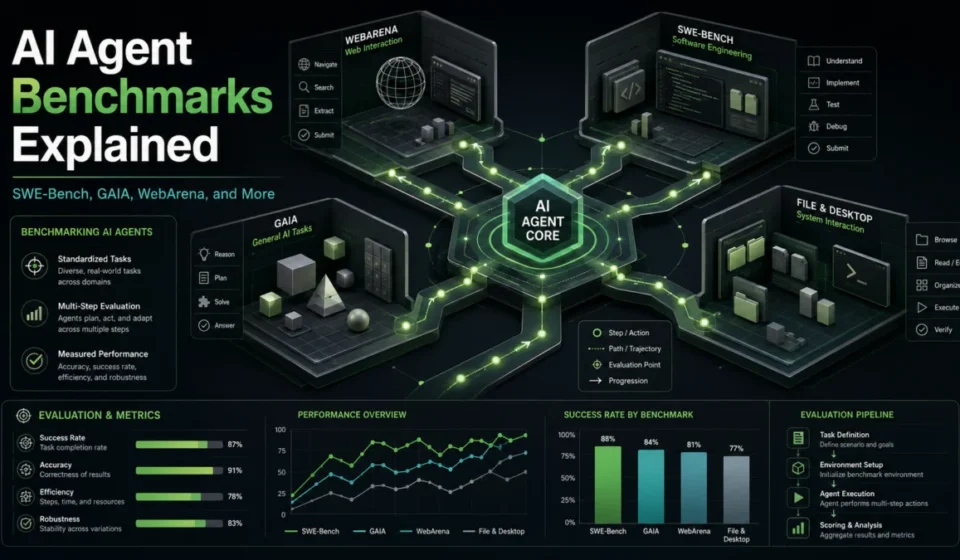
The rapid transition from static Large Language Models (LLMs) to autonomous AI agents marks a pivotal shift in the artificial intelligence landscape, moving from systems that merely "know" to systems that "do." As major AI providers like OpenAI, Anthropic, and Google increasingly market their models as "agentic," the industry has seen a proliferation of specialized benchmarks designed to measure a model’s ability to navigate complex environments, use external tools, and execute multi-step workflows. However, for technology leaders and developers deploying these systems in production, the gap between a high leaderboard score and reliable real-world performance remains a significant hurdle. Understanding the nuances of these evaluations—ranging from software engineering simulations to full operating system control—is now essential for distinguishing between marketing hype and genuine utility.
The Paradigm Shift: From Static Models to Agentic Systems
To appreciate the current state of AI evaluation, one must distinguish between traditional model benchmarks and the new generation of agentic benchmarks. Traditional metrics, such as the Massive Multitask Language Understanding (MMLU) or HumanEval, function essentially as written examinations. They measure a model’s "zero-shot" or "few-shot" capabilities—its ability to provide a correct answer to a prompt in a single turn. While these are effective for gauging raw linguistic reasoning and coding knowledge, they fail to account for the "friction" of the physical and digital worlds.
AI agents, by contrast, are designed to operate in loops. They must perceive an environment, decide on an action (such as clicking a button or writing a file), observe the result, and iterate until a goal is achieved. Consequently, an agent benchmark is less like an exam and more like a live work simulation. Failure in this context is not just a factual error; it can manifest as an infinite loop, a "hallucination" of a user interface, or the accidental deletion of critical data. As agents move into the workforce to handle roles ranging from customer support to software development, the benchmarks used to validate them must reflect these complexities.
The Current Landscape: A Chronology of Major Benchmarks
The evolution of these benchmarks has occurred rapidly over the last three years, trailing the release of increasingly powerful models like GPT-4 and Claude 3. As the models became more capable, the benchmarks had to become more rigorous to prevent "ceiling effects" where models score perfectly, rendering the test useless.
SWE-bench: The Gold Standard for Engineering
Introduced by researchers at Princeton University and the University of Chicago, SWE-bench represents perhaps the most rigorous test for AI agents currently available. It utilizes 2,294 real-world GitHub issues pulled from popular open-source Python repositories, including Django, scikit-learn, and flask. To pass a task, an agent must explore the codebase, identify a bug or feature request, write a patch, and—crucially—pass the repository’s existing unit tests.
The introduction of "SWE-bench Verified" in 2024 addressed a significant concern in the research community: the quality of the benchmark itself. Human annotators discovered that many original tasks were either unsolvable or had flawed test suites. By curating a subset of 500 tasks, the researchers provided a cleaner signal for performance. Data from 2024 indicates that while early models struggled to solve even 2% of these tasks, newer "agentic" wrappers around models like Claude 3.5 Sonnet have pushed success rates toward 40%, signaling rapid progress in automated software engineering.
GAIA: Testing General Intelligence and Tool Use
The General AI Assistants (GAIA) benchmark, developed by researchers from Hugging Face, Meta, and AutoGPT, focuses on tasks that are conceptually simple for humans but difficult for AI. These tasks require the agent to coordinate across multiple modalities—such as reading a PDF, searching the web for a specific fact, and performing a mathematical calculation to arrive at a final answer.
GAIA’s philosophy is that the "reasoning" required should be minimal for a human, ensuring that the benchmark tests the agent’s ability to use tools and manage context rather than its ability to solve logic puzzles. This benchmark has become a primary metric for personal assistants and research agents.
WebArena and BrowserGym: Navigating the Digital Web
As the web is the primary interface for modern work, benchmarks like WebArena (developed by Carnegie Mellon University and other partners) have become essential. WebArena provides a fully functional, sandboxed environment containing clones of websites like GitLab, Reddit, and e-commerce stores. Agents are tasked with complex instructions, such as "Find a laptop under $1000 with at least 16GB of RAM on the store and add it to my wishlist."
BrowserGym builds upon this by offering a standardized framework for agents to interact with any website using Chromium. These benchmarks highlight a unique failure mode of AI: "visual hallucination," where an agent believes it has clicked a button that does not exist or fails to recognize a pop-up window that obstructs its path.
OSWorld: The Ultimate Frontier of Computer Use
Released in 2024, OSWorld is arguably the most ambitious benchmark to date. It places the AI agent in a virtualized operating system (Ubuntu, Windows, or macOS) and requires it to perform tasks across multiple applications, such as Excel, VLC, and Chrome. This evaluates the agent’s "cross-app" reasoning—for example, taking data from a spreadsheet and using it to draft an email. OSWorld is seen as the ultimate test for "Universal Agents" that aim to replace or augment human desktop workflows.
Supporting Data: The Leaderboard Arms Race
The competitive nature of the AI industry has turned these benchmarks into high-stakes marketing tools. In early 2024, the startup Cognition AI made waves by announcing "Devin," an AI software engineer that significantly outperformed existing models on SWE-bench. This announcement triggered a "leaderboard arms race," with companies like Factory, OpenDevin, and Princeton’s own SWE-agent project releasing weekly updates to their architectures.
However, data suggests that these scores are highly sensitive to the "wrapper" or the "scaffolding" around the model. A base model might score 10% on a benchmark, but when equipped with a "plan-and-execute" loop, memory retrieval, and self-correction steps, that same model’s score can triple. This indicates that agentic performance is as much a software engineering challenge as it is a model training challenge.
Critical Analysis: What the Metrics Hide
While the rise of these benchmarks is a sign of a maturing field, experts warn against over-reliance on them. Several "hidden" factors often dictate the success of an agent in a real-world environment but are absent from public leaderboards.
The Cost and Latency Trade-off
A major criticism of current agent evaluations is the lack of "efficiency" metrics. An agent might achieve a high score on SWE-bench by attempting a problem 100 times using different strategies, incurring hundreds of dollars in API costs for a single bug fix. In a corporate setting, the return on investment (ROI) would be negative. Furthermore, an agent that takes 30 minutes to "think" through a web navigation task is often less useful than a human, regardless of its accuracy.
The Contamination Problem
As LLMs are trained on vast swaths of the internet, there is a persistent risk that the solutions to benchmark tasks are included in the models’ training data. If a model has already "seen" the fix for a 2023 GitHub issue during its pre-training phase, its high SWE-bench score represents memorization rather than reasoning. This "data contamination" makes it difficult for researchers to know if a model is truly getting smarter or simply becoming a better search engine.
Safety and Destructive Actions
Current benchmarks operate in sandboxed environments where failure has no consequences. In production, an agent might be tasked with managing a cloud server or a corporate bank account. None of the major benchmarks effectively measure "negative constraints"—the ability of an agent to refrain from taking a harmful or irreversible action when it is uncertain.
Official Responses and Industry Reactions
The AI research community has responded to these challenges with increased transparency and more robust testing protocols. Meta and OpenAI have both published research papers detailing their internal "red-teaming" processes, which go beyond standard benchmarks to test for safety and reliability.
Enterprise leaders, however, remain cautious. "We don’t look at public leaderboards when deciding which agent to deploy," says a CTO of a Fortune 500 fintech firm. "We build our own ‘Golden Sets’—private benchmarks based on our specific legacy codebases and internal workflows. An agent that can solve a Django bug is impressive, but we need an agent that can solve a bug in our proprietary 20-year-old COBOL system."
This sentiment is echoed by the creators of GAIA and SWE-bench, who frequently state that their tools are intended as "directional signals" for researchers rather than "performance guarantees" for buyers.
Broader Impact and Future Implications
The development of AI agent benchmarks is more than a technical exercise; it is the foundation for the future of automated labor. As these benchmarks become more sophisticated, they will likely begin to influence insurance and regulatory standards. Just as a human driver must pass a standardized test to receive a license, autonomous agents may eventually require certification based on their performance in environments like OSWorld or WebArena.
The shift toward "Verified" benchmarks and human-in-the-loop evaluation suggests that the industry is moving away from purely automated scoring. The next generation of benchmarks will likely incorporate "human preference" and "process-based supervision," where agents are graded not just on whether they reached the goal, but on whether they followed a logical, safe, and efficient path to get there.
In conclusion, while SWE-bench, GAIA, and OSWorld provide a vital framework for measuring the progress of autonomous AI, they are only the first step. For organizations looking to harness the power of AI agents, the message is clear: use the public leaderboards to identify the strongest candidates, but rely on rigorous, internal, and task-specific evaluations to determine which agent is truly ready for the job. The transition from "chat" to "action" is well underway, but the road to reliable autonomy is paved with more than just high percentages on a leaderboard.