
Navigating the AI Tsunami: Scholarly Publishing Confronts Market Shifts, Evolving Discovery, and the Urgency of Engagement

The scholarly publishing industry finds itself at a critical juncture, grappling with profound shifts driven by artificial intelligence that are repricing major market players, fundamentally altering content consumption, and reshaping the very pathways of research discovery. On February 3 of this year, a seemingly innocuous event—Anthropic’s release of a legal plug-in for Claude—triggered a significant market reaction, with RELX falling 14%, Thomson Reuters approximately 18%, and Wolters Kluwer about 13% by day’s end. This dramatic repricing occurred without a single library canceling a subscription, a journal folding, or a publishing platform experiencing a breakdown, highlighting a stark disconnect between immediate operational realities and investor perception.
This gap between perceived threats and tangible impacts formed the central theme of Silverchair’s recent Platform Strategies conference in Washington, D.C., where industry leaders convened to decipher which signals demand immediate action, which provide essential context, and which are merely transient "weather." The discourse, initially framed by Silverchair CEO Will Schweitzer’s welcome address and enriched by vigorous debate among attendees, underscored a community actively seeking to navigate an unprecedented era of technological transformation.
The Shifting Sands of Industry Priorities: Insights from Platform Strategies
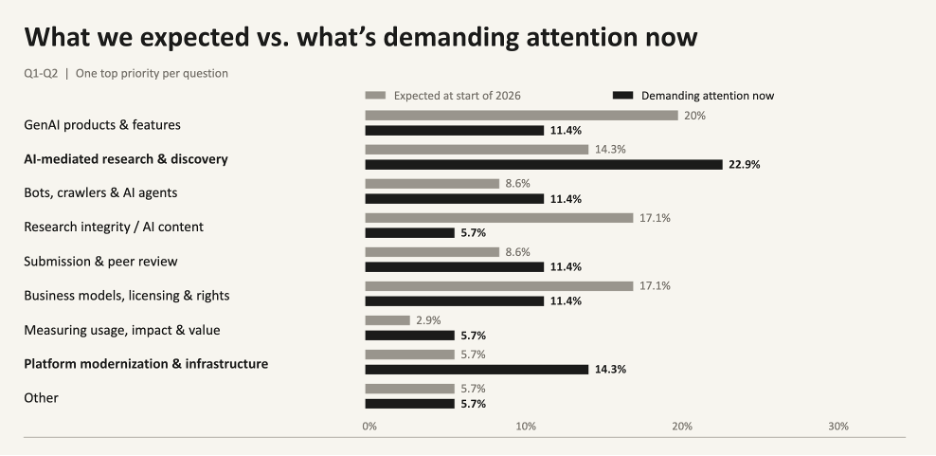
Wendy Queen, of Johns Hopkins University Press, opened Platform Strategies by asserting that the industry’s challenge isn’t a scarcity of information, but rather the discernment of actionable signals amidst a cacophony of data. Her innovative approach included polling the audience, revealing a dynamic shift in priorities among scholarly publishing professionals between January and September.
A notable surge in attention was directed towards AI-mediated research and discovery, which escalated from being a top priority for 14.3% of respondents to 22.9%. Simultaneously, platform modernization gained traction, rising from 5.7% to 14.3% as a primary concern. Conversely, focus shifted away from research integrity and AI content, with its priority ranking plummeting from 17.1% to 5.7%. While these were small-sample polls, they collectively painted a picture of an industry increasingly concerned with how AI facilitates the discovery of research, rather than solely focusing on the integrity of AI-generated content.
Two additional findings from Queen’s survey warrant close examination. First, an overwhelming 97.1% of respondents indicated their organizations were engaged in activities beyond mere observation, demonstrating a proactive stance within the community. Second, the most pressing "signal-to-noise" problem, identified by 22.9% of participants, was understanding and adapting to changing researcher behavior. This finding suggests that the core challenge isn’t merely selecting the right technology, but rather comprehending how the end-users—the researchers—are evolving their methods and needs in an AI-infused landscape. Queen also highlighted a critical concern for smaller society publishers: the escalating costs of platform maintenance without commensurate revenue growth, an issue exacerbated by technological advancements.
Her closing framework, adopted by many attendees, posited three crucial questions for evaluating any new signal: Is it a fundamental shift? Is it merely context? Or is it fleeting "weather"? This approach encourages a balanced assessment of potential disruptions, weighing the costs of acting prematurely against the often-overlooked perils of delayed response.
Financial Repercussions: A Market Repricing Beyond Publishing

The stock market’s reaction on February 3 was not an isolated incident but a symptom of a broader financial narrative impacting various sectors, including scholarly publishing. While six of the seven public companies in the scholarly market experienced faster growth in the first half of 2026 than in the preceding decade, four simultaneously saw their market value erode by 20% to 50% over the same period. This divergence between robust revenue growth and declining market valuation, meticulously tracked by Clarke and Esposito in The Brief, signals a significant repricing based on future outlooks rather than current performance.
A vivid analogy for this market phenomenon can be drawn from the grocery store snack aisle. In October 2023, a Walmart executive’s comment about customers taking GLP-1 drugs purchasing smaller baskets instantly repriced the entire packaged food sector. Three years later, while PepsiCo earned more per share in 2025 than in 2023, its shares were down about 16%. The underlying change was not a fall in revenue, but a re-evaluation of the price investors were willing to pay for each dollar PepsiCo earned, dropping from approximately $21 to $16.50. In contrast, Coca-Cola, operating on the same shelf and facing the same drug-induced consumer shifts, saw its price-to-earnings multiple rise from $19.80 to $29.30. The critical differentiator was business model: Coca-Cola’s asset-light model, having divested bottling operations to independent partners in 2017, resulted in fatter margins (roughly 26% operating margin in North America versus PepsiCo’s 12% for beverages) and volume growth. Investors weren’t pricing the drug’s impact on consumption, but rather which company was better positioned to absorb the disruption.
This analogy holds crucial implications for scholarly publishers, particularly those without public listings. The "Coca-Cola" equivalent in scholarly publishing will be organizations possessing sufficient profitability to absorb market disruptions, adept at integrating fast-growing AI products, and controlling a broad, unique, licensable, and high-quality content corpus. Without such attributes, even strong revenue growth may not protect against a future repricing of perceived value.
Beyond equity markets, a significant credit story is unfolding, impacting the vast majority of scholarly publishers who are privately held or mission-driven. In 2025, five technology companies issued an unprecedented $121 billion in bonds to finance AI infrastructure, a stark contrast to the $28 billion annual average prior. By the Bank of England’s estimates, these five companies accounted for 3% of outstanding U.S. investment-grade debt by the end of 2025 and over 15% of new issuance by May. Moody’s further identified an additional $662 billion in data center leases, not yet commenced and off balance sheets, exceeding these companies’ total adjusted debt.
This massive competition for capital by "hyperscalers" has tangible consequences. When Federal Reserve Chair Jerome Powell was asked on September 16 why long-term yields continued to rise, his second reason was "competition for capital," explicitly naming these tech giants. This translates directly to higher borrowing costs for everyone else, impacting credit lines, altering endowment and reserve assumptions for non-profits, and raising the bar for any new investment. Even a small society publisher with no direct exposure to these tech companies feels the pinch of a higher cost of money. The situation was further sharpened by Oracle invoking force majeure on a $165 billion data center lease – the first such commitment to be rescinded – and the ten-year Treasury yield reaching 5.24% while equity volatility remained low, signaling a credit problem rather than an equity one. While the precise resolution remains uncertain, publishers must factor a higher cost of capital into their 2027 budgets and plan with longer time horizons, leveraging their privately held or mission-driven status to avoid quarterly reporting pressures.
The Silent Transformation: Our Readers Are Now Machines
While headlines focused on AI’s creation capabilities, a more fundamental shift was quietly reshaping how content is consumed: our readers changed. Data from an exemplary publisher site running on Silverchair’s platform revealed that between June and August, only 41% of content requests were identified as likely human, a number that continues to decline monthly. While this single-site, three-month snapshot is not definitive, it points to a trend largely unexamined by many publishers.
Broader industry data corroborates this. In May, LibLynx reported that out of 50 million access requests across approximately thirty scholarly publishers, 36% were robotic – a conservative estimate given that publishers had already applied their own filtering. On Michigan’s Deep Blue repository, humans accounted for only a quarter of 30 million requests. A COAR survey of 66 repositories found over 90% grappling with aggressive bots. This lack of granular, scholarly-specific data, in contrast to the extensive analytics available for news media from sources like Cloudflare and TollBit, means the industry is often "describing our own readers with somebody else’s instruments."
The implications of this shift are profound. Pew Research’s study of nearly 69,000 searches found that users click through on only 8% of searches when an AI summary appears, compared to 15% without one. Cloudflare reported that crawling for AI training purposes surged from 22% to 52% of all crawler requests in a single year. Moreover, "agentic browsers" now mimic ordinary Chrome sessions, complete with real institutional entitlements, rendering them indistinguishable from human users in server logs. This burgeoning non-human traffic presents significant challenges related to infrastructure costs, accurate usage metrics (prompting COUNTER’s second phase to include "AI retrievals" for off-platform usage), and the very value proposition publishers offer, as machines increasingly become the primary consumers of scholarly content.

The Battle for Discovery: Defaults Set by Outsiders
Perhaps the most alarming trend is the rapid establishment of new pathways for research discovery, largely by entities outside the traditional scholarly publishing ecosystem. These defaults, once set, will be exceedingly difficult to alter.
Anthropic’s Claude connector directory now boasts 862 connectors, including Clarivate Cortellis products and Springer Nature’s AdisInsight (a drug pipeline database). Crucially, third-party scholarly AI tools like Consensus, Scite, and Elicit are listed, but no society publisher has a direct presence. When "Claude Science" is activated, its default literature layer relies entirely on OpenAlex and arXiv, completely bypassing paywalled publisher corpora by default. Without proactive licensing or inference arrangements (like MCP-endpoints), publisher paywalls risk becoming significant discovery liabilities, impeding the fulfillment of their societal mission to disseminate knowledge.
However, a model for engagement is rapidly emerging. The same week as the Platform Strategies conference, Consensus became available across ChatGPT, Claude, and Microsoft 365 Copilot. Days later, AAAS licensed the full text of six Science family journals to Consensus, explicitly for retrieval and grounding, not for AI training. Shortly thereafter, De Gruyter Brill licensed its English-language list through Cashmere, and Sage did something similar with Causaly, both for inference only. This quickly settled model – content licensed for retrieval and grounding rather than training, brokered through intermediaries rather than frontier labs – represents a more defensible position than earlier training-corpus deals, but it necessitates active participation in these new channels.
The access layer itself is also being fundamentally redefined. On September 1, cryptographic bot identity became a working group document at the IETF, co-authored by Cloudflare and Google. On September 13, the AI preferences working group published a vocabulary with three verbs: training, use, and search. Just two days later, Cloudflare replaced its "block AI bots" switch with these three granular controls and introduced an "Accountable" designation for crawler operators, naming Apple, Google, and Microsoft. This rapid standardization and implementation by the web’s largest intermediary means that compliance frameworks are being built, and key players designated, in real-time. Cloudflare’s data further indicates that while 17% of sites block AI training in any form, fewer than 1% block search – a critical distinction for publishers to consider.
Whose Corpus? The Question of Substitutability and Trust
The geopolitical dimension of AI training data adds another layer of complexity. China’s stated ambition to become a leading supplier of AI training data by 2028 highlights a risk not tied to the origin of the AI model, but to the provenance of its training data. Research published in Nature this spring demonstrated that ChatGPT and Claude, when prompted in Chinese, answered more favorably to Beijing’s narratives, a bias traced to the inclusion of state media in their training datasets. Brandon Stewart of Princeton, a co-author, succinctly captured the essence of the problem for The New York Times: "AI disconnects the messenger from the message." For scholarly publishing, reconnecting these two is paramount. If the scholarly record is inaccessible through new AI discovery channels, the void will be filled by alternative data sources, potentially compromising accuracy and neutrality.
This context also necessitates a re-evaluation of the widely quoted line from the unredacted OpenAI filings of September 17, describing AI products as "largely substitutive, period." Read alongside Satya Nadella’s deposition, where he characterized the AI assistant as substituting for "needing to go to the underlying source," the claim is about the journey, not the inherent value of the destination. While for news, the journey and destination might be largely interchangeable, for primary research, they are not. A summary of a clinical trial is fundamentally distinct from the trial itself. This distinction represents one of scholarly publishing’s few structural advantages, but it only holds if the authoritative record remains accessible to users who prioritize provenance and verification.
The legal landscape surrounding AI and copyright remains in flux. While no court has yet ruled on whether AI training constitutes fair use, the case involving scholarly plaintiffs (Elsevier and others against Meta) moved to the Northern District of California on September 25. Additionally, a class action filed in July against Google specifically covers journal articles. The outcomes of these litigations will significantly shape the future of content licensing and AI development.
Meanwhile, Google DeepMind’s July paper arguing that AI agents are "conjecture machines" underscores the enduring importance of human judgment. They contend that while judgment itself becomes cheaper through AI, the essential act of refutation remains physical, institutional, costly, and slow. Everything around the act of judgment is being automated, making human judgment the increasingly valuable and expensive input. Silverchair’s own "Future of Peer Review" report found that securing a single review now requires 4.5 invitations, up from 2.3 in 2018. Any increase in the volume of plausible, AI-generated material will further strain this already challenged arithmetic. Verifying and maintaining the provenance of expert human judgment is the core value proposition of scholarly publishing, and its erosion poses an existential threat.
Actionable Strategies for Publishers
In light of these converging trends, several strategic actions become imperative for scholarly publishers:
- Develop a Content Strategy for AI-Mediated Discovery: Publishers must define which content assets will be available to AI tools, under what terms, and through which channels. This involves a proactive approach to licensing for retrieval and grounding, ensuring their unique and trusted content is present where researchers increasingly begin their discovery journeys. Simply blocking or observing is no longer a viable option.
- Actively Manage Non-Human Traffic: It is crucial to implement robust systems for identifying, categorizing, and managing non-human traffic. This means moving beyond basic bot detection to understanding the nature of bot activity (e.g., training, search, agentic use) and leveraging emerging standards like those from IETF and Cloudflare. Publishers need precise analytics to differentiate legitimate AI interactions from unwanted scraping, and to inform infrastructure investments and business models.
- Engage with Standards-Setting Bodies: The standards for AI interaction, content access, and usage attribution are being defined right now, largely by technology companies. Publishers must actively participate in these discussions, through industry associations and direct engagement, to ensure that the unique requirements and values of scholarly communication are embedded in these emerging frameworks. This includes contributing to the evolution of metrics like COUNTER and advocating for robust provenance and attribution mechanisms.
Beyond these immediate actions, an observation regarding AI disclosure is pertinent. An Oxford University Press study found that 74% of over 2,600 researchers were unclear about AI use disclosure requirements, only 36% recorded their own AI use, and a significant 44% believed disclosure would negatively impact how their work was judged. This indicates that under-disclosure is primarily a reputational problem, not merely an ignorance problem. Clearer guidelines alone will not overcome the fear of judgment. This parallels the protracted efforts required to destigmatize corrections and retractions. AI disclosure, being a similar issue rooted in academic norms and reputation, demands a patient, sustained conversation to shape new norms while they are still nascent.
The Imperative of Early Engagement
The financial signals emanating from the market are loud, primarily concerning the balance sheets of large tech firms. In contrast, the behavioral signals, reflecting how research is consumed, are quieter but profoundly impact publishers’ own operational and strategic considerations. Critically, the default settings for how research will be discovered are being established this year by external organizations, often without direct consultation with the scholarly community.
The concern for "first-movers" is not about a speculative advantage, but about ensuring a presence in these new channels while the terms of engagement are still negotiable—a window measured in months, not years. Historical shifts in research distribution consistently demonstrate that early engagement by those "in the room" when defaults are set determines long-term visibility. What Google Scholar could not index became effectively invisible to a generation of researchers. Scale advantages will compound similarly in the agentic distribution landscape.
Presently, the largest publishers are already establishing footholds in these AI assistant directories. The smallest organizations, often possessing the most distinctive and niche content but lacking the capacity to run extensive standards programs, stand to lose the most by waiting. There is a tangible risk of inadvertently perpetuating and exacerbating the same scale asymmetry in agentic distribution that has been built across other aspects of scholarly publishing over the past three decades. Proactive, strategic engagement with AI is not merely an option; it is an imperative for maintaining relevance, ensuring discoverability, and fulfilling the mission of scholarly communication in an AI-driven future.