Bridging the Gap: Scikit-LLM Empowers Few-Shot Text Classification with Familiar Scikit-learn Interface

The landscape of text classification, once a domain demanding extensive labeled datasets and intricate feature engineering, is undergoing a profound transformation with the advent of Large Language Models (LLMs). Traditionally, building a robust text classifier involved a laborious process: meticulously gathering hundreds, if not thousands, of meticulously labeled examples, painstakingly cleaning raw textual data, and then converting this processed text into numerical representations – such as embeddings or TF-IDF scores – suitable for consumption by machine learning models like logistic regression or random forests. This established methodology, while effective, was resource-intensive and often presented a significant barrier to entry for many applications.
However, the emergence of LLMs has fundamentally altered this paradigm. These powerful models possess an inherent ability to understand and generate human-like text, enabling them to perform classification tasks with remarkable accuracy, often with minimal direct supervision. The challenge, however, lies in seamlessly integrating these advanced LLM capabilities into existing machine learning workflows. Many practitioners find the shift from traditional prompt engineering to leveraging LLMs daunting, requiring a new set of skills and approaches.
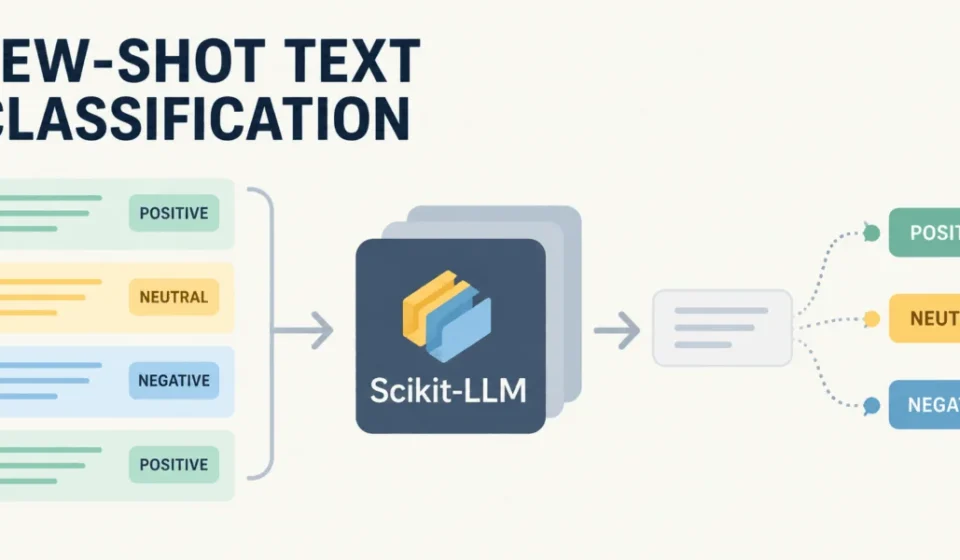
Enter Scikit-LLM, an innovative Python library designed to bridge this critical gap. Scikit-LLM ingeniously wraps the sophisticated functionalities of pre-trained LLMs within the well-recognized and user-friendly interface of the popular scikit-learn library. This integration means that developers can now leverage LLMs using familiar methods like fit() and predict(), significantly lowering the learning curve and accelerating development cycles.
This article delves into the practical application of Scikit-LLM for one of the most impactful text classification tasks in the contemporary AI ecosystem: few-shot classification. This technique allows for the accurate categorization of text based on a very limited number of labeled examples, effectively "teaching" an LLM the specific nuances and requirements of a particular domain or task without the need for extensive retraining.
Understanding Few-Shot vs. Zero-Shot Classification
Before exploring the implementation details, it is crucial to distinguish between few-shot classification and its closely related counterpart, zero-shot classification. Both have gained prominence with the rise of LLMs, but they cater to slightly different needs.
Zero-shot classification enables an LLM to classify text into categories it has not been explicitly trained on, relying solely on its general understanding of language and the provided category descriptions. This is powerful for broad, general-purpose classification tasks.
In contrast, few-shot classification leverages a small set of labeled examples to guide the LLM’s understanding for a specific, often more specialized, task. This approach is particularly advantageous for highly domain-specific applications where texts may contain unique jargon, subtle edge cases, or nuanced sentiments that a general-purpose LLM might otherwise misinterpret. The inclusion of just three to five well-chosen labeled examples can be sufficient to imbue a pre-trained LLM with the necessary contextual knowledge to perform accurate classification, all without the computationally expensive and time-consuming process of fine-tuning the entire model. Scikit-LLM simplifies this powerful technique, making it accessible to a wider audience.
Empowering Few-Shot Classification: A Step-by-Step Implementation with Scikit-LLM
This practical demonstration can be easily replicated within a Google Colab notebook environment, offering a readily accessible platform for experimentation. For this example, we will utilize Groq’s LLM API, which provides access to powerful models, including a free tier, making it an attractive option for developers.
Prerequisites:
To begin, users must register on the Groq website and generate a unique API key. This key is essential for authenticating access to their API services. Once generated, it is imperative to copy this API key securely. In Google Colab, this is achieved by navigating to the "Secrets" section (represented by a key icon on the left-hand sidebar) and creating a new secret variable. This variable should be named GROQ_API_KEY to ensure proper integration.
Installation:
The first step in setting up our environment is to install the Scikit-LLM library. This can be done with a simple pip command in the Colab notebook:
!pip install scikit-llm -qScikit-LLM is designed to be compatible with OpenAI-compatible LLM endpoints. Groq’s API falls under this category, allowing for seamless integration. The subsequent code snippet demonstrates how to securely retrieve the Groq API key from Google Colab Secrets and configure Scikit-LLM to connect to the Groq endpoint:
from google.colab import userdata
from skllm.config import SKLLMConfig

# Retrieve the API key securely from Google Colab Secrets
groq_key = userdata.get('GROQ_API_KEY')

# Point scikit-LLM to Groq's OpenAI-compatible endpoint
SKLLMConfig.set_gpt_url("https://api.groq.com/openai/v1")
SKLLMConfig.set_openai_key(groq_key)
Dataset Preparation for Few-Shot Learning:
The core advantage of few-shot classification lies in its minimal data requirements. Unlike traditional supervised learning, which demands vast labeled datasets, few-shot learning thrives on a small, representative collection of examples. This curated set serves as the "teaching material" for the LLM.
For our demonstration, we will simulate a common IT support scenario, aiming to classify incoming support tickets into three distinct categories: "Hardware," "Software," and "Access." In alignment with scikit-learn conventions, we will define our few-shot examples and their corresponding labels as X_train and y_train, respectively. We will also prepare X_test, a set of unlabeled tickets that we intend to classify.
# Our "Few-Shot" examples to teach the model the nuances
X_train = [
    "My laptop screen is flickering heavily.",
    "I need a new mouse, the scroll wheel is broken.",
    "Excel keeps crashing every time I open a macro.",
    "How do I update to the latest version of Photoshop?",
    "I forgot my VPN password.",
    "Can you grant me admin rights to the shared drive?"
]

y_train = [
    "Hardware",
    "Hardware",
    "Software",
    "Software",
    "Access",
    "Access"
]

# The unseen data we want to actually predict
X_test = [
    "The keyboard types double letters randomly.",
    "I am locked out of my email account.",
    "Zoom freezes when I share my screen."
]
Leveraging FewShotGPTClassifier:
Scikit-LLM provides a specialized class, FewShotGPTClassifier, tailored for this task. This class acts as a powerful wrapper, encapsulating a chosen compatible LLM – such as Groq’s openai/gpt-oss-20b model – within a task-specific layer. This abstraction allows developers to interact with the LLM as if it were a standard scikit-learn model, utilizing its familiar fit() and predict() methods.
from skllm.models.gpt.classification.few_shot import FewShotGPTClassifier

# Use a confirmed free-tier model on Groq, ensuring the custom_url:: prefix is present
# The custom_url:: prefix is crucial for directing Scikit-LLM to the specific endpoint.
clf = FewShotGPTClassifier(model="custom_url::openai/gpt-oss-20b")

# "Train" the model by constructing the few-shot prompt memory
clf.fit(X_train, y_train)
It is important to note that the fit() method in this context does not involve traditional model training, such as updating weights. Instead, it focuses on constructing a "few-shot prompt memory." This memory stores the labeled examples provided, which the LLM will then reference to reason about and generate its responses for new, unseen data. This mechanism is central to how LLMs perform few-shot learning.
Generating Predictions:
With the model "trained" (i.e., its few-shot prompt memory populated), the next step is to obtain predictions for our unlabeled test data. This is achieved by simply calling the predict() method:
# Generate predictions
predictions = clf.predict(X_test)

# Display the results
for text, label in zip(X_test, predictions):
    print(f"Ticket: 'text'nPredicted Category: labeln")
The output of this process is remarkably insightful, demonstrating the effectiveness of few-shot learning facilitated by Scikit-LLM:
Ticket: 'The keyboard types double letters randomly.'
Predicted Category: Hardware

Ticket: 'I am locked out of my email account.'
Predicted Category: Access

Ticket: 'Zoom freezes when I share my screen.'
Predicted Category: Software
As the results show, the model accurately classifies all three IT support tickets into their respective categories, aligning perfectly with our expectations and showcasing the power of providing just a few examples.
Broader Implications and the Future of Text Classification
The demonstration highlights a significant shift in how we can approach complex AI tasks. Scikit-LLM’s elegant design democratizes the use of powerful LLMs for domain-specific applications like few-shot classification. The ability to achieve high accuracy with minimal labeled data, without the need for extensive model retraining or reliance on large, proprietary paid models, has profound implications.
This approach drastically reduces the barriers to entry for businesses and developers looking to leverage AI for text analysis. Tasks that were once prohibitively expensive and time-consuming can now be implemented relatively quickly and cost-effectively. The implications extend beyond IT support ticket classification; this methodology can be applied to a vast array of problems, including sentiment analysis for niche markets, customer feedback categorization, legal document review, and even medical text analysis, where labeled data is often scarce and highly specialized.
The trend towards few-shot and zero-shot learning, amplified by tools like Scikit-LLM, suggests a future where AI models are more adaptable and require less upfront data engineering. This fosters a more agile and iterative development process, allowing for rapid prototyping and deployment of AI solutions. As LLMs continue to evolve, libraries like Scikit-LLM will play an increasingly vital role in translating their cutting-edge capabilities into practical, real-world applications, making advanced AI more accessible and efficient than ever before.
The author, Iván Palomares Carrascosa, is recognized as a leader, writer, speaker, and advisor in the fields of Artificial Intelligence, Machine Learning, Deep Learning, and Large Language Models. His work focuses on empowering individuals and organizations to harness the power of AI effectively in practical scenarios.