
The rapid integration of "agentic AI" into production infrastructure has outpaced many industry predictions, transitioning from theoretical research to practical deployment across diverse sectors. Systems capable of autonomous planning, tool utilization, and iterative goal achievement are now integral to code review pipelines, research assistance platforms, customer operations, and internal automation tools within organizations of all sizes. This widespread adoption, however, highlights a significant engineering challenge: the substantial leap from creating compelling demonstrations to deploying agents that function reliably in real-world, high-stakes environments. The complexities of state management, failure recovery, sandboxed execution, and the evaluation of multi-step operational sequences, rather than isolated outputs, represent a distinct class of engineering hurdles.
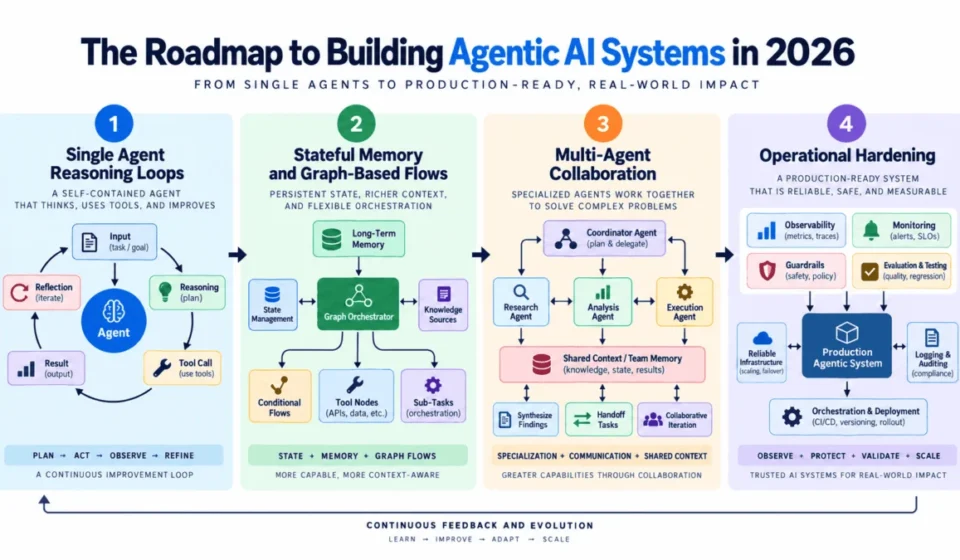
This roadmap outlines a four-tiered progression of system complexity, guiding developers from an in-depth understanding of individual agent cognitive architectures to the design, hardening, and meticulous observation of comprehensive multi-agent systems.
Step 1: The Foundation of Agentic AI – Cognitive Architectures and Tool Interaction
The initial and most critical phase in developing agentic AI systems is establishing a profound understanding of how a single agent operates. Within the AI domain, an "agent" is defined as a system that perceives its environment, makes strategic action selections, executes these actions through defined tools, and leverages the outcomes to inform subsequent decisions. This continuous feedback loop, repeated over numerous steps, fundamentally distinguishes an agent from a conventional, single-turn language model interaction.
Several key reasoning paradigms underpin the structure of this operational loop. These include:
- Reasoning and Acting (ReAct): This foundational paradigm, articulated in research such as the seminal "ReAct: Synergizing Reasoning and Acting in Language Models" paper, emphasizes the synergistic interplay between an agent’s reasoning capabilities and its ability to perform actions. The agent alternates between generating thoughts (reasoning) and taking actions (tool use), creating a more dynamic and effective problem-solving process.
- Plan-and-Execute: In this approach, an agent first formulates a comprehensive plan to achieve a goal and then systematically executes the steps outlined in that plan. This can be effective for tasks with clearly defined sub-goals.
- Hierarchical Task Networks (HTNs): HTNs represent tasks as hierarchical structures, breaking down complex goals into smaller, more manageable sub-tasks. This allows for more sophisticated planning and decomposition.
Beyond the core reasoning mechanisms, structured tool interaction emerges as a second pivotal concept. Modern agents engage with external tools via function-calling protocols. The AI model outputs a structured command, specifying a defined function (e.g., web search, code execution, database query), receives the resultant data, and integrates this information into its subsequent reasoning cycle. Robust output validation, often implemented using libraries like Pydantic or TypeChat, is paramount. This ensures that malformed tool calls do not propagate and trigger cascading failures throughout the agent’s operational pipeline. For instance, a malformed search query could lead to erroneous data retrieval, impacting all subsequent decision-making.
Dynamic context assembly represents the third significant challenge. Long-running agents consume computational resources, particularly tokens, with each operational loop. Effectively managing what information is retained within the context window at each step, what gets summarized for brevity, and what is retrieved from persistent memory rather than being held directly in immediate memory is a practical systems problem. This directly influences both the operational cost of the agent and the coherence of its output over extended periods.
Consider the following Python code snippet illustrating structured tool call validation using Pydantic:
from pydantic import BaseModel
from typing import Literal
import json

class SearchToolCall(BaseModel):
    tool: Literal["web_search"]
    query: str
    max_results: int = 5

class CodeToolCall(BaseModel):
    tool: Literal["run_python"]
    code: str
    timeout_seconds: int = 30

# Example of raw, potentially malformed tool output
raw_output = '"tool": "web_search", "query": "2026 AI benchmarks", "max_results": 3'

# Strict validation before execution
try:
    call = SearchToolCall(**json.loads(raw_output))
    print(f"Validated tool call: call")
    # Proceed with tool execution
except Exception as e:
    print(f"Tool call validation failed: e")
    # Handle the error gracefully
This validation mechanism is crucial for preventing a wide spectrum of runtime failures in the continuous operation of agentic loops.
Recommended Resources for Step 1:
- The original ReAct paper ("ReAct: Synergizing Reasoning and Acting in Language Models") provides the theoretical underpinnings of this paradigm.
- The LangChain documentation offers comprehensive guidance on agents and their tool-use capabilities.
- The Pydantic documentation details effective patterns for output validation.
Portfolio Exercise for Step 1:
Develop a single-agent system capable of answering multi-hop research questions by integrating web search functionality with a calculator tool. Crucially, log every reasoning step and tool call made by the agent to a persistent file for later analysis.
Step 2: Enhancing Resilience – Stateful Memory and Graph-Based Control Flows
A single-loop agent that fails to maintain context between tool calls is inherently brittle. The subsequent level of agent design focuses on endowing systems with persistent memory that endures across operational steps and transitioning from linear execution chains to more adaptable, graph-based control flows.
Memory in agentic systems typically manifests in three distinct forms:
- Episodic Memory: This refers to the agent’s ability to recall specific past interactions, queries, and their associated outcomes. Techniques like vector embeddings and similarity searches are often employed to store and retrieve relevant past experiences.
- Working Memory: This is a more transient form of memory, holding information relevant to the current task or immediate context. It might include intermediate results, current goals, and recently executed actions.
- Long-Term Memory: This encompasses a broader repository of knowledge, learned behaviors, and general world understanding that the agent can draw upon. This can be achieved through fine-tuning models or integrating with external knowledge bases.
The shift from linear chains to graph-based execution is as significant as the introduction of memory. Linear chains, where operations follow a strict A -> B -> C sequence, are simple but lack flexibility. Real-world tasks often involve branching logic; for instance, a research agent might pursue one course of action if a particular source is found and an entirely different path if it is not. Frameworks like LangGraph are designed to model these execution flows as directed acyclic graphs (DAGs) or, where iterative processes are required, as cyclical state machines. Microsoft’s AutoGen offers a similar capability with a distinct user ergonomic model, facilitating complex multi-agent conversations and task delegation.
State persistence is a key differentiator for production-grade agentic systems compared to experimental prototypes. The ability to checkpoint the agent’s state at each operational step unlocks three vital capabilities:
- Rollback: The system can revert to a previous, stable state if an error or unexpected event occurs, preventing complete task failure.
- Resumption: Paused runs can be seamlessly resumed, which is critical for long-running tasks, tasks requiring human approval gates, or scenarios involving system restarts.
- Debugging: Branching execution paths can be meticulously reconstructed and analyzed post-execution, greatly simplifying the identification of root causes for errors.
The following Python code demonstrates a basic LangGraph state machine, showcasing typed state management, which forms the bedrock for constructing more sophisticated agentic workflows:
from langgraph.graph import StateGraph, END
from typing import TypedDict, List

class AgentState(TypedDict):
    query: str
    search_results: List[str]
    final_answer: str

def search_node(state: AgentState) -> AgentState:
    # Placeholder for actual search logic
    print("Executing search node...")
    results = ["result_1 from search", "result_2 from search"]
    return **state, "search_results": results

def answer_node(state: AgentState) -> AgentState:
    # Placeholder for actual answer generation logic
    print("Executing answer node...")
    answer = f"Based on len(state['search_results']) results, the answer is..."
    return **state, "final_answer": answer

# Initialize the graph
graph = StateGraph(AgentState)

# Add nodes to the graph
graph.add_node("search", search_node)
graph.add_node("answer", answer_node)

# Define edges to connect nodes
graph.add_edge("search", "answer")
graph.add_edge("answer", END) # End the graph after the answer node

# Set the entry point for the graph execution
graph.set_entry_point("search")

# To run the graph:
# from langgraph.checkpoint.memory import MemorySaver
# app = graph.compile(checkpointer=MemorySaver())
# inputs = "query": "What is the capital of France?"
# for output in app.stream(inputs):
#     print(output)
This example illustrates a foundational pattern for building complex agentic flows, emphasizing structured state management.
Recommended Resources for Step 2:
- The LangGraph documentation and conceptual guides are essential for understanding graph-based execution.
- The AutoGen paper and its associated GitHub repository offer insights into conversational AI agents.
- The book "Building LLM-Powered Applications" by Valentina Alto provides broader architectural context for LLM applications.
Portfolio Exercise for Step 2:
Enhance the single-agent research system developed in Step 1 by incorporating vector-based episodic memory. Implement functionality to store past queries and their corresponding results, and then retrieve relevant past information when processing new queries. Benchmark the system to determine if memory retrieval demonstrably improves answer quality, particularly in areas that have been previously researched.
Step 3: Collaborative Intelligence – Multi-Agent Systems and Protocol Design
When the complexity or scale of a task exceeds the capabilities of a single agent, the next logical progression involves designing teams of specialized agents that collaborate effectively. This approach is crucial for tackling problems too large or intricate for one system to manage autonomously.
The initial design decision in a multi-agent setting pertains to team topology:
- Swarm: In this model, a large number of agents work collectively, often with less defined roles, towards a common goal. This is suitable for tasks requiring broad coverage or parallel processing.
- Federated: Agents operate semi-autonomously within their specialized domains but share information and coordinate efforts through defined protocols. This is common in scenarios with distinct functional areas.
- Hierarchical: Agents are organized in a hierarchy, with a leader agent overseeing and delegating tasks to subordinate agents. This structure is effective for complex, multi-stage processes.
Inter-agent communication protocol design is an often-underappreciated but absolutely essential element. Agents that communicate solely through unstructured text are prone to accumulating errors during handoffs, leading to misinterpretations and operational inefficiencies. Establishing structured message schemas for task assignments, status updates, and result reporting, coupled with explicit task handoff contracts, significantly reduces coordination failures.
Conflict resolution becomes a necessary consideration when specialized agents produce divergent or conflicting outputs. For instance, a "critic" agent might reject a "coder" agent’s proposed solution, or a "research" agent might uncover evidence that contradicts a "planner" agent’s initial assumptions. The system must incorporate defined mechanisms for handling these divergences, which could include:
- Voting mechanisms: Agents can vote on the most plausible outcome.
- Re-querying: The system can initiate further investigation or clarification, providing the conflicting context to the relevant agents.
- Escalation to human review: For critical decisions or intractable conflicts, human oversight can be integrated.
The Model Context Protocol (MCP), an initiative championed by Anthropic, offers a standardized interface for connecting agents to external tools and data sources. Its growing adoption as a cross-vendor standard for agent tool integration aims to streamline interoperability and reduce the friction in developing complex agent ecosystems.
Recommended Resources for Step 3:
- The AutoGen paper’s section on conversation patterns provides valuable insights into designing multi-agent dialogues.
- The CrewAI documentation offers a high-level orchestration framework for multi-agent systems.
- The MCP specification and ecosystem documentation are crucial for understanding standardized agent communication.
Portfolio Exercise for Step 3:
Construct a three-agent system comprising a "researcher," a "writer," and a "critic." The objective is to produce a structured report on a given topic. Design the system such that the critic agent rejects the writer’s initial draft at least once, and meticulously trace how the system recovers from this rejection to ultimately produce a finalized report.
Step 4: Production Readiness – Operational Hardening, Sandboxing, and Observability
A multi-agent system that performs admirably in a development environment but falters unpredictably in production is not a complete product. This final stage addresses the engineering practices necessary to ensure agentic systems are reliable, secure, and debuggable at scale.
Runaway loop mitigation is a primary operational concern. Agents that lose track of their objectives, encounter unexpected tool outputs, or become trapped in self-reinforcing reasoning loops can consume unbounded computational resources, leading to excessive token usage and prolonged execution times. Robust infrastructure must incorporate:
- Circuit breakers: These halt execution after a predefined number of failed steps.
- Recursion depth caps: Limiting the depth of recursive calls prevents infinite loops.
- Dynamic token expenditure ceilings: Setting limits on token consumption per operation or per session.
These safeguards should be considered fundamental infrastructure components, not afterthoughts.
Sandboxed code execution is non-negotiable for any agent possessing code execution capabilities. Permitting an agent to run arbitrary Python code on a shared server poses significant security risks. Isolated execution environments, such as Docker containers, cloud sandboxes like e2b, or WebAssembly runtimes, provide the necessary confinement to allow agents to write and execute code safely without compromising the integrity of the host system.
Observability is an area where many early agentic deployments fall short. Evaluating the quality of a multi-step agent trajectory requires more than simply inspecting the final output. Tools like LangSmith and Arize Phoenix offer execution graph tracing capabilities. These tools record every agent step, tool call, and intermediate state, making it possible to pinpoint precisely where in a trajectory an agent deviated from its intended path—not merely whether the final answer was correct.
Trajectory-level evaluation, which assesses the efficiency and correctness of the entire execution path rather than solely the terminal output, is emerging as the standard for gauging the quality of production-grade agentic systems.
The following code snippet demonstrates how to integrate LangSmith tracing into agent operations:
from langsmith import traceable

@traceable(name="research_agent_step", run_type="chain")
def research_step(query: str, step_number: int) -> dict:
    # Placeholder for the agent's actual research logic
    print(f"Performing research step step_number for query: query")
    # Simulate some agent work
    result = "step": step_number, "query": query, "status": "completed", "data_found": "relevant_info"
    return result

# All calls to research_step will now be automatically traced in LangSmith
try:
    output = research_step("AI safety benchmarks 2026", step_number=1)
    print(f"Research step output: output")
except Exception as e:
    print(f"An error occurred during research step: e")
Wrapping agent steps with decorators like LangSmith’s @traceable enables comprehensive trajectory tracing with minimal code modifications, significantly enhancing debuggability and performance analysis.
Recommended Resources for Step 4:
- The LangSmith documentation on tracing and evaluation provides in-depth guidance.
- Arize Phoenix documentation offers insights into open-source observability solutions.
- The e2b documentation details secure cloud sandbox execution environments.
- The book "Reliable Machine Learning" by Cathy Chen et al. offers a broader perspective on production systems context.
Portfolio Exercise for Step 4:
Take the multi-agent system developed in Step 3 and integrate LangSmith tracing into every agent’s operational step. Execute the system for ten distinct test cases and then conduct a thorough trajectory analysis to identify the most prevalent failure points within the execution graph.
Conclusion: Building for Reliability
Agentic AI systems signify a profound shift in software behavior, moving from passive tools that respond to queries to active systems that pursue goals across extended time horizons. This evolution introduces a commensurate increase in engineering responsibility. The four levels of this roadmap are structured by increasing complexity, but they are also ordered by the sequence in which failures typically manifest. Agents lacking structured validation falter on malformed outputs. Those without robust state management lose coherence during extended tasks. Agent systems without disciplined protocol design accumulate errors across handoffs. Critically, all agentic systems without comprehensive observability infrastructure become intractable to debug when issues arise.
Each layer of development must be approached deliberately. The investment made in hardening at each stage directly compounds into enhanced reliability at subsequent levels. As Vinod Chugani, an AI and data science educator specializing in agentic AI, emphasizes, "Build each layer deliberately. The investment in hardening at each level compounds directly into reliability at the next." This methodical approach is key to unlocking the full potential of agentic AI in production environments.