The AI Data Center Dilemma: Who Pays for the Power, Water, and the Future of Our Grids?

John Steinbach’s electricity bill in Manassas, Virginia, more than doubled in January 2026, jumping from approximately $100 to $281. "It’s just so far beyond any bill that I’ve ever had," he told Consumer Reports, expressing deep concern about future rate hikes as more Artificial Intelligence (AI) data centers connect to the local power grid. Steinbach’s experience is far from isolated. A March 2026 Gallup poll revealed that a staggering seven in 10 Americans oppose the construction of AI data centers in their communities, with 48% expressing strong opposition across the political spectrum – Democrats, Republicans, and Independents alike.
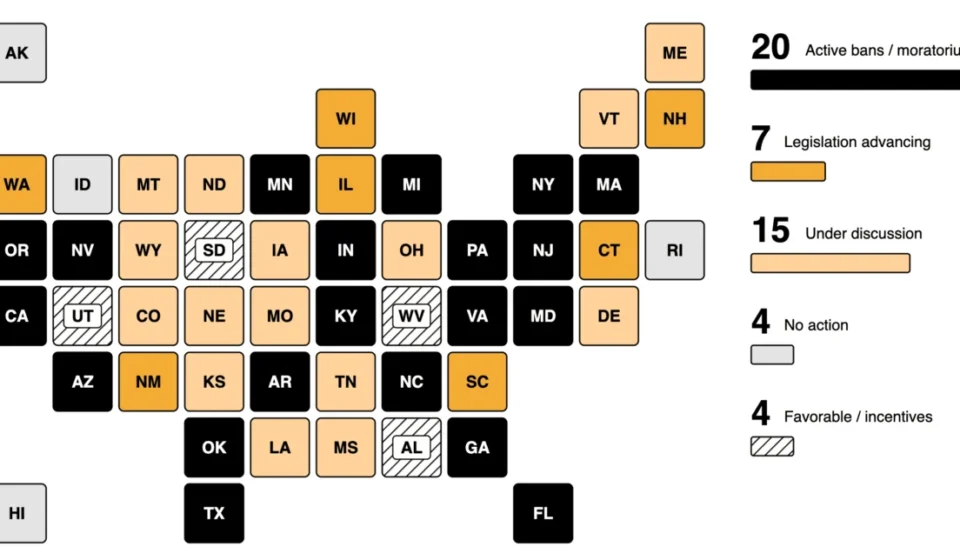
This widespread public sentiment has translated into tangible opposition to development. Data Center Watch reported that in the first half of 2026, local opposition disrupted approximately 120 data center projects, with at least 45 projects, valued at around $68 billion, being stalled in the second quarter alone. The trend is so pronounced that 379 U.S. jurisdictions have implemented moratoriums or outright bans on data centers. Indianapolis, for instance, voted 23-1 in August to halt new data center construction through 2027. Similarly, Charlotte enacted a 150-day pause on approvals following a city survey indicating 78% public opposition. Brookings notes that data centers have become a significant campaign issue, with candidates from both major parties running advertisements against these facilities in the lead-up to the 2026 midterm elections.
While the debate often centers on whether these facilities should be built, a more fundamental and pressing question lies beneath: who bears the costs, and who holds the decision-making power? The immediate financial and environmental burdens are borne locally, while the perceived benefits are often regional or national and realized over a longer timeframe. Crucially, the regulatory frameworks governing the distribution of these costs and benefits were established in an era predating the current AI-driven surge in demand. This article delves into the multifaceted conflict surrounding data centers, examining the arguments from critics, the industry’s perspective, and the emerging evidence.
The AI Revolution’s Impact on Infrastructure Demands
The advent of AI has fundamentally altered the operational calculus for data centers. Unlike traditional cloud data centers, which manage variable workloads on general-purpose servers, AI clusters are characterized by densely packed Graphics Processing Units (GPUs). These clusters generate significantly more heat per rack and consume power continuously, particularly during intensive training phases. This concentrated demand places unprecedented strain on local power grids and water systems.
In 2023, U.S. data centers consumed an estimated 176 terawatt-hours of electricity, accounting for roughly 4.4% of the nation’s total electricity consumption, according to a report by Lawrence Berkeley National Laboratory for the Department of Energy. The projected growth, however, is the focal point of considerable debate. Bloom Energy’s January 2026 power report forecasts a near doubling of U.S. data center IT load, from approximately 80 gigawatts in 2025 to around 150 gigawatts by 2028. While Bloom Energy, a seller of on-site power systems, has a vested interest in this forecast, the underlying trend is supported by broader industry observations.
A significant bottleneck has emerged in power delivery. Utilities are anticipating delivery of power 1.5 to 2 years later than data center developers initially planned. This delay is prompting some companies to explore building their own power generation facilities, with forecasts suggesting that roughly one-third of data centers might operate entirely on on-site power by 2030.
Electricity Costs: The Burden of the Evolving Grid
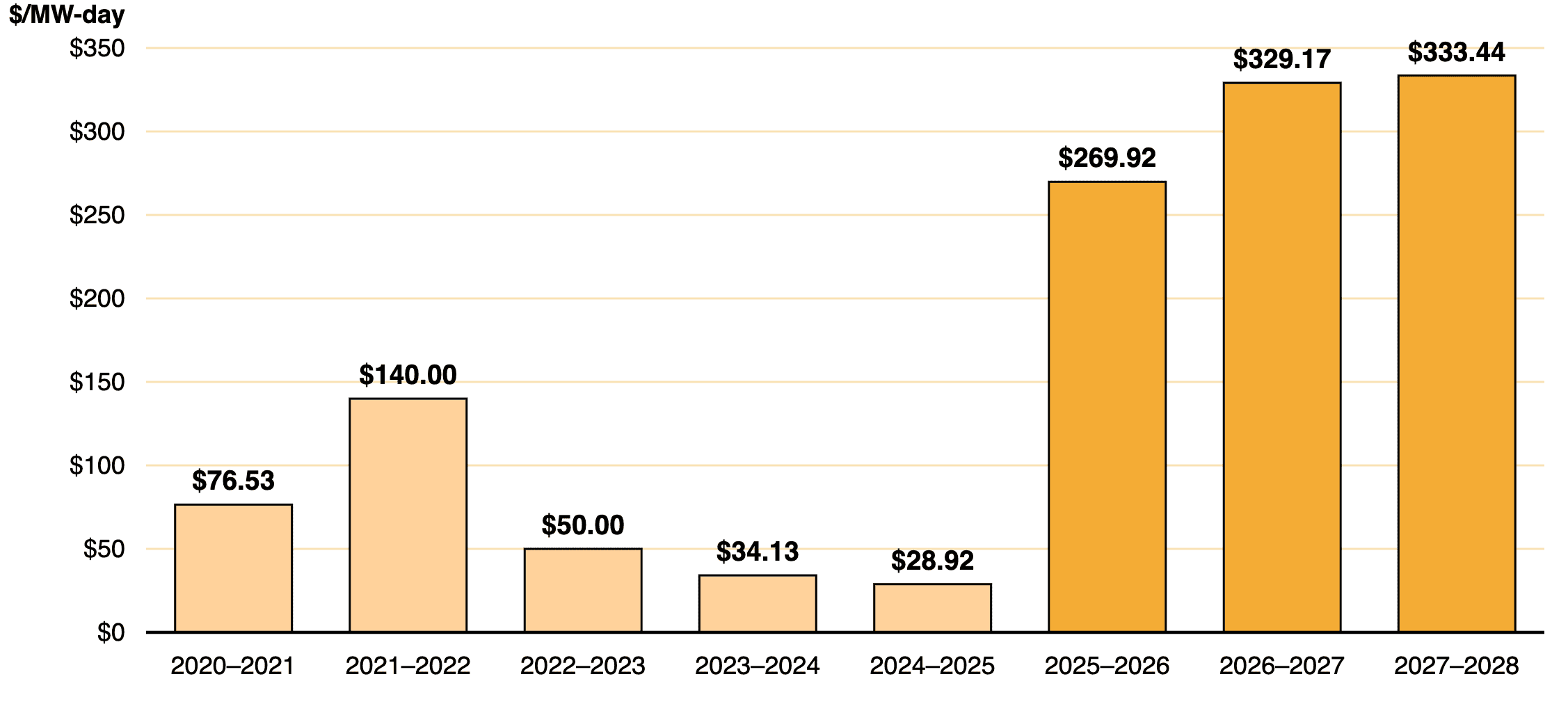
The financial implications are most acutely felt in regional electricity markets. PJM, the grid operator responsible for power in 13 states and Washington D.C., utilizes capacity auctions to incentivize power plants to remain available during peak demand. The clearing price for these auctions has seen a dramatic escalation. For the 2024/25 period, the price was $28.92 per megawatt-day, soaring to $269.92 for 2025/26. Subsequent auctions hit the price cap at $329.17 and $333.44. PJM’s independent market monitor attributed 63% of the 2025/26 increase, totaling approximately $9.3 billion, directly to data center load growth.
Evidence from Virginia corroborates this trend. According to EIA data, residential electricity prices in the state rose by about 13% over a 12-month period. A January 2026 survey conducted by Global Strategy Group and the Chesapeake Climate Action Network Action Fund found that nearly three-quarters of Virginia voters blamed data centers for these rising costs.
Looking ahead, a peer-reviewed study involving researchers from NC State, Carnegie Mellon, and other universities projects a national increase in wholesale electricity prices ranging from 6% to 29% by 2030 compared to a scenario without data center expansion. In the most heavily impacted regions, this increase could reach up to 57%. It is important to note that these figures represent wholesale prices and may not directly translate to retail consumer bills.
The industry counters that large customers typically contribute to lower overall rates. A study by the Electric Power Research Institute (EPRI) covering 2015 to 2024 indicated that for every doubling of data center capacity, average retail electricity prices decreased by 3.5%. This phenomenon is explained by the argument that large, consistent power demands help to spread a utility’s fixed infrastructure costs across a larger customer base.
An Amazon-funded analysis by the consultancy E3 suggested that Amazon’s payments in four utility territories met or exceeded the costs of serving its data centers, generating an average net surplus of approximately $3.4 million per site. A separate E3 report, commissioned by the Data Center Coalition, estimated that load growth accounted for about 50% of the PJM increase in 2025/26, a figure lower than the independent market monitor’s assessment. Furthermore, the free-market oriented Institute for Energy Research found no statistically significant correlation between a state’s data center density and its electricity prices.
Rutgers’ New Jersey State Policy Lab reported in 2024 that data centers had not yet had a statistically significant impact on utility-level electricity bills, while cautioning that " ‘not yet’ is not the same as ‘nothing to worry about.’ " The historical argument for data centers lowering rates relied on existing grid capacity. However, with significant grid expansion now required, the fixed costs associated with this new infrastructure will inevitably be spread among a smaller number of customers if demand projections fall short. Compounding this, Berkeley Lab’s 2026 price-trends update highlights rising expenditures on transmission and distribution infrastructure for hardening, replacement, and expansion. Therefore, the critical question shifts from whether data centers have already increased bills to who will ultimately fund the necessary grid modernization and expansion.
Water Resources: National Totals Mask Local Stress
Water-cooled data centers can consume millions of gallons of water daily, a figure that becomes particularly concerning in water-scarce regions. Arizona, for example, is grappling with a federal plan that mandates a 760,000 acre-feet reduction in its Colorado River water allocation, representing a cut of approximately 27% to 30%.

This context has heavily influenced local decision-making. In August 2025, Tucson’s city council unanimously rejected Amazon’s "Project Blue" following intense community pressure. The following December, Chandler rejected another data center proposal with a 7-0 vote. In Florida, Orange County’s vice mayor has proposed a one-year moratorium on data centers, citing a projected groundwater shortfall of 96 million gallons per day by 2045.
A viral claim suggesting that each 100-word AI prompt consumes half a liter of water, originating from a GPT-4 era estimate by UC Riverside researchers, has fueled public concern. However, Google’s 2025 figure for a median Gemini text prompt is approximately 0.26 milliliters, roughly five drops, though this metric primarily accounts for on-site water usage.
The scale of water consumption remains a significant factor. Berkeley Lab estimates that U.S. data centers directly utilized about 17.5 billion gallons of water in 2023, a figure that could potentially double or quadruple by 2028. Jim Pethokoukis of the American Enterprise Institute, cited by The Dispatch, places data centers’ share of U.S. freshwater consumption below 0.5% and compares the water usage of Google’s Iowa facility to that of several golf courses.
An Arizona State University report found no increase in water usage by central Arizona power suppliers despite the growth of data centers in the region. It also notes that agriculture accounts for 72% of the state’s water consumption. However, a more comprehensive analysis reveals a different picture: Berkeley Lab also estimates approximately 211 billion gallons of indirect water use through power generation in 2023.
The evidence strongly suggests that national water usage figures obscure localized stress. In Botetourt County, Virginia, a planned Google data center campus could consume up to 2 million gallons of water per day, potentially rising to 8 million gallons. This is particularly impactful in a county where many residents rely on private wells. To address this, the county is investing $300 million in a new regional water supply, which is intended to be offset by the project’s tax revenue.
Economic Benefits: Jobs and Tax Revenue – A Tale of Two Arguments
The argument for data centers is often anchored in their potential to generate significant tax revenue and economic development. Across Northern Virginia, data centers reportedly paid an estimated $1.3 billion in property taxes in 2024, with total supported local revenue exceeding $2 billion, according to the Chamber of Progress, a technology industry advocacy group.
Quincy, Washington, presents a compelling case study. In this small agricultural town, approximately 30 data centers contribute an estimated 57% of the property tax base. This revenue has funded substantial community investments, including a $120 million high school, a hospital, new police and fire stations, and a $30 million water reuse facility developed in partnership with Microsoft, as reported by CNN and KOMO News.
Industry figures in Texas claim that in 2023, data centers supported 61,060 direct jobs and generated $3.5 billion in state and local taxes. A proposed $10 billion campus in Lacy Lakeview, a town of roughly 7,000 residents, is projected to contribute $50 million annually in local revenue. Even Virginia’s legislative auditors ranked the state’s data center tax exemption as its second-most productive incentive, yielding $6.1 million in personal income for every $1 million in forgone revenue.
However, the argument for widespread job creation is less robust. A Brookings analysis of approximately 1,500 data center facilities found that the introduction of a large data center in a county typically adds between 100 and 200 jobs over a decade, with no discernible impact on wage levels.
The thresholds for state incentives reflect this reality. Texas offers sales tax exemptions for facilities exceeding 100,000 square feet that create 20 jobs. Maryland requires five jobs and $2 million in investment in its Tier 1 areas for similar tax incentives. While construction jobs are significant, they are temporary, ending with the completion of the facility.
Consequently, states are re-evaluating their incentive programs. Governors in Illinois, Massachusetts, Nebraska, Nevada, and Ohio have either paused or revised their data center tax breaks. Arizona has frozen new awards for three years, according to the Arizona Capitol Times. Virginia, while retaining its exemption, has introduced a tax of 1.1 cents per kilowatt-hour on data center electricity consumption, effective from July 2026 to June 2028, with an annual cap of $600 million.
Air Quality and On-Site Power: The Memphis Example
The situation in Memphis, Tennessee, offers a stark illustration of what can occur when companies prioritize speed over conventional grid connections. To power its Colossus 1 supercomputer in 2024, xAI deployed trailer-mounted methane gas turbines in South Memphis, near the historically industrial Boxtown community. The Southern Environmental Law Center (SELC) identified as many as 35 such turbines through aerial imaging. For its Colossus 2 project, xAI located turbines just across the state line in Southaven, Mississippi, with 46 units operating by May 2026.
Initially classified as "non-road engines," these units allowed xAI to bypass air permit requirements. However, an EPA rule issued in January 2026 clarified that large turbines function as stationary sources and necessitate permits. SpaceX, which acquired xAI in February 2026, currently operates 69 turbines and has indicated it will not fully remove the unpermitted units until July 2027. The company is also constructing a permanent 1.2-gigawatt gas plant. The NAACP, represented by SELC and Earthjustice, has filed a lawsuit against xAI under the Clean Air Act.
The company has found an unexpected ally in the Justice Department, which intervened on xAI’s behalf in June, citing the turbines’ role in "national, economic, and energy security." While third-party tests have indicated that the measured pollutants were not at dangerous levels, SELC noted that ozone was not tested, and wind conditions on test days may have skewed results. Proponents of rapid deployment argue that grid connections can take years, while AI competition necessitates swift action.
Studies on the environmental impact have yielded conflicting results. An analysis by the University of Tennessee, Knoxville, for TIME, using satellite data, found a 3% increase in average nitrogen dioxide levels after June 2024, with peak concentrations rising by 79% directly around the site and 9% in Boxtown. Researchers at the University of Memphis, publishing in The Conversation, modeled a roughly 1% increase in fine particulate matter and observed no significant changes in satellite data, though they acknowledged their methods could not detect several hazardous compounds.
While the average localized effects appear modest, they are superimposed on an area already exceeding federal air quality standards. Furthermore, these emissions originate from a facility that circumvented the standard permitting process designed to address such issues. A more common, albeit quieter, concern arises from facilities like the proposed Trident campus in Aurora, Colorado, which plans to install 28 diesel backup generators.
Local Autonomy: The Struggle for Community Input
A significant portion of the public backlash stems from concerns about process and transparency, in addition to environmental and economic impacts. Before Applied Digital’s $3.6 billion Louisiana campus, known as Delta Forge 1, was publicly announced, it operated under nondisclosure agreements (NDAs) signed by state senators, the parish assessor, and members of the approving board, as reported by NPR. In contrast, Hut 8’s $10 billion project in West Feliciana Parish proceeded without NDAs, as the parish president opted for open negotiations. Legislative efforts to ban such agreements are underway in Michigan, Oklahoma, Kentucky, and Ohio, and Pennsylvania Governor Josh Shapiro has prohibited state agencies under his purview from entering into them.
Zoning regulations can also effectively disenfranchise residents. In Aurora, Colorado, Vantage’s proposed 500-megawatt Trident campus could be approved administratively, without public hearings, due to existing zoning that permits data centers. This site is located across from a residential development, and the campus is projected to consume approximately 11 times the power of Denver International Airport.
Local control faces significant limitations, which developers often test. Hill County, Texas, initially passed a moratorium on data centers by a 3-2 vote, only to rescind it two weeks later after a developer filed a lawsuit seeking over $100 million. The county subsequently adopted a checklist for developers, requiring them to report expected water use, traffic, noise, and economic impacts, along with providing public notice to nearby residents. Tom Green County, Texas, also abandoned plans for its own moratorium. Inver Grove Heights, Minnesota, took a different approach, enacting a moratorium by a 3-2 vote in June, despite a developer’s letter threatening over $150 million in damages. Charlotte is navigating a similar dilemma, with city staff recommending an extension of the current pause by up to eleven months, pending a public hearing and council vote.
States are increasingly asserting control over these decisions. In August, Texas Governor Greg Abbott ordered an audit of all data centers seeking grid connections, and in September, the state halted all state permitting for data center projects pending the completion of these audits. As of June, 14 states had considered moratoriums, according to the Rockefeller Institute, with MultiState counting moratorium bills in 11 states, many of which face considerable opposition. Pro-growth advocates, including The Dispatch, warn that blocking projects domestically will simply lead them to relocate overseas, taking jobs and tax revenue with them.
Understated Risks: The Demand Equation for Both Sides
A shared assumption between data center critics and proponents is the inevitability of continued demand growth. McKinsey’s widely cited estimate projects global data center capital spending to reach approximately $6.7 trillion by 2030, with arguments for construction often taking this scale of demand as a given. Opponents, too, tend to view this growth as an unassailable certainty.
However, if this projected demand falls short, the associated costs do not disappear. Utilities that invest in generation and transmission infrastructure for projects that are later scaled back or canceled must recoup these expenditures, inevitably spreading fixed costs across a reduced customer base. This reality underscores the growing importance of policy discussions around minimum payment guarantees and exit clauses. Virginia regulators, for instance, now require the largest customers to cover at least 85% of their contracted transmission and distribution demand and 60% of their generation demand, irrespective of actual usage.
Conclusion: Navigating the Future of Data Center Development
The strongest evidence presented by both critics and industry advocates points toward a consistent pattern: the immediate costs associated with data centers are largely local and short-term, encompassing capacity charges, water infrastructure, air permits, and land use. Conversely, the perceived benefits are predominantly regional or national and materialize over a longer horizon. The existing regulatory frameworks for distributing these costs and benefits were formulated prior to the current AI-driven surge in demand. Therefore, neither the narrative of "data centers are universally destructive" nor "opposition is merely NIMBYism" holds up under scrutiny.
The issues unfold consistently across various aspects of data center development. While studies have not yet conclusively linked data centers to measurably higher residential electricity bills, the capacity market has already seen significant price adjustments. Water usage, though a small fraction of national totals, represents a significant local burden, as exemplified by the $300 million investment required for a new water supply in Botetourt County, Virginia. The tax base generated by data centers is substantial, yet the number of permanent jobs created remains relatively low.
Current policy initiatives emerging from state legislatures are primarily focused on addressing this cost-benefit imbalance. For communities considering a data center proposal, a crucial question emerges: if the projected demand for AI computing power does not materialize, who will bear the financial responsibility for the substantial infrastructure upgrades undertaken in anticipation?
Data centers will undoubtedly continue to be built. The central challenge lies in ensuring that their development is accompanied by equitable cost allocation, addressing the concerns of local communities and securing a fair outcome for all stakeholders. The question is not whether more data centers will be built, but whether the next wave will arrive with a truly fair and sustainable financial framework.