Vice President JD Vance Announces Major Investigation into J-1 Visa Abuse at Nine Prominent Universities

Vice President JD Vance declared Thursday that nine leading universities are currently under investigation by the Department of Labor for alleged abuses of the J-1 visa program, a critical exchange visitor initiative designed to facilitate temporary educational and cultural exchange. Speaking at a press conference focused on visa fraud, Vance, who chairs the administration’s task force dedicated to eliminating fraud, accused certain institutions of manipulating the program to suppress the wages of American workers, particularly graduate students and researchers. Subpoenas have reportedly been served to the implicated higher education institutions, signaling a significant escalation in the administration’s scrutiny of academic hiring practices and federal grant utilization.
The Allegations Unveiled: Undercutting American Wages
At the heart of the investigation are accusations that universities are disproportionately employing J-1 visa holders for federally funded grants, far exceeding national averages. Vice President Vance specifically pointed to data indicating that the nine targeted institutions utilize J-1 visas for federally funded grants at an approximate rate of 61 percent, starkly contrasting with the national average of 38 percent. "Something weird is going on at these universities," Vance stated, suggesting a deliberate strategy to "bring in foreigners to undercut the wages of American residents." He further alleged that American graduate students and researchers typically earn $20,000 more annually than individuals working under J-1 visas in comparable roles, implying a systemic wage disparity exploited by these institutions.
The universities named in the probe include some of the nation’s most prestigious academic powerhouses: Arizona State University, Brown University, Harvard University, Yale University, Stanford University, the California Institute of Technology (Caltech), the Massachusetts Institute of Technology (MIT), the University of California, Davis, and the University of Pittsburgh. This high-profile list underscores the broad reach and potential impact of the investigation across the American higher education landscape.
Understanding the J-1 Exchange Visitor Program
The J-1 visa, part of the Exchange Visitor Program, is administered by the U.S. Department of State and was established under the Mutual Educational and Cultural Exchange Act of 1961 (often referred to as the Fulbright-Hays Act). Its primary objective is to promote mutual understanding between the people of the United States and other countries through educational and cultural exchanges. The program encompasses a wide array of categories, including students, scholars, professors, research scholars, short-term scholars, specialists, and interns, among others. For academic institutions, the J-1 visa is particularly vital for bringing in international professors, researchers, and specialists who contribute to cutting-edge research, diversify academic perspectives, and fill specialized roles that may be challenging to staff domestically.
Historically, the J-1 program has been lauded for fostering international collaboration, enhancing the global competitiveness of U.S. research, and enriching the educational experience for both foreign and domestic participants. According to the Department of State, hundreds of thousands of exchange visitors participate annually, contributing significantly to America’s scientific and intellectual prowess. The integrity of this program is crucial not only for diplomatic relations but also for the continued flow of global talent into U.S. academic and research ecosystems. The current allegations, if proven, would represent a significant deviation from the program’s intended purpose of cultural exchange and mutual benefit.
The Enforcement Drive: Department of Labor’s Unyielding Stance
Leading the charge in this investigation is the Department of Labor, with its Inspector General, Anthony D’Esposito, pledging a rigorous and uncompromising inquiry. D’Esposito characterized the probe as a "historic investigation into J-1 visa fraud," vowing to "follow the money and uncover the schemes." His rhetoric at the press conference was particularly forceful, emphasizing accountability regardless of an institution’s prestige or influence. "I don’t care how prestigious a university thinks it is," D’Esposito declared. "Break the law and screw the American people, and I will personally cuff you in the university square. I don’t care how large your endowment is, how powerful your alumni are or how many politicians you have on speed dial."
This aggressive stance underscores the administration’s commitment to rooting out perceived fraud within federal programs and protecting the domestic workforce. D’Esposito also broadened the scope of concern, stating that the investigation would explore "whether foreign influence, improper financial relationships, or visa abuse are compromising federally funded research," explicitly pointing to concerns about China. This suggests that the probe extends beyond mere wage concerns to potential national security implications and the protection of intellectual property generated through U.S. taxpayer-funded research. The serving of subpoenas indicates the formal initiation of a discovery process, compelling universities to provide extensive documentation related to their J-1 visa programs and federally funded grants.
Targeted Institutions Respond: Defending Compliance and Contributions
In the wake of the Vice President’s announcement, several of the implicated universities swiftly issued statements, largely asserting compliance with all applicable laws and regulations while defending the invaluable contributions of their international scholars.
A spokesperson for Brown University confirmed receipt of a subpoena and stated, "Brown’s international scholars, students and employees make essential contributions on our campus, including to teaching and research that advances American innovation, competitiveness and economic vitality. We have received a subpoena from the government for various records pertaining to foreign labor programs administered by the U.S. government, and we will respond promptly and directly to the government." This response highlights the dual commitment to cooperation with the investigation and advocacy for the role of international talent.
Arizona State University, a significant hub for STEM education and research, emphasized its extensive contributions to the national economy. An ASU spokesperson noted that the university educates more STEM majors than any other institution and employs one of the largest technical and scientific workforces in the country. "This benefits both the Arizona and the United States economies and in doing so, ASU has hired the talent needed to perform these functions and done so in complete compliance with existing United States policy and law," the spokesperson affirmed, underscoring their adherence to legal frameworks while meeting talent demands.
Stanford University also issued a concise statement, reiterating its compliance with all applicable visa laws and pledging full cooperation with the federal investigation. Similarly, Kimberly Allen, Executive Director of Media Relations at MIT, confirmed that the university is reviewing a "very broad" subpoena from the Labor Department. Allen underscored the rigorous vetting process for J-1 visa holders by the U.S. government and articulated MIT’s stance: "We value international students and scholars on our campus. America’s ability to attract top talent from around the world while protecting U.S. economic and security interests is a national strength, and that competitive advantage should be supported." These institutional responses collectively convey a message of compliance, cooperation, and a strong defense of the merits of international academic exchange.
Background to the Investigation: A Broader "America First" Agenda
This investigation does not occur in a vacuum but is firmly situated within the administration’s broader "America First" policy framework, which prioritizes domestic workers and aims to curb perceived abuses across various immigration programs. Vice President Vance’s role as chair of the "Task Force to Eliminate Fraud," established in March 2026, signals a concerted effort to scrutinize and reform systems deemed vulnerable to exploitation. The task force’s mandate extends across federal programs, with immigration and visa programs often being a focal point due to their direct impact on the U.S. labor market.

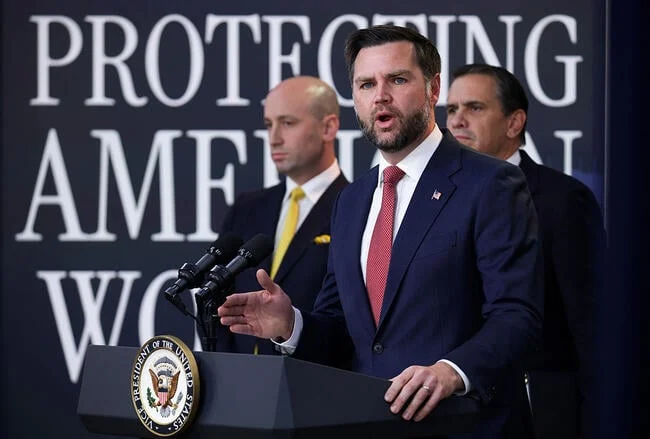
The administration has previously expressed concerns about other visa categories, such as the H-1B visa for skilled foreign workers and the F-1 Optional Practical Training (OPT) program for international students, alleging similar patterns of wage suppression and displacement of American workers. This consistent messaging forms the ideological backdrop for the current J-1 visa probe, framing it as a necessary measure to protect American jobs and taxpayers’ investments in federally funded research. The visual backdrop at the press conference, a banner proclaiming "Protecting American Workers," further reinforced this central theme.
Broader Context: Immigration, Academia, and Global Competitiveness
The delicate balance between attracting top global talent and safeguarding domestic employment has long been a subject of debate in the United States. U.S. universities are global leaders in research and innovation, and a significant portion of their scientific output, particularly in STEM fields, is attributed to international scholars and graduate students. These individuals often bring specialized skills, diverse perspectives, and contribute to research teams that secure billions of dollars in federal grants annually.
According to various studies, international students and scholars contribute billions to the U.S. economy through tuition, living expenses, and research contributions. Their presence is also seen as crucial for maintaining America’s competitive edge in scientific discovery and technological advancement. Many groundbreaking innovations in the U.S. have been pioneered or significantly advanced by foreign-born researchers. The current investigation, while focusing on potential abuse, inevitably raises questions about its broader implications for this vital ecosystem. If the flow of international talent is curtailed or made more challenging, there are concerns it could diminish the capacity of U.S. institutions to conduct world-leading research, potentially ceding ground to competitor nations.
Potential Implications for Higher Education and Research
The investigation carries significant implications for U.S. higher education, potentially reshaping how universities engage with international scholars and manage federally funded research.
Impact on Research and Innovation
A primary concern is the potential chilling effect on international academic collaboration. Should universities face heightened scrutiny, punitive measures, or more restrictive visa policies, it could deter foreign researchers from choosing the U.S. This, in turn, could slow down research progress, particularly in fields heavily reliant on international expertise, such as advanced computing, biotechnology, and renewable energy. Federal funding for research, often tied to specific projects and personnel, could also be impacted if institutions are found non-compliant.
University Operations and Compliance Burden
Universities will face substantial administrative and legal burdens in responding to comprehensive subpoenas. This includes compiling vast amounts of data on personnel, visa statuses, funding sources, and grant expenditures. The legal costs associated with such an investigation could be considerable, diverting resources from academic and research pursuits. Furthermore, the reputational damage, regardless of the investigation’s outcome, could affect institutions’ ability to attract both domestic and international talent.
International Students and Scholars Community
The probe could create an environment of uncertainty and apprehension for international students and scholars already in the U.S. or considering coming. Concerns about visa restrictions, increased scrutiny, and potential challenges to their academic and professional pathways could lead many to explore opportunities in other countries with more stable and welcoming immigration policies.
Domestic Workforce Dynamics
From the administration’s perspective, a successful investigation could be touted as a victory for American graduate students and researchers, potentially leading to policy changes that prioritize domestic talent for federally funded positions. If the allegations of wage suppression are substantiated, it could prompt reforms aimed at ensuring equitable compensation across all employment categories within academia.
The Road Ahead: Legal and Political Ramifications
The path forward for this investigation is likely to be complex and protracted. The Department of Labor’s Inspector General’s office will meticulously examine financial records, employment contracts, visa applications, and grant agreements. Potential outcomes could range from significant fines and compliance agreements for universities found in violation, to more severe penalties, including potential criminal charges for individuals or institutions if deliberate fraud is uncovered.
Politically, the investigation serves multiple purposes for the administration. It reinforces its commitment to protecting American workers, appeals to a base concerned about immigration’s impact on domestic jobs, and signals a tougher stance on institutional accountability. The explicit mention of "foreign influence" and China by D’Esposito also aligns with broader geopolitical concerns, adding another layer of complexity to the probe.
Higher education advocacy groups, such as the American Council on Education (ACE) and NAFSA: Association of International Educators, are expected to monitor the investigation closely. They will likely emphasize the importance of international exchange for national prosperity and intellectual leadership, advocating for due process and caution against measures that could inadvertently harm the U.S.’s standing in global academia. Immigration legal experts will also be analyzing the nuances of J-1 visa regulations and the legal precedents that could emerge from this "historic investigation."
Conclusion
The federal investigation into J-1 visa abuse at nine prominent U.S. universities marks a significant development in the ongoing discourse surrounding immigration, labor, and higher education. Led by Vice President JD Vance and the Department of Labor, the probe alleges systemic wage undercutting of American workers through the misuse of a program intended for cultural and educational exchange. While universities assert compliance and highlight the vital contributions of international scholars, the aggressive stance of federal investigators signals a determined effort to enforce regulations and protect domestic labor interests. The outcomes of this investigation could profoundly impact the operational frameworks of U.S. academic institutions, influence the flow of global talent, and potentially reshape the landscape of federally funded research for years to come.