Word Wipe: A Digital Mirror Reflecting the Erosion of Academic Freedom and Free Expression in 2026.

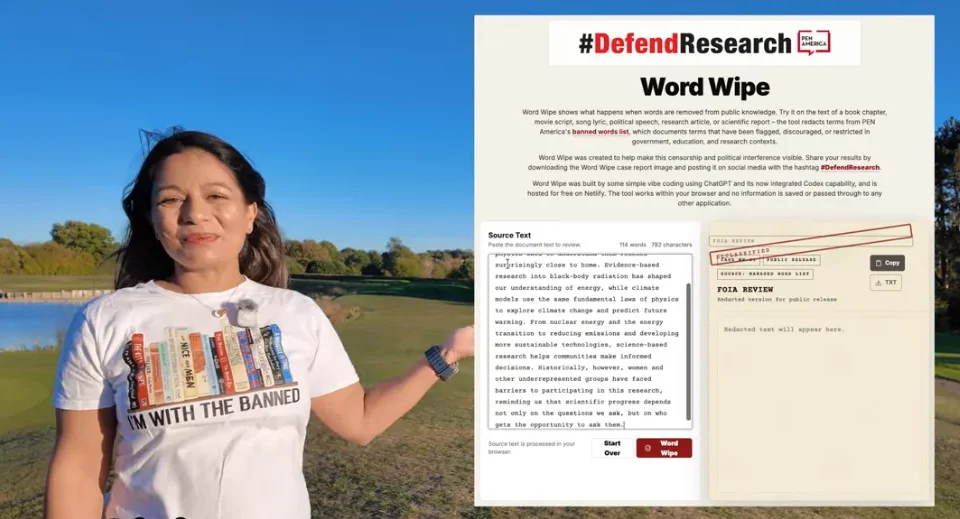
In an era marked by escalating concerns over governmental interference in scientific discourse and public information, a new collaborative initiative has emerged to starkly illustrate the potential future of suppressed knowledge. Launched as a pivotal component of the "Fall of Freedom 2026" campaign, the "Word Wipe" tool, developed jointly by #DefendResearch and PEN America, serves as a digital looking glass into a world where critical terminology is systematically redacted from public and scholarly texts. Spearheaded by Chef Alice Meadows and guest chef Suze Kundu, a renowned science communicator and research community engagement consultant – both contributing in a personal capacity as members of the #DefendResearch team – Word Wipe is a potent reminder of the ongoing challenges to research integrity and free expression under the continuing Trump administration.
The Intensifying Climate of Censorship and its Roots
The development and launch of Word Wipe did not occur in a vacuum but against a backdrop of increasing apprehension within scientific and academic communities regarding the politicization of data and language. For years, observers have noted a worrying trend of governmental agencies attempting to control the narrative around sensitive topics, often by dictating acceptable terminology or suppressing research findings deemed inconvenient to political agendas. This phenomenon gained significant traction during previous administrations, but the period leading up to and including 2026 under the renewed Trump administration has seen these efforts intensify, leading to a palpable sense of alarm among researchers, educators, and free speech advocates.
Early warning signs emerged as far back as 2017-2020, when reports surfaced of federal agencies like the Centers for Disease Control and Prevention (CDC) being advised against using terms such as "fetus," "transgender," "vulnerable," "entitlement," "diversity," "evidence-based," and "science-based." While these initial instances were often framed as guidance for budget documents, the implications for broader scientific communication and policy formulation were profound. Over time, this evolved into more direct and widespread directives, impacting environmental science, public health, and social research. Scientists reported feeling pressured to alter language in grants, presentations, and publications, or even to avoid certain research areas altogether to secure funding or avoid scrutiny. This created a chilling effect, where self-censorship became a survival mechanism, ultimately compromising the objectivity and comprehensiveness of publicly funded research.
The "Fall of Freedom 2026" campaign, of which Word Wipe is a part, represents a concerted effort to push back against these encroachments. It underscores a collective belief that the freedom to research, communicate findings without political interference, and engage in open intellectual discourse are fundamental pillars of a democratic society and essential for addressing complex global challenges.
Genesis of Word Wipe: A Collaborative Stand for Truth
The "Word Wipe" tool is the tangible outcome of a strategic alliance between #DefendResearch and PEN America, two organizations committed to safeguarding intellectual freedom and transparent communication. #DefendResearch coalesced as a grassroots movement comprising scientists, academics, and concerned citizens dedicated to protecting the integrity of scientific research from political manipulation. Its mission centers on advocating for evidence-based policymaking, defending academic freedom, and ensuring the unfettered dissemination of scientific knowledge.
PEN America, a venerable organization championing free expression and literary freedom, brought its extensive experience in documenting and combating censorship to the partnership. PEN has long maintained a comprehensive "banned words list," meticulously compiled from official directives, leaked documents, and testimonies from affected individuals across various sectors. This list serves as a critical barometer for measuring the extent of linguistic control being exerted by governmental bodies. By collaborating, #DefendResearch and PEN America sought to transform this static list into an interactive and immediately impactful demonstration tool. Suze Kundu, celebrated for her ability to distill complex scientific concepts into accessible formats, was instrumental in conceptualizing the user-friendly interface and practical application of Word Wipe. Chef Alice Meadows, drawing on her own experiences within the research community, helped ensure the tool resonated with the specific challenges faced by academics and researchers.
The core idea was simple yet powerful: to allow anyone to experience firsthand the impact of these linguistic prohibitions. By pasting any text – be it a research article, a poem, a historical document, or even a personal email – into the Word Wipe interface, users can instantly visualize how their communication would be altered, redacted, and ultimately diminished under the current regime’s linguistic strictures.
Mechanics and Demonstrative Power of Word Wipe
Word Wipe is designed for maximum accessibility and impact. Its user interface is straightforward: a text box for source material and a prominent "Word Wipe" button. Once activated, the tool rapidly scans the submitted text against PEN America’s meticulously maintained list of banned words and phrases. Terms such as "abortion," "women and underrepresented," "continuum," "field drainage," "peanut allergy," "diversity," "evidence-based," "science-based," "Black," and "people of color" are among those flagged and redacted. The tool then presents the modified text, with censored words replaced by blank spaces or redaction marks, alongside a count of how many words were removed.
The power of Word Wipe lies in its ability to personalize the abstract concept of censorship. Users are often struck by the sheer volume and seemingly arbitrary nature of the redacted terms. For instance, the original article highlights the ironic revelation that even some of the President’s own Executive Orders, such as a September 2026 directive on "Accelerating Access to Veterans Benefits and Employment Opportunities," would be heavily censored if subjected to the Word Wipe filter. This self-contradictory outcome underscores the pervasive and often illogical nature of such linguistic controls, demonstrating that the directives are not merely about precision or avoiding certain topics, but rather about asserting ideological dominance over language itself.
Consider a scientific paper on climate change: terms like "continuum" (referring to gradual environmental shifts) or "evidence-based" (describing methodology) could be redacted, fundamentally undermining the paper’s scientific rigor and clarity. A public health report discussing maternal mortality might find "women" and "underrepresented" censored, stripping away crucial demographic identifiers. Even seemingly innocuous phrases like "peanut allergy," a personal favorite mentioned by the authors, can fall victim to the purge, indicating an almost absurd level of linguistic control that extends beyond overtly political topics into areas of basic health and safety.
The contrast with non-banned terms further illuminates the ideological underpinnings of this censorship. While "women" and "Black" are targeted, "man" and "white" are typically not, pointing to a deliberate effort to suppress discussions around gender equality, racial justice, and diversity initiatives. This selective censorship does not merely remove words; it actively reshapes narratives, stifles critical analysis, and ultimately seeks to control thought by controlling its expression.
Broader Implications for Research, Society, and Democracy
The implications of such pervasive linguistic control extend far beyond the inconvenience of academic writing; they threaten the very foundations of scientific progress, public health, and democratic governance.
Impact on Research Integrity and Funding: When key terms are banned, researchers face an impossible dilemma. They must either self-censor, thereby compromising the accuracy and completeness of their work, or risk losing crucial funding and publication opportunities. This directly undermines the integrity of research, particularly in fields like climate science, social justice, and public health, where the "banned words" are often central to understanding and addressing critical issues. How can meaningful research on health disparities be conducted if terms like "diversity" or "underrepresented" are off-limits? The ability to present "evidence-based" or "science-based" conclusions is fundamental to scientific credibility, and their suppression can erode public trust in scientific findings.
Academic Freedom and the Chilling Effect: The fear of using "wrong" words creates a chilling effect across academia. Scholars may shy away from certain research topics, avoid collaborations, or dilute their findings to conform to linguistic mandates. This stifles innovation, discourages critical inquiry, and ultimately impoverishes the intellectual landscape. The freedom to pursue knowledge wherever it leads, and to communicate those findings openly, is a cornerstone of academic life.
Public Understanding and Policy-Making: Censoring scientific terminology has direct consequences for public understanding and informed policy-making. If government reports and public health advisories are stripped of essential context and precise language, the public’s ability to grasp complex issues is hampered. Policymakers, too, are deprived of accurate and comprehensive information, leading to decisions based on incomplete or biased data, with potentially severe societal repercussions. For example, suppressing terms related to "field drainage" could hinder effective agricultural policy, while limiting discussions on "continuum" could impede understanding of long-term environmental trends.
Diversity, Equity, and Inclusion (DEI) Initiatives: The targeted banning of words like "diversity," "underrepresented," "Black," and "people of color" is a direct assault on efforts to promote equity and address systemic inequalities. These terms are foundational to understanding demographic shifts, social justice issues, and the need for inclusive practices across all sectors. Their removal signals a governmental disinterest, or even opposition, to these critical societal goals.
Timeline of Escalating Concerns (Inferred from Article Context):
- 2024 Presidential Election: Re-election of the Trump administration sets the stage for intensified policies regarding scientific communication and federal agency directives.
- Early 2025: Initial reports and internal memos begin circulating within federal agencies, advising against or prohibiting the use of specific terms in official documents, grant proposals, and public communications.
- Mid-2025: Scientific organizations and academic bodies begin to voice public concerns regarding the increasing politicization of science and potential impacts on research funding and integrity. #DefendResearch likely begins to formalize its structure and advocacy efforts.
- Late 2025: PEN America’s banned words list is updated to reflect the expanding scope of linguistic prohibitions, drawing attention from wider media and advocacy groups.
- Spring 2026: Preparations for "Fall of Freedom 2026" begin, with #DefendResearch and PEN America collaborating on educational tools and public awareness campaigns.
- September 2026: "Fall of Freedom 2026" officially launches, with Word Wipe being a central feature, alongside other initiatives aimed at exposing and combating censorship. The President’s Executive Order mentioned in the article is issued, providing a timely example for Word Wipe’s demonstration.
Statements and Reactions from Related Parties
The launch of Word Wipe and the broader "Fall of Freedom 2026" campaign have garnered significant attention and varied reactions.
Scientific and Academic Organizations: Groups such as the American Association for the Advancement of Science (AAAS), the Union of Concerned Scientists, and various disciplinary academic associations have released statements expressing profound concern over the escalating censorship. They typically reiterate the importance of scientific independence, evidence-based policy, and the right of researchers to communicate their findings freely. Many have praised Word Wipe as an effective educational tool, underscoring its capacity to make the abstract threat of censorship concrete and relatable. "The ability to accurately describe our world and our research is not a privilege, but a fundamental necessity for scientific progress and public well-being," stated a spokesperson for a leading scientific society, advocating for the protection of open scientific discourse.
Free Speech Advocates: Organizations like the American Civil Liberties Union (ACLU) and PEN America itself have consistently highlighted the dangers of governmental control over language as an infringement on free speech. They view the banned words list, and tools like Word Wipe, as critical instruments for defending the First Amendment. "When the government dictates what words can or cannot be used, it’s not just controlling communication; it’s attempting to control thought itself," commented a PEN America representative, emphasizing the insidious nature of linguistic censorship.
Government Response (Inferred): Official government responses to criticisms of censorship have often been dismissive, framing such directives as efforts to ensure "clarity," "efficiency," or to avoid "politically charged" language. Administration spokespersons might argue that these are internal communications guidelines, not censorship, or that they are merely streamlining communication to better serve the public. However, critics argue that the selective nature of the banned words reveals a clear ideological agenda rather than a neutral pursuit of clarity.
Public and Grassroots Engagement: The tool has been widely shared across social media platforms, sparking conversations and raising awareness among a broader public audience. Many users express shock and frustration upon seeing their own texts redacted, confirming the visceral impact of the tool. The sentiment often aligns with the spirit of "good trouble," as advocated by the late Congressman John Lewis – using peaceful, creative means to challenge injustice and spark necessary dialogue.
Conclusion: A Call to Vigilance and "Good Trouble"
Word Wipe stands as more than just a digital tool; it is a potent symbol and a call to action. By making the invisible hand of censorship visible, it empowers individuals to understand the profound implications of linguistic control on scientific integrity, academic freedom, and democratic discourse. The tool’s ability to render tangible the absurdity and danger of political interference in language serves as a crucial educational and advocacy instrument in the "Fall of Freedom 2026" campaign.
The message from Chef Alice Meadows, Suze Kundu, and the entire #DefendResearch team is clear: active vigilance is required to protect the spaces where knowledge is generated and shared. Playing with Word Wipe, sharing its results within communities, and engaging in the conversations it provokes is presented not merely as an exercise in digital curiosity, but as a form of civic engagement. In the spirit of John Lewis’s enduring legacy, it encourages citizens to make "good trouble" – to peacefully challenge the suppression of truth and to defend the fundamental right to speak, write, and research freely, ensuring that the full spectrum of human knowledge remains accessible and unredacted for future generations. The fight against the erosion of academic freedom and free expression is ongoing, and Word Wipe serves as a stark, interactive reminder of what is at stake.