
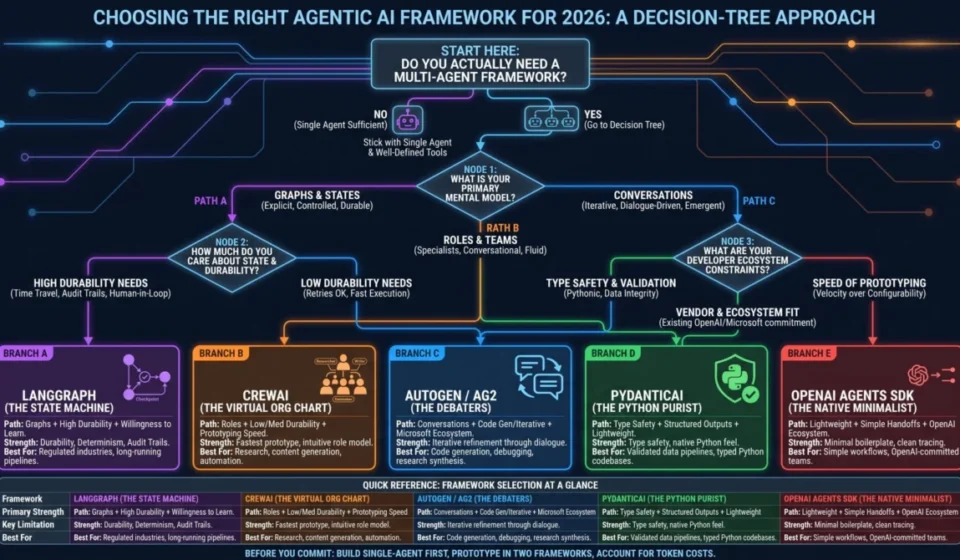
How to Choose the Right Agentic AI Framework for Production Systems in 2026

The landscape of artificial intelligence has shifted fundamentally from isolated Large Language Model (LLM) queries to complex, multi-agent orchestrations that define the modern enterprise technology stack. As of 2026, the initial novelty of "agentic" behavior has been replaced by a rigorous requirement for stability, observability, and cost-efficiency in production environments. For Chief Technology Officers and lead architects, the challenge is no longer merely finding a tool that works, but selecting an orchestration framework that aligns with specific workload requirements, compliance mandates, and long-term scalability. Choosing the wrong framework in this mature market does not just lead to technical debt; it can result in catastrophic failure modes where autonomous agents operate outside of defined guardrails in high-stakes environments.
The Evolution of Agentic Systems: A Brief Chronology
To understand the current selection of frameworks, one must look at the rapid evolution of the field over the last three years. In 2023, the industry saw the emergence of experimental "autonomous" scripts like AutoGPT and BabyAGI. These were largely proof-of-concepts that demonstrated the potential for LLMs to use tools and loop through tasks, but they suffered from infinite loops and high token costs.
By 2024, the focus shifted to "orchestration." Frameworks began to introduce the concept of multi-agent collaboration, allowing developers to break complex tasks into smaller, specialized roles. This era saw the rise of the first generation of LangChain and early iterations of Microsoft’s AutoGen. However, these tools often felt like "black boxes," making it difficult for developers to debug why an agent made a specific decision.
In 2025, the industry reached a "reliability plateau." Frameworks matured to include first-class support for state management, human-in-the-loop (HITL) interventions, and strict type safety. As we move through 2026, the market has bifurcated into specialized branches: those optimized for rigid, deterministic workflows and those designed for fluid, conversational problem-solving.
The Core Conflict: Single-Agent vs. Multi-Agent Architectures
Before an organization commits to a framework, a fundamental architectural audit is required. Industry data suggests that approximately 40% of developers implement multi-agent systems when a single-agent architecture would suffice. A single agent, equipped with a robust set of tools and a clear system prompt, remains the gold standard for simplicity. It offers lower latency, reduced token consumption, and a smaller surface area for errors.
The transition to a multi-agent framework is typically justified only when a single agent hits a "complexity ceiling." This occurs when the prompt context becomes too bloated with conflicting instructions, when the toolset exceeds the model’s reasoning capacity, or when the task requires distinct "personas" (e.g., a "Security Auditor" agent critiquing the work of a "Developer" agent). Once the decision to move to a multi-agent system is finalized, the selection process moves to a structured decision-tree approach.
Node 1: Defining the Primary Mental Model
The most critical factor in framework selection is the developer’s mental model of the workflow. Engineering teams generally categorize their agentic needs into three distinct patterns:
1. Graphs and States (Deterministic Focus):
If a workflow is visualized as a flowchart with explicit transitions, "if-then" logic, and clear success/failure branches, it requires a graph-based framework. This model is essential for tasks where the sequence of operations is as important as the output itself.
2. Roles and Teams (Collaborative Focus):
When the task mimics a human organization—where a "Manager" assigns work to a "Researcher" who then passes a draft to an "Editor"—a role-based framework is superior. This model prioritizes the "hand-off" between specialists.
3. Conversational Iteration (Emergent Focus):
Some tasks, such as code generation or complex creative writing, benefit from agents "talking it out." In this model, structure is not prescribed but emerges through a back-and-forth dialogue until a quality threshold is met.
Node 2: Durability, Persistence, and Compliance
The second node of the decision tree concerns the lifecycle of a task. In production, "durability" refers to the system’s ability to survive a crash or a pause.
For high-durability needs—common in banking, legal, and healthcare sectors—the framework must support "checkpointing." This allows a process to be paused for human approval and resumed hours or days later without losing the execution state. According to a 2025 industry report on AI reliability, systems with built-in state persistence reduced operational recovery time by 65% compared to "stateless" agent systems.
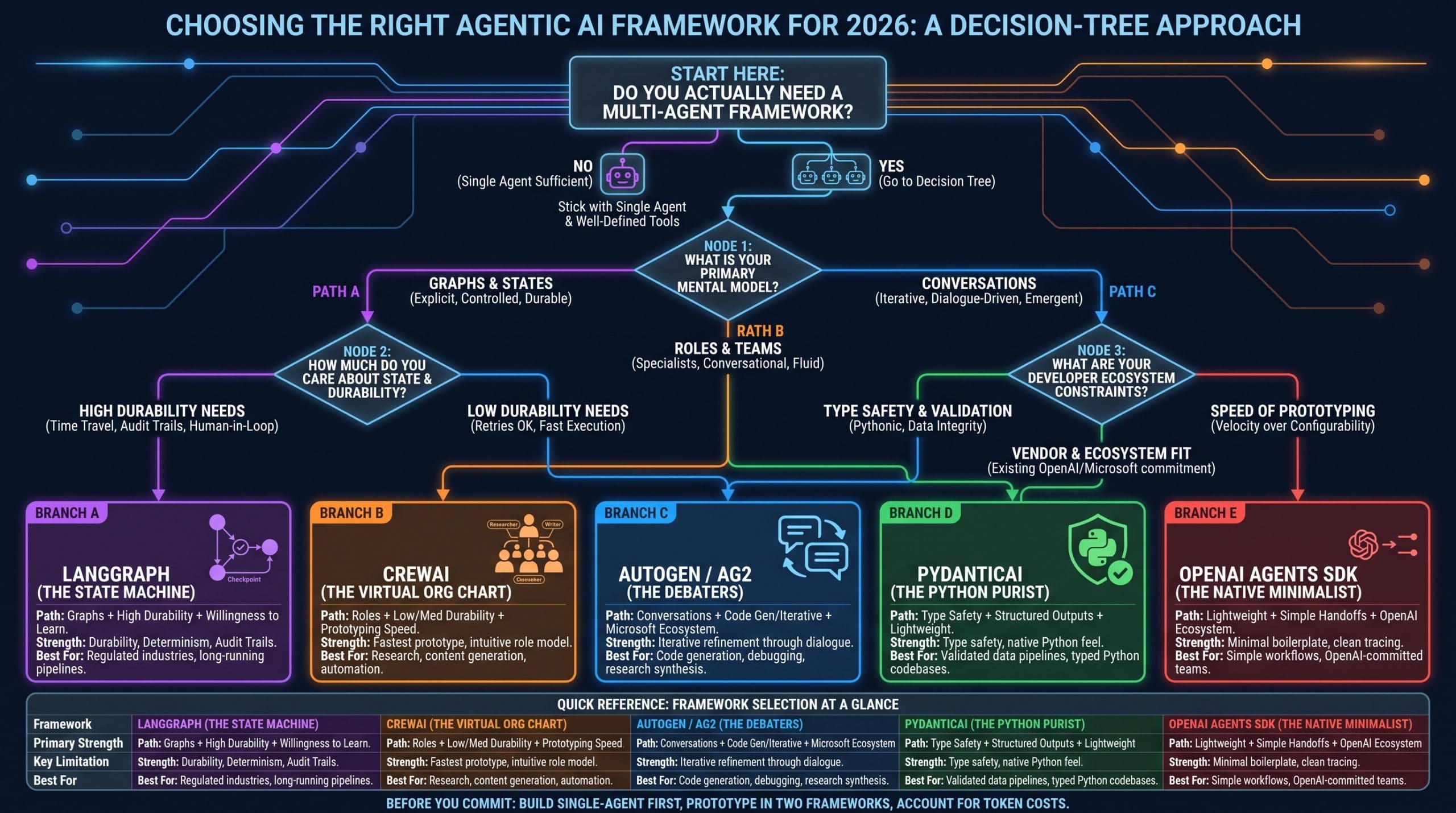
Low-durability workflows are those that execute in real-time, such as customer support chatbots or quick data summarizers. If these fail, the cost of a full retry is negligible, allowing for lighter, faster frameworks.
The Five Primary Framework Branches of 2026
Based on these nodes, the market has settled into five primary branches, each serving a specific niche of the production ecosystem.
Branch A: LangGraph (The State Machine)
LangGraph has emerged as the industry leader for "high-stakes" orchestration. By modeling workflows as explicit directed graphs, it provides developers with granular control over every transition. Its standout feature is "time travel," which allows developers to rewind the state of an agentic run, modify a variable, and re-simulate the outcome.
- Best For: Compliance-heavy industries and long-running workflows.
- Trade-off: High verbosity and a steep learning curve.
Branch B: CrewAI (The Virtual Org Chart)
CrewAI has captured the segment of the market focused on business process automation. By using a "team" metaphor, it allows non-specialist developers to quickly assemble groups of agents with distinct backstories and goals.
- Best For: Marketing, research pipelines, and rapid prototyping.
- Trade-off: Difficulty in constraining agents when they deviate from their assigned roles.
Branch C: AutoGen / AG2 (The Debaters)
AG2, the successor to Microsoft’s AutoGen, remains the premier choice for iterative refinement. It excels at "agent-to-agent" conversation, particularly in technical domains like automated software engineering.
- Best For: Code generation, data analysis, and the Microsoft/Azure ecosystem.
- Trade-off: "Conversational drift," where agents may loop indefinitely without reaching a conclusion.
Branch D: PydanticAI (The Python Purist)
A favorite among backend engineers, PydanticAI prioritizes type safety and structured data. It treats agents as standard Python functions, ensuring that every input and output is validated against a schema.
- Best For: Integrating AI agents into existing, strictly-typed Python applications.
- Trade-off: It lacks built-in orchestration for complex multi-step hand-offs.
Branch E: OpenAI Agents SDK (The Native Minimalist)
For teams fully committed to the OpenAI ecosystem, the official SDK provides the path of least resistance. It offers a streamlined experience with minimal boilerplate code.
- Best For: Simple, linear workflows and internal tools.
- Trade-off: Significant vendor lock-in and limited flexibility for non-OpenAI models.
Supporting Data: Performance and Operational Costs
Data from 2026 production benchmarks highlights the "Agentic Tax"—the hidden costs of multi-agent systems. On average, a multi-agent workflow consumes 3.5 times more tokens than a single-agent equivalent for the same task. Furthermore, latency increases by approximately 40% for every additional agent added to a synchronous loop.
However, the "Accuracy Dividend" often justifies these costs. In complex document extraction tasks, multi-agent "critic" loops (where one agent extracts and another verifies) have shown a 22% reduction in hallucination rates compared to single-agent runs.
Expert Analysis and Industry Implications
Technical analysts suggest that the "framework wars" of the mid-2020s are settling into a period of interoperability. "The choice of framework is becoming less about the library and more about the underlying architecture of the data," says Dr. Aris Chugani, a leading researcher in agentic systems. "In 2026, we are seeing a shift where the framework is simply the ‘glue’ for a much more important asset: the organization’s proprietary state and memory."
The broader implication for the labor market is significant. The role of the "Prompt Engineer" has evolved into the "Agent Architect." This new class of developer must understand distributed systems, state machines, and asynchronous programming as much as they understand linguistics.
Final Recommendations for Implementation
Before committing to a framework, organizations should adhere to three practical mandates:
- Prototype the Failure, Not the Success: When testing a framework, evaluate how it handles a 500-error from an API or a nonsensical LLM response. The "best" framework is the one that makes failure recovery the easiest.
- Evaluate the "Exit Strategy": Avoid frameworks that make it impossible to switch model providers. The volatility of the LLM market requires an orchestration layer that is model-agnostic.
- Monitor the Token-to-Value Ratio: Implement strict observability to ensure that the multi-agent coordination isn’t just "chatting" away the company’s compute budget without a proportional increase in output quality.
As agentic AI continues to integrate into the core of enterprise operations, the selection of an orchestration framework will remain one of the most consequential decisions an engineering team can make. By following a structured decision-tree based on mental models, durability needs, and ecosystem constraints, organizations can build systems that are not only intelligent but resilient and auditable in a production environment.