
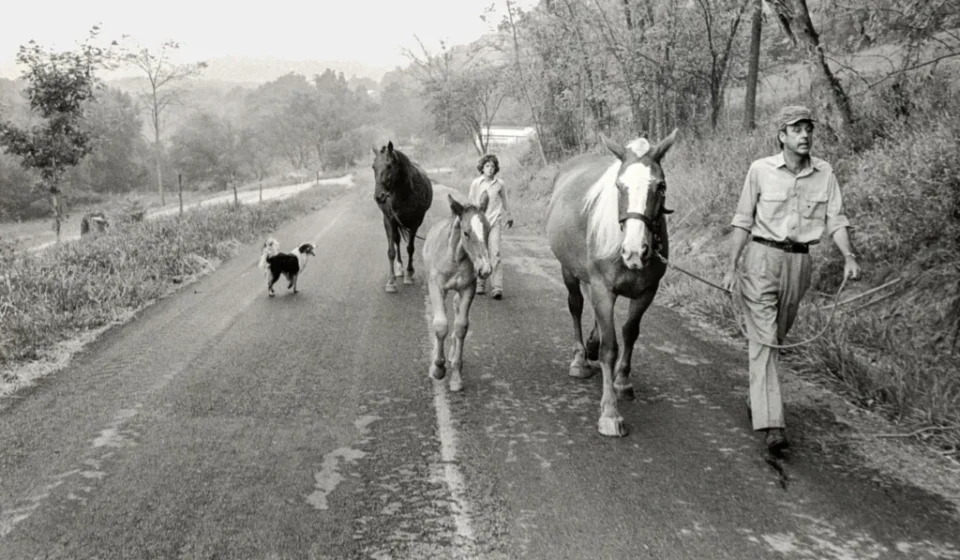

Wendell Berry, the revered writer, farmer, and philosopher whose life and work championed a return to agrarian values and intentional living, died last week at the age of 92. He passed away at his home in Port Royal, Kentucky, a place that became synonymous with his profound connection to the land and his deliberate rejection of modern conveniences. Berry was known for his rigorous farming practices, eschewing electricity in his writing cabin and tending his land with time-honored techniques. His passing marks the end of an era for many who found inspiration in his unwavering commitment to a life lived on purpose.
Berry’s legacy is multifaceted, extending far beyond his sharp critiques of industrial agriculture and his poignant tributes to the enduring strength of family farms and small communities. For individuals not directly involved in food production or unable to relocate to rural settings, Berry’s example offers a compelling blueprint for cultivating a more meaningful existence. His life’s work consistently underscored the profound satisfactions that arise from consciously directing one’s life, a philosophy that resonates deeply in an increasingly disengaged and technologically saturated world.
A Journey Away From and Back to the Land
Berry’s early life hinted at a trajectory towards a distinguished academic career. After obtaining his bachelor’s and master’s degrees from the University of Kentucky, he pursued a master of fine arts in creative writing at Stanford University. His intellectual journey also included a period abroad in Italy and France, supported by a prestigious Guggenheim Fellowship, and subsequently, a professorship at New York University’s Heights campus in the Bronx. During this period, he married and started a family, establishing what appeared to be a conventional path to success.
However, at the age of 29, in 1964, Berry made a decision that would redefine his life and influence generations: he resigned from his position to return to Henry County, Kentucky, the ancestral home of his family, where they had farmed for generations. This pivotal choice represented a deliberate departure from the established markers of professional achievement in favor of a life deeply rooted in place.
The profound nature of this decision was not lost on his contemporaries. As writer David Demaree recounted in a piece for Front Porch Republic, Berry’s supervisor at NYU expressed deep concern over his resignation, viewing it as a forfeiture of immense potential. The senior faculty member, perhaps believing Berry, then under thirty, did not fully comprehend what he was relinquishing, made a final appeal. He warned Berry against abandoning the promise of intellectual engagement in the "cultural springs of the metropolis" for the perceived obscurity and perceived provincialism of rural Kentucky. The supervisor invoked the poignant phrase from Thomas Wolfe’s novel, "You can’t go home again," in an attempt to dissuade him. Yet, Berry remained resolute, his gaze fixed on Kentucky, unmoved by the appeals to conventional success.
Berry’s decision was not an act of romantic escapism, but rather a deeply held conviction. He believed that to write authentically about the intrinsic connection between "people and place," he needed to be immersed in it. He articulated this rationale in a 2018 interview with The New York Times, stating, "The landscape was there to check me if I was wrong. I could never go away and make up stuff at cocktail parties about the backwoods of Kentucky." He emphasized the invaluable lessons learned from working alongside individuals from diverse walks of life in his community, describing the experience as "very rich." This commitment to lived experience over abstract theorizing became a cornerstone of his philosophy.
A World Defined by Numbness and Convenience
The contemporary world, as Berry implicitly and explicitly critiqued, is increasingly characterized by a pervasive sense of numbness and an over-reliance on convenience, often facilitated by digital technologies. The article notes the tendency to employ tools like artificial intelligence to circumvent cognitive effort and the reliance on algorithmically curated content on smartphones to pacify anxious minds. Professional environments are described as increasingly performative, with a cycle of digital communication—Slacks about emails about Zoom meetings—that often culminates in auto-transcribed summaries and PowerPoint presentations that receive little genuine engagement. Political discourse, too, has been reduced to a simplistic binary, fostering a form of "cosplay as radicals" from the perceived safety of social media platforms.
Berry’s perspective offers a stark contrast to these prevailing trends. He recognized the allure of such conveniences but also understood that hardship and strain are not inherently detrimental. When embraced with an intentional vision for one’s life, these challenges can forge a resilient foundation capable of withstanding the inevitable difficulties of human existence. His unwavering dedication to a simple life, sharply focused on his core values, represented a profound rejection of the 21st-century cultural edifice that often constricts individual freedom and authentic experience. The enduring lesson from Berry’s 92 years is the immense potential for personal transformation, for rebuilding one’s life into something fundamentally deeper and more substantial.
The Agrarian Ideal and Its Modern Relevance
Wendell Berry was a leading voice in the modern agrarian movement, advocating for a return to local economies, sustainable farming practices, and a deep respect for the land. His writings, which include novels, essays, and poetry, often explore the moral and ecological implications of industrialization and its impact on rural communities. He argued that the industrialization of agriculture not only degraded the environment but also severed the vital connection between people and their food sources, leading to a loss of community and a diminished sense of responsibility.
His philosophy is rooted in the idea that a healthy society depends on healthy local communities, which in turn depend on a healthy relationship with the land. This involves understanding the rhythms of nature, practicing stewardship rather than exploitation, and valuing the labor involved in producing food. Berry’s emphasis on "localism" extends beyond agriculture to encompass all aspects of life, encouraging individuals to engage with their immediate surroundings and to resist the homogenizing forces of globalization.
A Life of Deliberate Action
Berry’s decision to leave academia for farming was not an isolated incident but part of a broader pattern of deliberate action aimed at aligning his life with his principles. He understood that true commitment requires more than just intellectual assent; it demands tangible engagement. His physical presence on his farm in Kentucky served as a constant reminder of the realities of agricultural labor and the interconnectedness of human life with the natural world.
His writings often explore the concept of "the good life," which for Berry, was not about accumulating wealth or status, but about cultivating virtues such as patience, humility, and faithfulness. He believed that these virtues are best developed through engagement with the concrete realities of daily life, particularly through the demanding but rewarding work of farming. This involved not only the physical labor but also the intellectual and emotional engagement required to understand and care for the land.
Resisting the Digital Deluge
In an era where digital connectivity often substitutes for genuine human connection, Berry’s analog lifestyle stands as a powerful counterpoint. His choice to write with pencil and paper in a cabin without electricity was a conscious rejection of the constant distractions and superficiality that characterize much of modern digital life. He saw technology as a tool that could easily become a master, leading individuals away from the deeper, more meaningful aspects of existence.
Berry’s critique of technology is not a Luddite rejection of all innovation, but rather a call for discernment and intentionality in its use. He argued that while technology can offer benefits, it can also erode our capacity for deep thought, sustained attention, and authentic experience. By choosing to live a life less mediated by screens and algorithms, Berry demonstrated that it is possible to cultivate a richer inner life and a more profound connection to the world around us.
The Enduring Legacy of a "Deep Life"
Wendell Berry’s passing leaves a void in the landscape of American letters and thought, but his enduring legacy lies in the profound challenge he issued to his readers: to consider the quality and purpose of their own lives. His life’s work serves as a powerful testament to the idea that a "deep life," lived intentionally and in close connection with the natural world and one’s community, offers a profound and lasting source of satisfaction. In a world that often prioritizes speed, efficiency, and superficial engagement, Berry’s example reminds us of the enduring value of slowness, deliberation, and genuine rootedness. His 92 years on this earth were a masterclass in living deliberately, a lesson that continues to resonate and inspire those seeking a more meaningful existence.