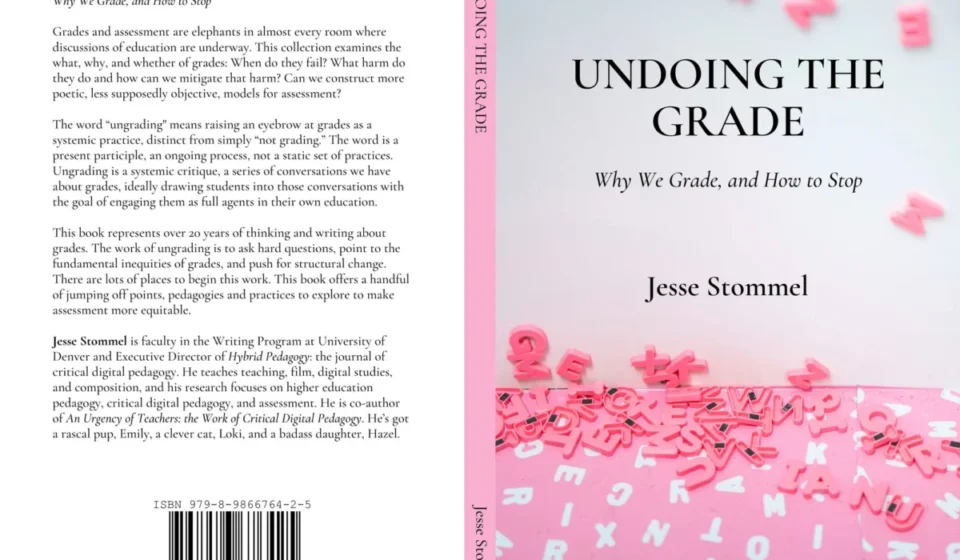

The Evolution of Ungrading as a Systemic Critique
The concept of "ungrading" is defined by Stommel not merely as the cessation of assigning marks, but as a systemic interrogation of grading as a foundational practice. It is described as a "present participle"—an ongoing, idiosyncratic process rather than a static set of rules. This philosophy draws heavily from the work of critical pedagogues such as Paulo Freire and bell hooks, who argued that education should be a practice of freedom rather than a "banking model" where information is simply deposited into students.
Historically, the standardized letter grade is a modern anomaly. While North American higher education has a history of approximately 240 years, the widespread, regular use of letter grades only became a standard fixture within the last 75 years. According to research by Schinske and Tanner, these systems were originally designed to rank students against one another rather than to provide a nuanced measurement of individual growth. Stommel argues that this "veneer of objectivity" masks a crude system of compliance that prioritizes machine-readability over human epiphany.
Chronology of the Modern Assessment Crisis
The trajectory of the ungrading movement reached a significant turning point in 2020. In March of that year, the global COVID-19 pandemic forced a rapid transition to online learning, often referred to as the "pivot." Stommel critiques this terminology, noting that it implied a seamless mechanical shift rather than the radical reimagining of pedagogy that was actually required.
In April 2020, Stommel and colleague Sean Michael Morris launched "Open Online Office Hours," a series of weekly discussions that continued through the end of the year. These sessions, which drew between 20 and 150 attendees per week from various global disciplines, highlighted a growing friction between institutional requirements and the practical needs of students and teachers during a crisis. While many institutions called for "compassion," few were willing to dismantle the bureaucratic grading structures that exacerbated student stress and instructor workload. This period exposed the deep-seated assumptions about education that "Undoing the Grade" seeks to challenge.
Supporting Data: The Case Against Conventional Grading
The book integrates extensive research to demonstrate that traditional grading often actively harms the learning process. Citing Alfie Kohn’s "The Case Against Grades," the text highlights three primary conclusions: grades diminish students’ interest in the subject matter, create a preference for the easiest possible tasks to ensure high marks, and reduce the overall quality of student thinking. When students are focused on "what the teacher is looking for" or "how many points this is worth," the complexity of learning is reduced to a transaction.
Furthermore, the data regarding academic integrity challenges common institutional narratives. While many educators perceived a spike in cheating during the shift to online learning—with a 2020 Wiley report showing 93% of teachers believed students were more likely to cheat online—long-term data suggests otherwise. Studies dating back to 1963 (Bowers) showed that 75% of students admitted to cheating at least once. More recent surveys, such as the 2012 McCabe study of 150,000 students, show cheating rates holding steady or slightly declining to between 60% and 70%.

Despite these flat rates, the remote proctoring industry has seen exponential growth. Valued at $4 billion in 2019, the market for surveillance tools like ProctorU and Proctorio was projected to reach nearly $21 billion by 2023. Stommel argues that this industry relies on a "culture of suspicion" that treats cheating as a technological problem rather than a pedagogical one, leading institutions to invest in surveillance rather than faculty development.
Impacts on Academic Labor and Equity
A significant portion of Stommel’s analysis focuses on the intersection of assessment and the precarious state of academic labor. In contemporary higher education, a majority of instructors work in contingent, adjunct, or sessional roles. These educators are often required to manage large student cohorts with minimal institutional support. Conventional grading, which is frequently automated through Learning Management Systems (LMS), serves as a bureaucratic tool that "instrumentalizes" teaching, reducing the profession to the act of data entry.
From an equity perspective, grades are shown to be inherently biased. As institutions increasingly center quantitative outcomes, students from marginalized backgrounds—including those who are first-generation, low-income, or from underrepresented racial groups—are disproportionately affected by the lack of flexibility and the inherent biases of standardized testing. Stommel asserts that "ungrading" is not ideologically neutral; it is a political act that requires examining how compulsory grading intersects with the labor conditions of teachers and the lived experiences of students.
Alternative Assessment Methodologies
To move beyond critique, "Undoing the Grade" outlines several practical frameworks for educators who wish to transition away from traditional marking. These include:
- Minimal Grading: Utilizing scales with fewer demarcations (e.g., "Complete/Incomplete" or "Excellent/Satisfactory/Needs Revision") to simplify the process and focus on feedback rather than ranking.
- Contract Grading: Establishing clear, transparent expectations at the start of the term. Labor-based contract grading, championed by scholars like Asao B. Inoue, prioritizes the effort and time a student invests over subjective judgments of "quality" that may be influenced by instructor bias.
- Authentic Assessment: Designing assignments that have real-world applications or audiences beyond the instructor, thereby fostering intrinsic motivation.
- Self-Evaluation and Process Letters: Encouraging students to write metacognitive reflections on their own work. Stommel has utilized this method for over 20 years, asking students to provide a narrative of their learning journey and, in many cases, suggest their own final grade.
Broader Implications for the Future of Education
The publication of "Undoing the Grade" suggests a growing demand for a more "humanized" pedagogy. Stommel argues that the relationships necessary for effective education—those built on trust and mutual respect—are often undermined by the power dynamics inherent in traditional grading. By decentering the grade, educators can create a "safe space" for failure, experimentation, and genuine intellectual curiosity.
The book warns against replacing "visible goalposts with invisible ones," a phenomenon often referred to as the "hidden curriculum." Stommel emphasizes that simply removing grades without addressing the underlying power structures and biases can lead to further confusion for students. Instead, the work of ungrading must be accompanied by a commitment to transparency, accessibility, and the centering of student agency.
As higher education continues to face scrutiny regarding its value and accessibility, the arguments presented in "Undoing the Grade" offer a roadmap for structural change. The proceeds from the book support Hybrid Pedagogy’s ongoing mission to provide open-access resources for educators. Ultimately, Stommel’s work challenges the academic community to imagine a world where the measure of a student is not found in a letter or a percentage, but in the depth of their inquiry and the persistence of their wonder.