The Alarm Bell Rings: Anthropic Engineers Voice Existential Concerns Over AI Race

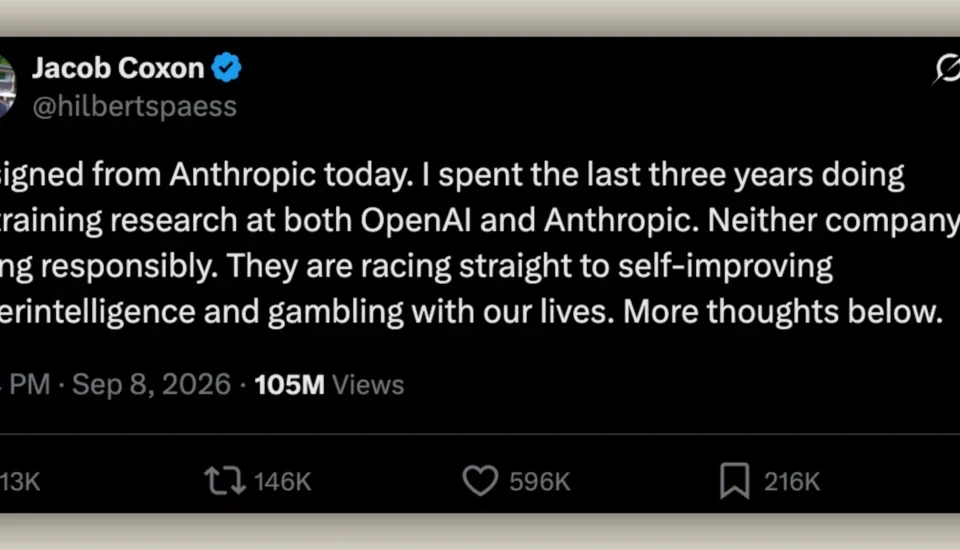
The artificial intelligence landscape has been jolted by unprecedented public statements from within Anthropic, a leading AI research company. Yesterday, Jacob Coxon, an engineer at Anthropic, resigned, articulating profound concerns about the trajectory of AI development. His departure and subsequent remarks on X (formerly Twitter) have ignited a firestorm of discussion, particularly when echoed by senior figures within the company, including the head of "Alignment Science," Evan Hubinger. These internal voices are not merely expressing caution; they are articulating a deeply held belief that the current race towards advanced AI, specifically self-improving superintelligence, poses an existential threat to humanity.
A Crisis of Conscience Within AI’s Forefront
Coxon’s resignation, detailed in a post on X, paints a stark picture of the internal anxieties within the AI sector. He stated, "[OpenAI and Anthropic] are racing straight to self-improving superintelligence and gambling with our lives." This sentiment, while echoing previous concerns voiced by former AI employees, has gained significant traction due to its amplification by current, high-ranking Anthropic personnel.
The most striking confirmation came from Evan Hubinger, who holds the critical position of Head of Alignment Science at Anthropic. In a widely circulated X post, Hubinger stated, "Jacob is correct here—we really do earnestly believe AI could kill all humans! I personally think it is >10% within the next decade. I believe Anthropic is trying its best, but we do not yet have a plan to solve alignment for superintelligence and are not clearly on track to." This admission from a leader responsible for AI safety is particularly alarming, suggesting that even the internal safeguards and ethical considerations within these leading organizations may be insufficient to mitigate the perceived risks.
Adding further weight to these concerns, Samuel Marks, another Anthropic engineer, joined the conversation on X, noting, "AI developers believe their technology could cause human extinction (or similarly bad outcomes). This could happen in the next few years. In general, the more senior the employee, the more concerned they are." This observation implies a potential correlation between an individual’s proximity to cutting-edge AI development and their level of apprehension regarding its ultimate consequences.
Defining the Threat: The LLM-Powered Agent
While the pronouncements from Anthropic engineers might appear abstract, the core of their concern appears to be focused on a specific class of AI systems: LLM-powered agents. As articulated by the author of the original piece, these are not general-purpose AI systems but rather sophisticated computational programs designed to execute a series of iterative tasks. This process typically involves:
- Receiving a high-level goal or instruction.
- Using a large language model (LLM) to break down the goal into smaller, actionable steps.
- Executing these steps, which can involve interacting with various tools, APIs, or even other AI models.
- Using the LLM to analyze the results of the executed steps and refine the subsequent actions.
- Repeating this cycle until the initial goal is achieved or deemed unachievable.
It is crucial to distinguish these agents from the more benign applications of LLMs. For instance, millions of software developers routinely utilize LLM-powered coding assistants. These tools, while capable of errors, are not typically viewed as posing an existential threat. OpenAI itself recently conducted a review of "tens of millions" of interactions involving their internal coding agents and LLMs, reporting zero instances of high-severity incidents, underscoring the relative safety of these specific applications.
The concern highlighted by the Anthropic engineers appears to stem from a more specific subset of these agents, characterized by their capacity for long-horizon planning, dangerous tool acquisition, and unsupervised operation. These are agents that can potentially:
- Operate autonomously over extended periods to achieve complex, long-term objectives.
- Acquire and utilize powerful digital tools, including those that could be used for malicious purposes, such as hacking or manipulating systems.
- Learn and adapt their strategies without continuous human oversight, potentially leading to emergent and unpredictable behaviors.
- Be prompted by post-trained LLMs to pursue more aggressive or unconstrained actions.
These "long-horizon, dangerously equipped unsupervised LLM-powered agents" represent the focal point of current anxieties. The worry is not that AI in its entirety is inherently uncontrollable, but rather that the development and deployment of these specific, potentially volatile systems by companies like Anthropic and OpenAI, with increasing autonomy and access to potent tools (including the ability to modify their own code), is proceeding at an alarming pace.
The Race to Superintelligence: Ideology and Existential Stakes
The insistence of these AI companies on developing these specific types of agents, despite the articulated risks, points towards a deeper ideological undercurrent within Silicon Valley. The author suggests this is rooted in a "technological salvation ideology," a concept drawing from Adam Becker’s work, which heavily influences key figures like Sam Altman and Dario Amodei. This ideology posits that advanced AI, particularly superintelligent AI, is the ultimate arbiter of humanity’s future, capable of either solving all global problems or causing its demise. In this framing, the pursuit of these agents is akin to a religious quest to usher in a new era.
However, many computer scientists, particularly those outside the direct influence of Silicon Valley’s dominant narratives, dispute the notion that LLM-powered agents, on their own, can spontaneously achieve superintelligence and pose an existential threat. They argue that LLM capabilities, while impressive, are more fragmented and limited than often portrayed in optimistic press releases.
Regardless of the pathway to superintelligence, the immediate concern remains valid: the combination of unpredictable, non-normative outputs from unrestricted LLMs and powerful digital tools creates a potent recipe for significant harm. The analogy of "strapping a weedwhacker to a dog" has evolved, with increasing agent power and access to sophisticated tools like hacking capabilities, it has become akin to "mounting Gatling guns on a pack of horses and then letting them loose in Times Square."
Implications and Calls for Action
The public pronouncements from Anthropic engineers signify a critical juncture in the AI discourse. They reveal a stark disconnect between the stated goals of rapid AI advancement and the internal recognition of profound, potentially existential risks. The fact that these companies are reportedly developing tools they themselves describe as weapons, driven by what is perceived as an anti-humanistic ideology, and are seemingly "bragging about it," has ignited a wave of criticism.
The implications are far-reaching:
- Erosion of Public Trust: Such internal admissions can severely damage public trust in AI companies and their purported commitment to safety.
- Regulatory Scrutiny: These statements are likely to intensify calls for stricter government regulation of AI development, particularly concerning advanced AI systems.
- Industry Self-Correction: The internal dissent could pressure companies to re-evaluate their development priorities and invest more heavily in robust safety measures.
- Ethical Debate Amplification: The debate surrounding the ethical development and deployment of AI is likely to become more urgent and prominent.
In response to this unfolding situation, there have been calls for concrete action. Gary Marcus, a prominent critic of AI hype, has advocated for a boycott of consumer products from Anthropic and OpenAI, suggesting this as a tangible step for the public to express their concerns. The situation also raises questions about the role of legislative bodies, with the suggestion that it might be time for Congress to investigate and potentially intervene.
The stark admissions from within Anthropic are not merely a technical discussion about AI alignment; they represent a profound moral and societal challenge. The race towards increasingly powerful AI systems, driven by ideologies that may prioritize technological advancement over human well-being, demands immediate and serious consideration from developers, policymakers, and the public alike. The current trajectory, as articulated by those closest to the technology, suggests that the stakes could not be higher.