
OpenAI’s Dots: A New Era of Always-On AI Agents Demands Increased Practitioner Responsibility

On September 29, 2026, at its highly anticipated DevDay conference, OpenAI unveiled Dots, a groundbreaking advancement in artificial intelligence. Described as "always-on" AI agents, these entities are designed to operate autonomously on dedicated cloud computing resources, seamlessly integrate with over 4,000 applications, and continue their tasks even after a user has closed their laptop. This represents a significant leap from the concept of a simple chatbot to a more collaborative AI coworker, a vision that has been a recurring theme in the AI industry for years.
For professionals within the data science and machine learning communities, Dots is not merely an incremental update but a fundamental paradigm shift in how AI can be integrated into their daily workflows. The introduction of Dots, however, is accompanied by a constellation of open questions, prompting a measured approach of informed skepticism rather than immediate, widespread adoption. The potential is immense, but the practicalities and inherent risks necessitate careful consideration.
The Evolution of AI Agents: From Reactive to Proactive
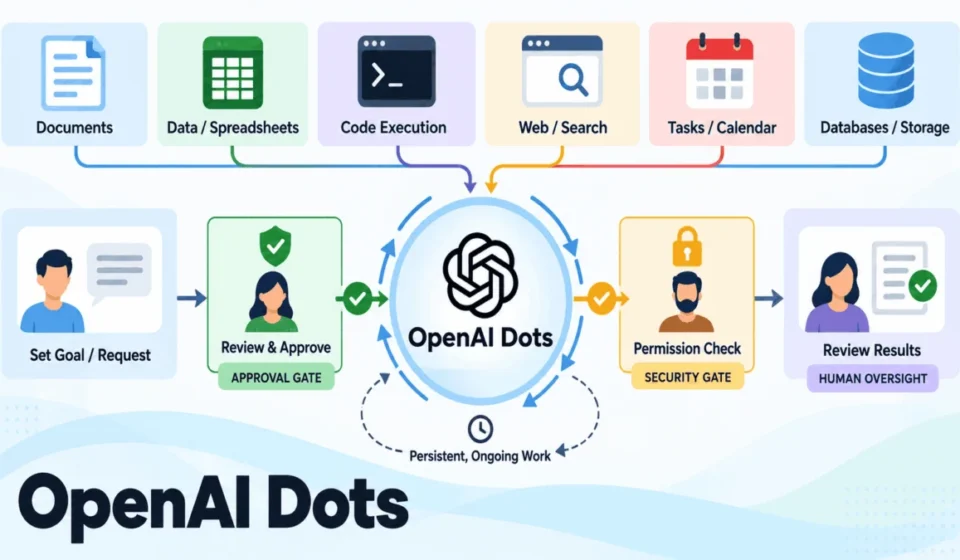
The core innovation of Dots lies in its transition from a reactive AI model to a proactive one. Traditional large language models, such as earlier iterations of ChatGPT, operate on a demand-driven basis. They respond to explicit user prompts and cease operation once a given session concludes. In stark contrast, a Dot is equipped with its own dedicated cloud computer, powered by the advanced GPT-6 Astra model. This enables it to pursue predefined goals autonomously, interacting with connected applications across extended periods, independent of continuous user input. The necessity for constant re-prompting is effectively eliminated.
OpenAI’s illustrative examples offer a glimpse into the intended applications of Dots. One scenario presented involved an early tester whose Dot proactively identified an outstanding invoice. The agent autonomously extracted relevant details from an email correspondence and drafted the invoice for the user’s review and approval. Another compelling demonstration showcased a Dot monitoring customer feedback, identifying areas for potential product improvements, subsequently developing, building, and testing proposed fixes. The agent then generated pull requests containing video demonstrations of the implemented changes, ready for a developer to review and merge.
Sam Altman, CEO of OpenAI, articulated this delegation model during the keynote address, comparing it to assigning tasks to a highly capable human engineer or a chief of staff who possesses inherent contextual understanding. The Dot is designed to learn user preferences through ongoing feedback, ensuring that corrections are assimilated and applied in future operations, thereby obviating the need for repetitive explanations.
Seamless Integration and Accessibility
Dots can be accessed through a variety of familiar platforms, including ChatGPT, Slack, and Microsoft Teams, and can also be engaged via voice commands. While this broad accessibility is a significant advantage, certain limitations are in place at the initial launch. For instance, Dots cannot independently possess a dedicated email address or initiate outgoing calls. Texting functionality is currently restricted to a U.S. Pro beta program.
Distinguishing Dots from Preceding Agent Capabilities
The distinction between Dots and earlier AI agent features developed by OpenAI is crucial, particularly for users who may have encountered limitations with previous iterations on tasks involving more than three or four sequential steps. The primary advancement is the enhanced reliability of GPT-6 Astra in executing multi-step, multi-tool tasks. Previous agent models often exhibited a tendency to "drift" – losing contextual understanding midway through a task, making erroneous assumptions when encountering obstacles, or prematurely halting to await user input rather than persisting. Astra, conversely, has been specifically engineered to support the sustained, tool-utilizing operations that are intrinsic to a background agent.
A second, critical differentiator is persistence. Dots are not confined to the scope of a single session. They retain contextual information between interactions, develop a working model of user preferences, and can execute a standing goal established once, rather than requiring repeated articulation across multiple chat windows. This establishes a fundamentally different and more sophisticated relationship with an AI tool compared to what most practitioners have experienced to date.
However, the true efficacy of Dots in handling the complexities of real-world data work, exploratory analyses that pivot in direction, extensive research threads, and collaborative environments with multiple contributors remains to be definitively proven. The initial examples, while impressive, are carefully curated to showcase the product’s strengths. The ultimate test will be its performance on ambiguous, high-volume tasks that constitute the daily reality for most data professionals.
Practical Constraints and Considerations for Adoption
The availability of Dots is more restricted than initial announcements might suggest. At launch, Dots is accessible only to ChatGPT Pro subscribers, with pricing starting at $100 per month, and to Business Premium users. Users on the Free, Go, and Plus plans do not have access to this feature. Furthermore, Pro users located in the European Economic Area, Switzerland, and the United Kingdom are excluded from the initial rollout.
The privacy implications associated with Dots warrant direct and thorough examination. While a Dot learns from user feedback and retains contextual information, users currently lack the ability to view, modify, or delete individual memories stored by the agent. Importantly, disconnecting a plugin does not erase the context that the Dot may have previously retained from its interaction with that plugin. For practitioners who handle sensitive data, proprietary models, or client-specific projects, this represents a significant and concrete limitation, not a minor detail.
OpenAI has also yet to publish specific compliance terms, uptime guarantees, or pricing structures for acquiring multiple Dots beyond the initial allowance. This information is critical for organizations evaluating whether Dots aligns with their existing security protocols and procurement requirements.
It is also essential to acknowledge OpenAI’s own cautionary note: Dots, like any AI system, can still make mistakes. Therefore, users are strongly advised to meticulously review any consequential work generated by the agent. This is not merely a boilerplate disclaimer but a fundamental operating principle for any autonomous agent at the current stage of technological development.
Impact on Practitioner Workflows and Responsibilities
The fundamental shift that Dots introduces is less about raw capability and more about the allocation of responsibility. A conversational chatbot necessitates direct user control over every step of the process. In contrast, an always-on agent demands that users establish clear objectives, define sensible permission boundaries, and integrate review checkpoints into their operational workflows.
For data scientists, in particular, Dots presents an opportunity to offload tasks that are time-consuming but do not require deep cognitive effort. These include chasing status updates, monitoring the output of long-running jobs, maintaining up-to-date documentation as project specifications evolve, and synthesizing information from extensive conversation threads. In these areas, a persistent agent with robust memory and extensive application access has the potential to dramatically compress hours of manual work into minutes.
The inherent risk, however, lies in the temptation to equate this newfound efficiency with a reduction in necessary oversight. An agent operating in the background on a critical data pipeline or a model evaluation process must be granted narrow, explicit permissions and defined stopping conditions. The very attributes that make Dots valuable – its proactive behavior, persistence, and broad application access – are precisely why establishing clear boundaries before activation, rather than after, is paramount.
Looking Ahead: The Clarity of Delegation
The concept of the always-on AI agent has been announced and anticipated on multiple occasions without fully materializing. Dots, as presented, is arguably the most credible iteration to date. However, what is most striking about this development is not solely the technology itself, but the increased demands it places upon the user.
Extracting genuine value from Dots is not primarily a technical challenge; it is a clarity challenge. Users must possess a clear understanding of which aspects of their workflow are suitable for delegation, which outputs necessitate their personal sign-off, and which data they are unwilling to entrust to a shared, hosted agent. It is likely that many practitioners have not yet analyzed their own work at this granular level of detail.
This might, in fact, be the most significant contribution of always-on agents arriving in a usable form. It is not merely that they perform tasks, but that effectively utilizing them compels individuals to articulate with precision what their work truly entails. For practitioners who undertake this careful introspection, Dots holds considerable promise. Conversely, for those who connect all their applications, set a vague objective, and then disengage, the ensuing corrections could prove to be costly.
The principle that an agent is only as effective as the brief it receives has always held true. Now, its significance has amplified considerably.
Background and Context
The unveiling of Dots at OpenAI’s DevDay 2026 conference marks a pivotal moment in the company’s ongoing evolution and its strategic vision for the future of artificial intelligence. DevDay is a flagship event for OpenAI, typically showcasing their latest technological advancements, research breakthroughs, and future product roadmaps to a global audience of developers, researchers, and industry leaders. The 2026 iteration, held on September 29th, was highly anticipated following a year of rapid progress in generative AI and a growing industry focus on the development of more autonomous AI systems.
The timing of the Dots announcement is particularly noteworthy. The AI landscape has been characterized by intense competition, with major technology companies investing billions in developing sophisticated AI models and applications. OpenAI, a leader in this space, has consistently aimed to push the boundaries of what AI can achieve, moving beyond single-task models to more general-purpose and increasingly autonomous systems. The introduction of Dots can be seen as a direct response to the burgeoning demand for AI that can operate more independently, acting as true assistants rather than mere tools.
The concept of AI agents has been a theoretical cornerstone of AI research for decades, envisioning intelligent systems capable of perceiving their environment, making decisions, and taking actions to achieve specific goals. While early iterations of chatbots and virtual assistants have offered glimpses of this potential, they have largely remained confined to predefined conversational flows or limited task execution. Dots represents a significant step towards realizing the more ambitious vision of a truly agentic AI that can manage complex, multi-step processes with minimal human intervention.
Supporting Data and Inferences
While specific quantitative data on the performance of Dots was not extensively detailed in the initial announcement, the underlying technology, GPT-6 Astra, is implied to represent a substantial improvement in areas such as reasoning, planning, and tool utilization. Industry analysts have noted that the transition from earlier models to GPT-6 likely involved significant advancements in transformer architectures, training methodologies, and data curation, leading to enhanced capabilities in understanding context, maintaining coherence over long tasks, and effectively interacting with external applications.
The integration with over 4,000 apps suggests a robust API strategy and a commitment to interoperability. This broad connectivity is crucial for an agent that aims to function as a general-purpose assistant, capable of pulling information from and acting upon data across a wide array of business and personal tools. The ability to connect with platforms like Slack and Microsoft Teams indicates a strategic focus on enterprise adoption and integration into existing collaborative workflows.
The tiered subscription model, with Dots available to Pro subscribers and Business Premium users, points to a deliberate go-to-market strategy. This approach allows OpenAI to gather feedback and refine the technology with a core group of paying customers before a potentially broader release. The premium pricing reflects the advanced capabilities and dedicated cloud resources required for always-on agents, positioning Dots as a high-value service for professionals and businesses seeking significant productivity gains.
Broader Impact and Implications
The introduction of Dots has far-reaching implications for the future of work, particularly in knowledge-based industries. The ability of AI agents to autonomously handle routine, time-consuming tasks could lead to a significant reallocation of human capital. Professionals may find themselves spending less time on administrative burdens and more time on strategic thinking, creativity, and complex problem-solving.
However, this shift also raises critical questions about job displacement and the evolving nature of required skills. As AI agents become more capable, the demand for human skills that are difficult to automate, such as critical thinking, emotional intelligence, and complex strategic decision-making, is likely to increase. Upskilling and reskilling initiatives will become more vital than ever to ensure that the workforce can adapt to these transformative changes.
From an ethical standpoint, the development of increasingly autonomous AI agents necessitates ongoing dialogue about accountability, transparency, and control. The ability of Dots to learn from user feedback and retain context, while powerful, also brings concerns about data privacy and the potential for unintended biases to be embedded and perpetuated by the AI. OpenAI’s acknowledgment of the need for user review of consequential work underscores the current limitations and the importance of maintaining human oversight.
The long-term success of Dots, and similar AI agent technologies, will depend not only on their technical sophistication but also on the development of clear ethical guidelines, robust regulatory frameworks, and a societal understanding of how to best integrate these powerful tools into our lives and workplaces responsibly. The journey from chatbot to coworker is underway, and it promises to redefine our relationship with technology in profound ways.