How to Build a Custom LLM Evaluation Harness in Python from Scratch

The rapid proliferation of Large Language Models (LLMs) in production environments has fundamentally shifted the focus of artificial intelligence development from model training to rigorous evaluation. While public benchmarks like MMLU (Massive Multitask Language Understanding) or GSM8K provide a generalized baseline for model intelligence, they frequently fail to capture the nuances of specific enterprise applications, such as specialized customer support agents, Retrieval-Augmented Generation (RAG) pipelines, or domain-specific code assistants. To bridge this gap, engineers are increasingly turning toward custom evaluation harnesses—modular, repeatable pipelines designed to measure performance against proprietary datasets and unique scoring criteria.
The Shift Toward Domain-Specific Evaluation
In the current landscape of generative AI, a model’s general capability is often secondary to its reliability within a defined constraint. A model that scores in the 90th percentile on a general logic test might still fail to adhere to a specific corporate refusal policy or hallucinate technical specifications in a niche engineering context. Consequently, the "test harness"—a concept borrowed from traditional software engineering—has become the gold standard for AI reliability.
A test harness serves as the scaffolding that feeds controlled inputs into a system, captures the resulting outputs, and evaluates those outputs against a known baseline. When applied to LLMs, this involves managing a suite of prompts, tracking pass/fail rates, monitoring latency, and calculating API costs over time. By building a custom harness from scratch, developers gain full transparency into the evaluation logic, avoiding the "black box" limitations of third-party evaluation platforms.
Foundational Architecture of an Evaluation Pipeline
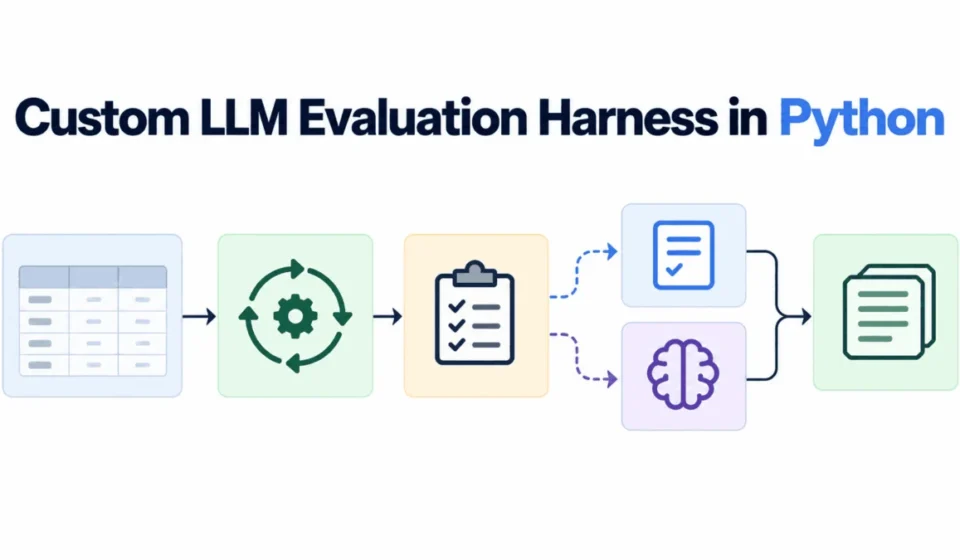
A robust, production-grade evaluation harness is typically structured around four modular components: a golden dataset, an inference runner, a judge layer, and a persistent logging system. This modularity ensures that each part of the process can be updated or replaced without disrupting the entire pipeline. For instance, the grading logic (the judge) can be refined without needing to re-run the expensive and time-consuming inference process.
To implement this in Python, modern libraries such as litellm and pydantic have become essential. LiteLLM provides a unified interface for interacting with various model backends—including OpenAI, Anthropic, Google Vertex AI, and locally hosted models—using a consistent function signature. Meanwhile, Pydantic ensures that the evaluation data remains structured and type-safe, which is critical when dealing with the inherently probabilistic and often messy outputs of LLMs.
Constructing the Golden Dataset
The "Golden Dataset" is the cornerstone of any evaluation effort. It consists of a curated list of test cases, where each case pairs a specific input prompt with a description of the desired outcome. Industry experts suggest starting with a small but high-quality set of 20 to 50 cases. Crucially, these cases should be derived from real-world user logs or identified failure modes rather than being purely synthetic. Synthetic data often reflects "happy path" scenarios, whereas actual user inputs are frequently ambiguous, poorly formatted, or adversarial.
A standard test case structure includes:
- Unique Identifier: An ID for tracking performance over multiple iterations.
- Input Prompt: The exact text to be sent to the model.
- Expected Concept: A concise, unambiguous description of what constitutes a successful response.
By maintaining a rigorous dataset, organizations can establish a "ground truth" that allows them to measure whether a model update or a prompt engineering change actually improves performance or introduces new regressions.
The Inference Runner and Asynchronous Execution
The second module, the inference runner, is responsible for executing the test cases against the target model. Because LLM API calls are I/O-bound and can take several seconds to complete, running them sequentially is inefficient for large datasets. Utilizing Python’s asyncio library allows for concurrent execution, significantly reducing the "wall-clock" time required for an evaluation run.
A reliable runner must also account for the volatility of cloud-based APIs. Implementing automatic retries (e.g., num_retries=3) and strict timeouts is necessary to handle rate limits or transient network failures. By decoupling the runner from the scoring logic, the system captures the raw output of the model in its entirety, preserving the data for future analysis or re-grading.
The Judge Layer: Deterministic vs. Semantic Scoring
Perhaps the most complex aspect of the harness is the judge layer, which determines whether a model’s response meets the criteria defined in the golden dataset. There are two primary approaches to this:
1. Deterministic Judging: This method uses traditional programming logic to check for specific strings, keywords, or formats. It is fast, cost-effective, and perfectly consistent. Deterministic judges are ideal for testing code generation, JSON formatting, or specific keyword adherence.
2. LLM-as-a-Judge: For tasks where semantic meaning is more important than exact phrasing, another LLM is used as the evaluator. For example, if a test case requires a "refusal" of a dangerous prompt, an LLM judge can recognize that "I cannot assist with that request" and "This operation is prohibited" both constitute a pass, even though the wording differs. To prevent the judge from becoming too verbose, Pydantic is used to force the judge model to return structured JSON, typically including a boolean passed field and a reason field for transparency.
The use of an LLM-as-a-judge has seen significant adoption in the industry, particularly with models like GPT-4o being used to grade smaller, faster models. This creates a "teacher-student" dynamic that can scale evaluation without requiring constant human intervention.
Persistent Logging and Data Integrity
A common pitfall in AI development is the loss of evaluation data due to system crashes or unhandled exceptions. To mitigate this, a robust harness employs an append-only logging strategy, typically using the .jsonl (JSON Lines) format. This format ensures that each result is written to disk immediately after it is scored. If the process is interrupted, the data from completed cases remains intact.
Furthermore, by logging the raw model output alongside the score, developers can perform "back-testing." If the grading rubric is updated, the developer can re-run the judge layer against the previously saved raw outputs. This approach saves significant costs by avoiding unnecessary calls to the primary inference model, which is often the most expensive part of the process.
Strategic Implications and Industry Trends
The move toward custom evaluation harnesses reflects a broader trend toward "AI Engineering" as a disciplined practice. As organizations move past the experimental phase of Generative AI, the ability to quantify model performance becomes a prerequisite for deployment.
The implications of a custom harness extend beyond simple accuracy. By tracking token usage and response latency within the harness, companies can conduct cost-benefit analyses of different models. For instance, an evaluation might reveal that a smaller, cheaper model performs at 95% the accuracy of a larger model for a specific task, justifying a switch that could save thousands of dollars in operational costs.
Moreover, integrating these harnesses into Continuous Integration/Continuous Deployment (CI/CD) pipelines allows for automated regression testing. Every time a developer modifies a system prompt or updates a RAG retrieval algorithm, the harness can automatically run a "smoke test" to ensure that core functionalities remain intact.
Chronology of an Evaluation Workflow
The lifecycle of an evaluation run typically follows a predictable sequence:
- Initialization: The environment is configured with API keys and the target model version is specified.
- Dataset Loading: The golden dataset is pulled from a version-controlled repository or database.
- Concurrent Inference: The runner dispatches prompts to the model backend via asynchronous calls.
- Scoring: The judge layer (deterministic or LLM-based) processes the raw outputs.
- Persistence: Results are streamed to a
.jsonlfile with timestamps and metadata. - Summarization: A final report is generated, calculating the overall pass rate and identifying specific failure clusters.
Future Outlook: Toward Automated Rubrics
As the field matures, the judge layer is expected to become increasingly sophisticated. Researchers are currently exploring "multi-agent" evaluation, where multiple LLM judges deliberate on a response to reach a consensus, thereby reducing the bias of a single evaluator. Additionally, the integration of "uncertainty quantification" may allow harnesses to flag responses where the model—or the judge—is unsure of the result, prompting human review.
Building a custom LLM evaluation harness in Python provides the transparency and flexibility required for professional AI development. By focusing on modularity and structured data, developers can move away from anecdotal evidence and toward a data-driven approach to model optimization. This transition is not merely a technical upgrade; it is a fundamental requirement for building trustworthy, scalable, and cost-effective AI systems in a rapidly evolving technological landscape.