Choosing the Right Agentic AI Framework for 2026: A Decision-Tree Approach

The Evolution of Agentic Orchestration: A 2023–2026 Chronology
The journey to the current multi-agent ecosystem began in early 2023 with the emergence of AutoGen and the initial "Agent" craze sparked by projects like AutoGPT. These early iterations were often criticized for their high "hallucination" rates and lack of deterministic control. However, the subsequent years saw a rapid professionalization of the stack.
- 2023: The Experimental Era. Developers focused on single-agent loops and basic tool-calling. Frameworks were largely wrappers around OpenAI’s ChatCompletion API.
- 2024: The Rise of State and Roles. LangGraph introduced the concept of cyclic graphs to manage state, while CrewAI popularized the "Virtual Org Chart" metaphor. These developments allowed for more complex, multi-step workflows.
- 2025: Native Integration and Type Safety. OpenAI released its Agents SDK to provide a low-friction entry point for its ecosystem. Simultaneously, PydanticAI emerged to address the growing demand for strict type safety and data validation in Python-based AI systems.
- 2026: The Maturity Phase. Agentic frameworks are now evaluated based on their "Production Readiness Score," accounting for durability, auditability, and token-cost efficiency.
Industry analysts estimate that by the end of 2026, over 60% of Fortune 500 companies will have deployed at least one multi-agent system into a core business process, up from less than 5% in 2024. This surge in adoption has necessitated a more rigorous selection process, moving away from GitHub popularity and toward requirement-driven decision-making.
The Foundational Question: Is Multi-Agent Necessary?
Before a framework is selected, architects must evaluate the "Agentic Bottleneck." Engineering leaders increasingly warn against "Agent Sprawl"—the tendency to deploy multiple agents for tasks that a single agent with a well-defined system prompt could solve. A single-agent system is inherently easier to debug and significantly cheaper to run.
The industry consensus suggests moving to a multi-agent framework only when one of three triggers is met:
- Context Overflow: The task requires more tools or background information than can fit into a single agent’s prompt without degrading performance.
- Specialization Conflict: The task requires conflicting "personalities" (e.g., a creative writer and a pedantic fact-checker) that perform better when separated.
- Complex Parallelism: Different parts of the task can and should be executed simultaneously by independent entities to reduce total latency.
The Decision-Tree: Mapping Workloads to Frameworks
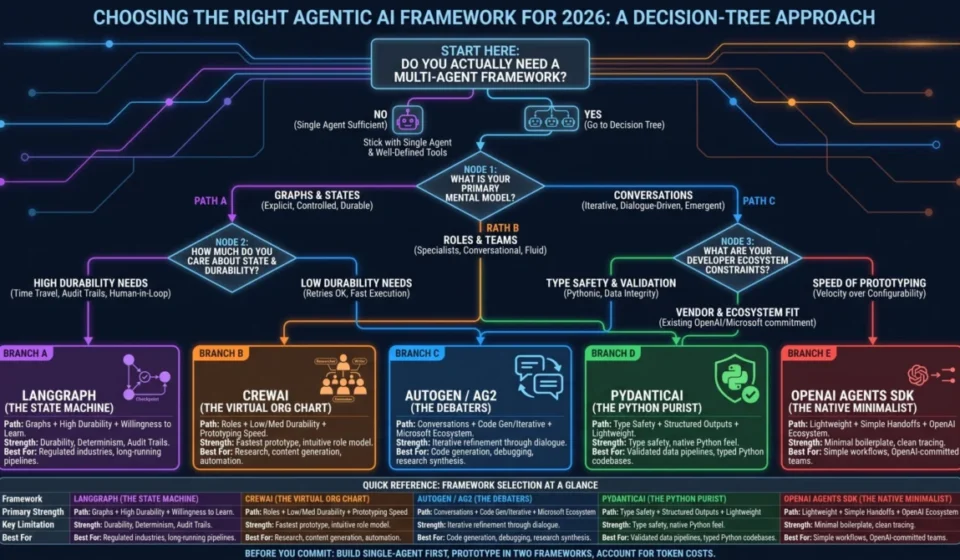
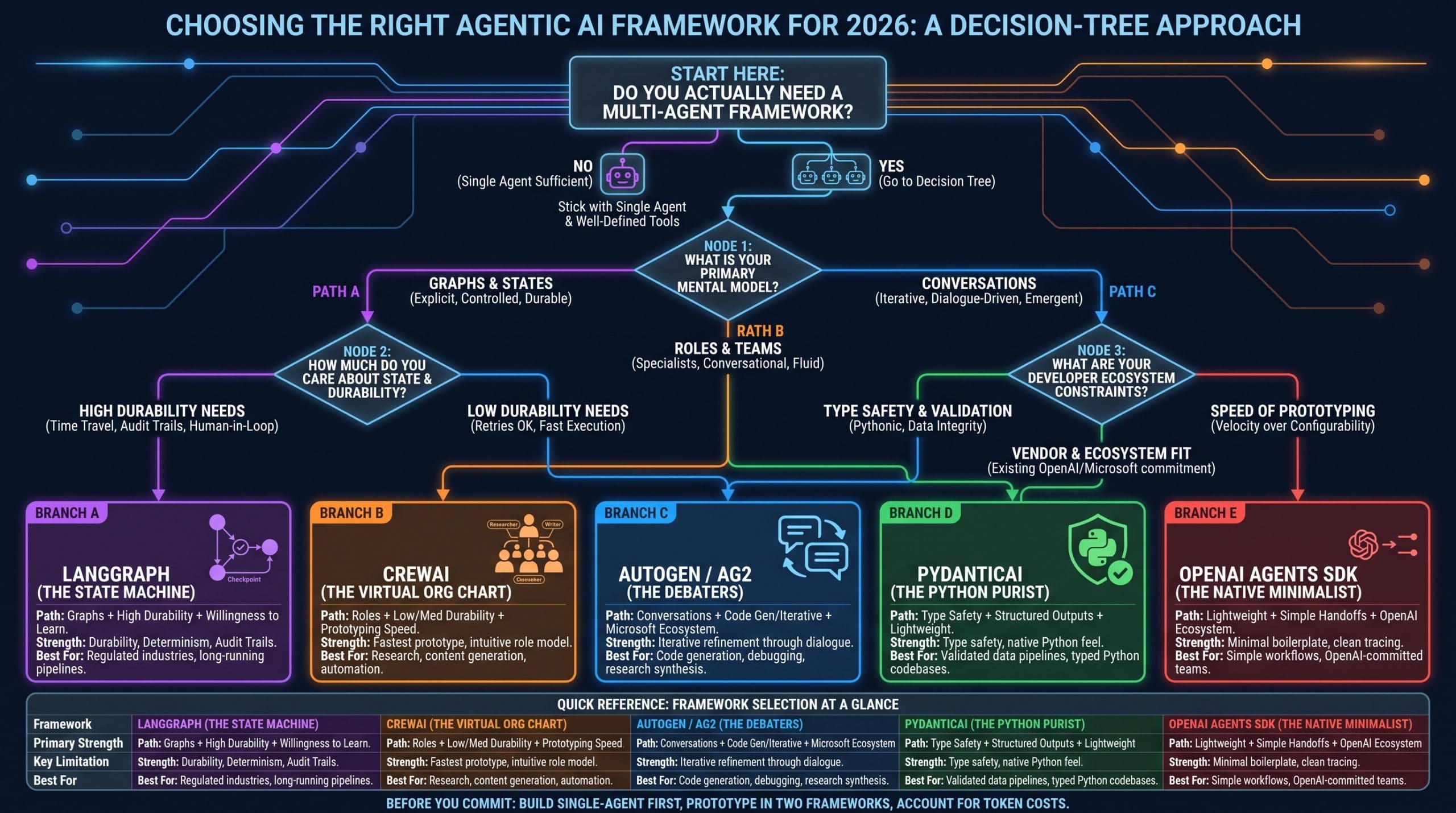
To navigate the current market, organizations are adopting a three-node decision-tree approach. This methodology prioritizes the mental model of the developer, the durability of the state, and the constraints of the existing ecosystem.
Node 1: Architectural Mental Models
The first branch of the decision tree concerns how the developer conceptualizes the workflow. If the workflow is a rigid series of steps with specific "if/then" logic, a Graph-based model is required. If the workflow mimics a department of employees handing off documents, a Role-based model is superior. For tasks requiring deep brainstorming or iterative debugging, a Conversational model is the standard.
Node 2: Durability and Human-in-the-Loop (HITL)
High-stakes industries, such as fintech and healthcare, require "High Durability." This means the system must be able to save its state to a database, pause for a human to approve a move, and resume hours later without losing progress. Low-durability needs are typical for "fire-and-forget" tasks like summarizing a news feed.
Node 3: Ecosystem and Developer Experience
Pragmatic constraints often override theoretical ideals. Teams deeply embedded in the Microsoft Azure ecosystem may lean toward AG2 (formerly AutoGen), while teams prioritizing Pythonic rigor and data integrity will favor PydanticAI.
Deep Dive: The Five Primary Framework Branches
1. LangGraph: The Enterprise State Machine
LangGraph has emerged as the preferred choice for regulated industries. By modeling workflows as directed acyclic (or cyclic) graphs, it treats "State" as a first-class citizen.
- Strengths: It offers unparalleled "time-travel" debugging, allowing developers to rewind an agent’s execution to a specific node to see exactly where a logic error occurred.
- Weaknesses: The learning curve is notoriously steep. It requires explicit definitions for every transition, which can lead to "boilerplate fatigue."
- Use Case: A bank’s mortgage approval process where every decision must be auditable and reversible.
2. CrewAI: The Organizational Orchestrator
CrewAI thrives on the metaphor of a "crew" of specialists. It is designed for speed and intuitive configuration.
- Strengths: It allows for rapid prototyping. A developer can define a "Researcher" and a "Writer" and have them collaborating in minutes.
- Weaknesses: Because it relies on natural language handoffs, it can be "jittery" in production. Agents may occasionally misinterpret their colleagues’ outputs.
- Use Case: A marketing department’s content engine that researches trends, drafts blogs, and formats social media posts.
3. AG2 (AutoGen): The Iterative Powerhouse
AG2 remains the leader in tasks involving code generation and complex multi-turn dialogues.
- Strengths: It excels at "Self-Healing" code. If Agent A writes code that fails, Agent B (the executor) provides the error log, and Agent A fixes it autonomously.
- Weaknesses: Conversational drift. Without strict termination conditions, agents can enter "infinite loops" of polite conversation, rapidly consuming tokens.
- Use Case: Automated software testing and data science pipelines.
4. PydanticAI: The Type-Safe Minimalist
For developers who view AI as just another function in their backend, PydanticAI offers a "no-nonsense" approach.
- Strengths: It leverages Pydantic for validation, ensuring that the data coming out of an LLM perfectly matches the schema required by the database.
- Weaknesses: It lacks built-in orchestration for complex, multi-agent "handoffs," requiring developers to write their own coordination logic.
- Use Case: High-traffic APIs where data integrity is more important than autonomous "thinking."
5. OpenAI Agents SDK: The Native Path
The 2025 release of the OpenAI Agents SDK simplified the landscape for teams already committed to the GPT-4o/o1 ecosystem.
- Strengths: Zero-configuration tracing and deep integration with OpenAI’s newest reasoning models.
- Weaknesses: Vendor lock-in. Switching to an open-source model like Llama 4 (projected) or Claude 4 would require a total rewrite.
- Use Case: Internal corporate tools where speed of delivery is the primary KPI.
Comparative Analysis: Operational and Economic Impact
A critical factor often overlooked in framework selection is the "Token Multiplier Effect." In a multi-agent system, the cost is not linear. Data from 2025 production deployments show that a three-agent "Crew" can consume up to 4.5 times more tokens than a single agent for the same output, due to the overhead of inter-agent communication and context re-sharing.
| Framework | Setup Complexity | Observability | Cost Efficiency | Industry Fit |
|---|---|---|---|---|
| LangGraph | High | Excellent | Moderate | Finance, Legal |
| CrewAI | Low | Moderate | Low | Creative, Marketing |
| AG2 | Moderate | High | Moderate | Engineering, R&D |
| PydanticAI | Moderate | Moderate | High | SaaS, Data Apps |
| OpenAI SDK | Very Low | High | Moderate | Startups, Prototypes |
Strategic Recommendations for 2026
As organizations move toward "Agentic Workflows," the following strategic guidelines are recommended by industry experts:
Implement an "Agentic Budget": Before deploying, calculate the maximum allowable token spend per task. If a multi-agent framework exceeds this by 50% without a 20% increase in accuracy, revert to a single-agent architecture.
Prioritize Interoperability: Avoid frameworks that do not support the Model Context Protocol (MCP). The ability to swap models (e.g., from GPT-4o to a specialized medical LLM) is essential for future-proofing.
Focus on "Human-in-the-Loop" Hooks: The most successful production systems in 2026 are those that treat humans as another "agent" in the graph. Ensure your chosen framework allows for seamless pausing and manual intervention.
The Path Forward
The "Framework Wars" of the mid-2020s have clarified one truth: there is no "one-size-fits-all" solution for agentic AI. The choice between the deterministic rigor of LangGraph and the fluid collaboration of CrewAI depends entirely on the business’s tolerance for unpredictability and its need for auditability. As we move into the latter half of the decade, the frameworks that survive will be those that provide the best "Developer Experience" while maintaining the strict "Operational Excellence" required by the modern enterprise. Organizations that master this decision-tree today will be the ones leading the autonomous economy of tomorrow.