Building a Multi-Modal RAG Pipeline in Python for Complex Document Retrieval and Reasoning

The evolution of Retrieval-Augmented Generation (RAG) has reached a critical juncture as enterprises seek to extract value from increasingly complex data formats. Traditional RAG systems, while proficient at processing plain text, frequently falter when confronted with the reality of modern business documentation: PDFs containing intricate charts, scanned diagrams, and nested data tables. To address these limitations, a new architecture known as multi-modal RAG has emerged, allowing AI systems to "see" and interpret visual elements alongside text. By integrating tools such as Python, LangChain, the Unstructured library, and the OpenAI GPT-4o model, developers can now build pipelines that treat images and tables as first-class retrievable objects, ensuring that no critical information is lost during the digitization and retrieval process.
The Limitations of Text-Centric Retrieval Systems
Standard RAG pipelines typically follow a linear path: a document is loaded, split into text chunks, converted into vector embeddings, and stored in a database. When a user asks a question, the system retrieves the most relevant text chunks to provide context to a Large Language Model (LLM). However, this method inherently ignores the visual context that often carries the most weight in technical or financial reports.
When a standard pipeline encounters a PDF, the text-extraction process often destroys table formatting, turning structured data into a disorganized "word soup." Furthermore, embedded images—such as quarterly revenue charts or engineering schematics—are typically skipped entirely. This results in a "knowledge gap" where the AI provides answers based on an incomplete version of the document. Industry analysis suggests that up to 80% of enterprise data is stored in unstructured formats, much of which includes visual components. Consequently, a multi-modal approach is not merely an upgrade but a necessity for high-stakes business applications.
Technical Framework and Environment Setup
Building a multi-modal RAG pipeline requires a sophisticated stack of libraries capable of handling both computer vision and natural language processing tasks. The primary engine for document decomposition in this architecture is the Unstructured library, which utilizes computer vision models to identify document layouts.
To initiate the development, a robust environment must be established. This includes the installation of langchain for orchestration, langchain-openai for model integration, and unstructured[pdf] for document parsing. A critical system-level dependency is poppler-utils, which serves as the underlying tool for rendering and extracting images from PDF files. In a production environment, developers must also secure an OpenAI API key, as the pipeline relies on GPT-4o’s vision capabilities to generate searchable descriptions of visual data.
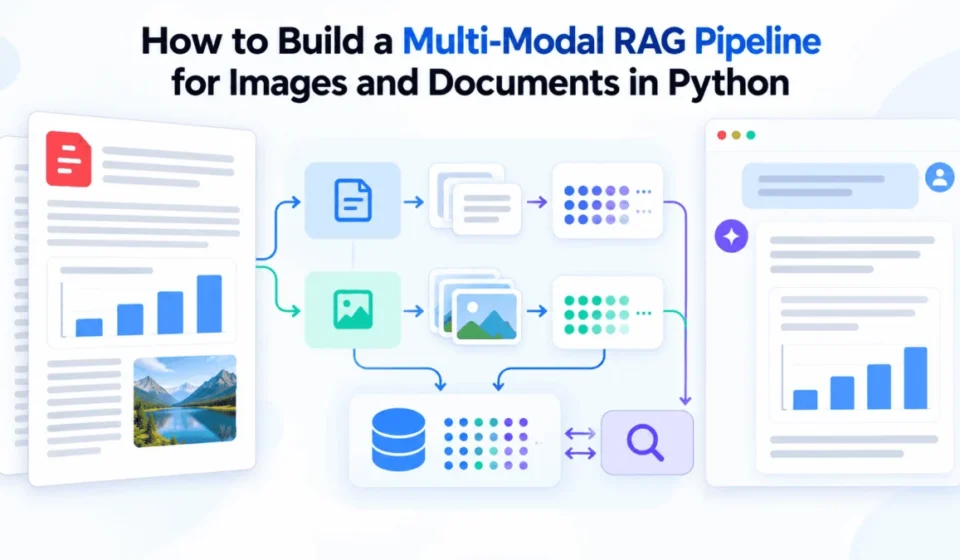
The architecture follows a four-stage chronology: document partitioning, image summarization, multi-vector indexing, and multimodal reasoning. This structured approach ensures that both text and visual evidence are preserved and linked throughout the lifecycle of the data.
Phase 1: Intelligent Document Partitioning
The first step in the pipeline involves moving beyond simple character streams toward structural awareness. Using the partition_pdf() function from the Unstructured library, the system performs an "element-level" analysis of the document. Unlike basic PDF loaders, this tool classifies every block of content as a paragraph, a title, a table, or an image.
By setting the infer_table_structure parameter to true, the system preserves the relationship between data points in a grid, which is vital for later reasoning. Simultaneously, the extract_image_block_types parameter targets embedded graphics, saving them as separate files in a designated directory. This stage transforms a flat PDF into a structured collection of elements, where each piece of information is categorized and prepared for specialized processing.
Phase 2: Bridging the Visual-Textual Gap via Summarization
The most significant challenge in multi-modal RAG is that traditional vector databases cannot index raw pixel data for semantic search. To solve this, the pipeline employs a strategy of "textual proxies." Every image extracted in the previous phase is passed to a vision-capable model, such as GPT-4o, to generate a dense, descriptive summary.
The summarization process involves base64-encoding the images and sending them to the API with a specific prompt: "Describe this image in detail for use in a search system." This ensures the resulting text contains the keywords and context necessary for a search engine to find the image later. For instance, a line graph showing a downward trend in Q3 expenses would be summarized with specific terms like "revenue chart," "downward trend," and "Q3," allowing a user’s query about "third-quarter financial performance" to successfully retrieve that specific visual.
Phase 3: The Multi-Vector Retrieval Architecture
The core innovation of this system lies in the MultiVectorRetriever architecture. In a standard RAG setup, the vector store holds the same content that is eventually passed to the LLM. In a multi-modal setup, the architecture diverges into two distinct layers:
- The Vector Store: This layer holds the embeddings of text chunks and the summaries of the images. It is used exclusively for the similarity search.
- The Document Store: This layer holds the raw content—the original text and the file paths to the actual images.
These two stores are linked by unique identifiers (UUIDs). When a user submits a query, the system searches the vector store for the most relevant text or image summary. Once a match is found, the system uses the linked ID to pull the high-resolution raw image or the original text from the document store. This ensures that the LLM receives the actual visual evidence rather than just a summary, allowing for much higher reasoning accuracy.
Phase 4: Multimodal Querying and Final Reasoning
The final stage of the pipeline involves the assembly of a multimodal prompt. When a query is processed, the retriever may return a mix of text documents and image files. The system must then route these elements correctly. Textual data is passed as standard strings, while image paths are converted back into base64-encoded data.
These elements are combined into a single message for GPT-4o. Because GPT-4o is a native multimodal model, it does not just read the text; it looks at the retrieved images to find the answer. If a user asks, "What was the primary driver of growth according to the charts?" the model can look at a retrieved bar graph, identify the tallest column, and explain the data in the context of the surrounding text. This "grounded" reasoning minimizes hallucinations and provides a verifiable link between the AI’s answer and the source document.
Industry Implications and Performance Data
The shift toward multi-modal RAG is already showing measurable impacts across various sectors. In financial services, where analysts must digest hundreds of pages of annual reports, multi-modal systems have shown a marked increase in accuracy for data extraction tasks. Internal benchmarks in the AI community suggest that while text-only RAG might achieve 60-70% accuracy on visual-heavy documents, multi-modal pipelines can push that figure above 90%.
In the legal and insurance fields, the ability to retrieve and reason over scanned documents, signatures, and photographic evidence within a single interface is transforming claims processing. Furthermore, the medical industry is exploring these pipelines to cross-reference clinical notes with diagnostic imagery, providing a more holistic view of patient data.
Strategic Considerations: Cost and Scalability
While the benefits of multi-modal RAG are clear, organizations must weigh the operational costs. Using models like GPT-4o for image summarization at scale can be expensive, as every image triggers an API call during the indexing phase. To mitigate these costs, developers are increasingly looking at strategies such as:
- Image Filtering: Automatically discarding images below a certain resolution or file size (such as icons or logos) to avoid unnecessary processing.
- Local Vision Models: Utilizing open-source models like LLaVA or Moondream for the initial summarization phase to reduce API dependency.
- Advanced Indexing: Exploring emerging technologies like ColPali, which attempts to embed entire document pages as images, potentially bypassing the need for complex partitioning in the future.
Conclusion and Future Outlook
The implementation of a multi-modal RAG pipeline represents a fundamental shift in how machines interact with human knowledge. By moving away from the "text-only" silo, developers can create AI agents that perceive documents in the same way humans do—as a cohesive blend of prose and visual data.
The four-stage process of parsing with Unstructured, summarizing with vision models, indexing with multi-vector stores, and reasoning with multimodal LLMs provides a blueprint for the next generation of enterprise AI. As models become more efficient and computer vision continues to advance, the "dark data" currently locked away in charts and diagrams will become increasingly accessible, leading to more informed decision-making and more reliable automated systems. For the modern enterprise, the question is no longer whether to adopt multi-modal AI, but how quickly it can be integrated into existing data workflows to maintain a competitive edge.