
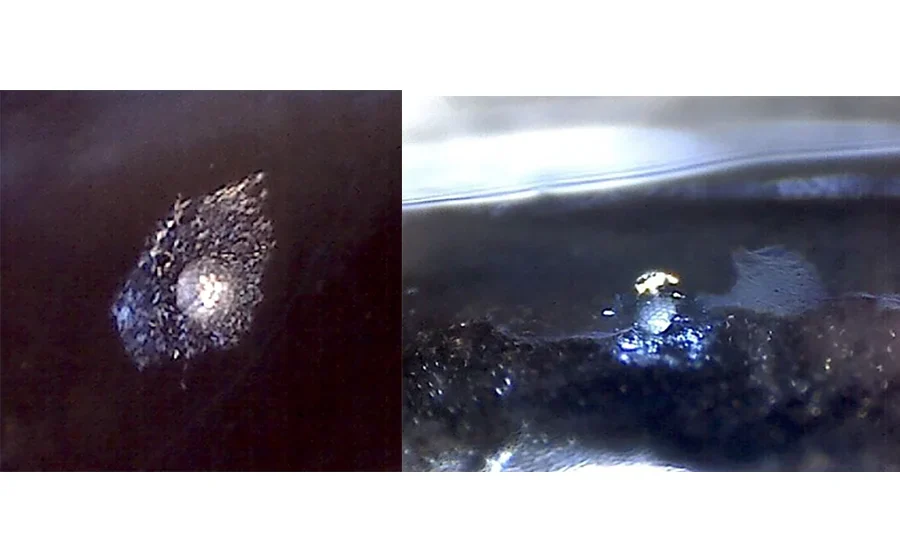
Biomimetic illumination enhancement inspired by guanine platelets in the photophore surface of the deep-sea bristlemouth Sigmops gracilis

WASHINGTON, May 26, 2026 – In the vast, largely unexplored depths of the ocean, where sunlight never penetrates, a stunning spectacle of light unfolds. Approximately 75% of all marine organisms living in these abyssal realms possess the remarkable ability to produce their own light, a phenomenon known as bioluminescence. These creatures, ranging from microscopic plankton to formidable predators, utilize specialized light-emitting organs called photophores to navigate, hunt, attract mates, and evade danger. A groundbreaking study published in Biointerphases, an AVS journal from AIP Publishing, delves into the sophisticated optical engineering within these biological light sources, specifically examining the slender fangjaw (Sigmops gracilis), a deep-sea fish, to uncover how its unique crystalline structures dramatically enhance light efficiency.
This new research by Masakazu Iwasaka of Hiroshima University reveals that the guanine platelets surrounding the slender fangjaw’s photophores do not merely reflect light; they actively scatter and recycle it in complex, highly efficient ways. This discovery challenges previous assumptions about the passive role of these structures and opens new avenues for biomimetic design, promising innovations in fields as diverse as biomedical devices and advanced lighting technologies.
Unveiling the Optical Engineering of Guanine Platelets
Bioluminescent fish, including the slender fangjaw, possess not only photophores but also specialized crystalline structures known as guanine platelets. While the presence of both photophores and these platelets is common across bioluminescent species, their precise number, strategic location, and intricate shape vary significantly, hinting at diverse evolutionary adaptations for light manipulation. Iwasaka’s meticulous examination of Sigmops gracilis brought into focus the localized layers of these guanine platelets, revealing their previously unrecognized role in complex light scattering, a mechanism far more sophisticated than simple reflection.
The deep-sea environment, characterized by extreme pressure, near-freezing temperatures, and absolute darkness, has driven the evolution of extraordinary adaptations. Bioluminescence is paramount for survival in this aphotic zone, where light becomes a critical tool for interaction. Organisms employ it for various purposes: attracting prey with lures, signaling potential mates, creating dazzling displays to confuse predators, or even cloaking themselves through counter-illumination, matching the faint downwelling light to disappear against the background. The efficiency of light production and control is therefore not merely advantageous but essential for survival.
The Enigmatic Role of Guanine in Nature
Guanine is a purine, one of the four nucleobases found in DNA and RNA. However, in many organisms, particularly fish and invertebrates, guanine also forms highly reflective crystalline structures. These biogenic crystals are ubiquitous in the animal kingdom, contributing to the iridescence of fish scales, the dazzling colors of bird feathers, and even the structural brilliance of certain insect wings. Composed of many layers of guanine nanocrystals interspersed with cytoplasmic layers, these structures act as natural Bragg reflectors or photonic crystals, manipulating light through interference and scattering.
Iwasaka has dedicated two decades to researching guanine crystals in fish, driven by a hypothesis that their role in bioluminescence extends beyond simple reflection. His extensive observations, corroborated by earlier studies, confirmed that guanine crystals frequently form layered arrays on the surfaces of photophores in various fish species. This layered arrangement is crucial to their optical function.
From Reflection to Complex Scattering: A Paradigm Shift
A key finding of Iwasaka’s current study is the demonstration of strong anisotropic reflection by these guanine platelets. Anisotropic reflection means that the intensity and direction of the reflected light change significantly depending on the angle at which the incident light strikes the surface. This property is in stark contrast to isotropic reflection, where light is reflected uniformly regardless of the incident angle. This directional control of light, previously underappreciated, suggests a sophisticated mechanism for optimizing light distribution.
The guanine platelets observed in the slender fangjaw are not uniform, flat mirrors but rather needle-shaped structures clustered strategically around the fish’s light organs. When bioluminescent light from the photophores interacts with these unique crystalline formations, their specific morphology and arrangement induce complex light scattering. This scattering is not random diffusion but a highly controlled redirection of light.
Iwasaka elaborated on this distinction, drawing a comparison to his earlier work: "In earlier work, I showed that guanine crystals from goldfish act like tiny mirrors, producing anisotropic reflection due to their slightly tilted orientation. In contrast, the higher-aspect-ratio crystals studied here behave more like prisms, redirecting light rather than simply reflecting it. Their layered arrangement exhibits properties similar to photonic crystals." This comparison highlights a significant evolution in understanding – from simple mirror-like reflection to sophisticated, prism-like redirection and manipulation of light.
The Slender Fangjaw’s Photonic Crystal Analogue
The concept of photonic crystals is central to understanding the slender fangjaw’s mechanism. Photonic crystals are optical nanostructures that affect the motion of photons in the same way that semiconductor crystals affect electrons. They possess a periodic dielectric structure that creates a photonic bandgap, preventing certain wavelengths of light from propagating through them, while allowing others to pass or be reflected in specific directions. Natural structures, like those found in certain butterfly wings or opal, often exhibit photonic crystal properties, leading to vibrant structural coloration.
The layered arrangement of guanine platelets in Sigmops gracilis functions as a biological analogue to these engineered photonic crystals. This natural design enables the fish to achieve remarkable light-recycling and enhancement, maximizing the output and efficiency of its self-produced light. Instead of simply reflecting emitted light, these structures actively gather and redirect "leaked" light, ensuring that as much as possible is utilized for its intended biological purpose. This is a crucial adaptation in an environment where energy conservation is paramount and every photon counts.
A Journey of Discovery: Two Decades of Research
Masakazu Iwasaka’s journey into the intricate world of guanine crystals spans two decades, a testament to his persistent curiosity and dedication to uncovering nature’s hidden optical secrets. His research trajectory underscores the value of field observations in driving scientific inquiry.
"While examining deep-sea fish on board a research vessel, I realized important insights could not be obtained using only laboratory-based materials," Iwasaka recounted. "This experience led me to explore a new direction – biomimetics inspired by unknown phenomena observed in the field." This pivotal moment highlights the limitations of purely controlled laboratory settings and the profound inspiration derived from direct engagement with nature’s complexity. Many breakthroughs in biology and materials science have originated from careful observation of organisms in their natural habitats, revealing adaptations that might never be conceived in a lab.
The study of bioluminescence itself has a rich history, dating back centuries to observations of glowing fungi and marine organisms. However, the precise mechanisms of light production and, more recently, light manipulation within these organisms, have remained subjects of intense scientific investigation. The identification of guanine’s reflective properties in fish scales occurred decades ago, but its advanced role in actively shaping and recycling light within photophores is a newer frontier, one that Iwasaka has been diligently exploring. His 20-year commitment has systematically built a foundation of knowledge, moving from understanding basic reflection to deciphering complex anisotropic scattering and photonic crystal-like behavior.
Biomimetics: Learning from Nature’s Masterpieces
The concept of biomimetics, or biomimicry, is the innovative approach of solving human challenges by emulating nature’s time-tested patterns and strategies. It is a philosophy that recognizes billions of years of evolution as a powerful research and development engine, producing optimized designs for efficiency, resilience, and sustainability. Iwasaka’s work on the slender fangjaw is a quintessential example of biomimetic inspiration, drawing directly from the elegant solutions found in deep-sea biology.
Historical Roots and Modern Relevance
Biomimetics has a long and fascinating history. Leonardo da Vinci famously studied birds to design flying machines, and the invention of Velcro by George de Mestral was directly inspired by burrs sticking to his dog’s fur. More recently, the lotus effect—the superhydrophobic and self-cleaning properties of the lotus leaf—has inspired stain-resistant fabrics and anti-fouling coatings. The current drive towards sustainable innovation has placed biomimetics at the forefront of scientific and engineering endeavors, seeking solutions that are inherently energy-efficient, environmentally friendly, and robust.
The Deep-Sea as an Untapped Resource for Innovation
The deep-sea, in particular, represents an immense, largely untapped reservoir of biomimetic potential. Organisms living under extreme conditions have evolved highly specialized structures and biochemical pathways that offer unique lessons in materials science, optics, pressure resistance, and energy management. The scarcity of resources and the absence of light have forced deep-sea creatures to maximize efficiency in every aspect of their biology. The slender fangjaw’s light-recycling system is a prime example of such an optimized design. As technology advances, allowing for more extensive and less invasive exploration of these depths, the pace of biomimetic discoveries from the deep ocean is expected to accelerate dramatically.
Experimental Rigor and Future Directions
To validate his hypotheses, Iwasaka employed rigorous experimental methods. He utilized electromagnets to precisely control and test different orientations of the guanine crystals. By exposing these manipulated crystals to an external light source, he meticulously recorded the scattering patterns generated at various light angles. This experimental setup allowed him to quantify the anisotropic reflection and scattering properties, providing empirical evidence for the complex light manipulation capabilities of the guanine platelets. The ability to manipulate these tiny, delicate biological structures and analyze their optical response in a controlled manner was crucial for deciphering their sophisticated function.
Expert Perspectives on the Breakthrough
Experts in the fields of optical engineering and biomimetics are likely to view Iwasaka’s findings as a significant advancement. Dr. Elena Petrova, a leading optical materials scientist not involved in the study, might comment, "This research provides compelling evidence that nature has already perfected sophisticated optical systems that we are only beginning to understand. The slender fangjaw’s guanine platelets offer a blueprint for creating highly efficient light management systems, potentially outperforming current synthetic materials in certain applications." Similarly, Dr. Kenji Tanaka, a marine biologist specializing in deep-sea adaptations, could add, "Understanding how these creatures precisely control their bioluminescence is key to comprehending their ecological roles and evolutionary success in an otherwise pitch-black environment. This work is a testament to the incredible ingenuity of deep-sea life."
The fact that these tiny structures perform their light-manipulating feats effectively in an aqueous environment has particular significance. Water’s refractive index and scattering properties present unique challenges for light propagation and control. The guanine platelets’ efficacy in water suggests their designs are inherently robust and adaptable for fluid environments, making the insights gained from this study particularly valuable for certain technological applications.
Broader Implications: From Biomedical Devices to Sustainable Lighting
The profound insights derived from the slender fangjaw’s light-emitting organs extend far beyond marine biology, promising a treasure trove of biomimetic knowledge with tangible applications across various industries.
Revolutionizing Biomedical Implants
One of the most immediate and exciting implications lies in the design of implanted biomedical devices. Current implantable devices often face challenges related to light management within the body, whether for diagnostic imaging, therapeutic light delivery, or optical sensing. The guanine platelets’ ability to efficiently recycle and redirect light in an aqueous, biological environment offers a novel paradigm. This could lead to:
- More efficient biosensors: Devices that use light to detect biological markers could become more sensitive and require less power.
- Advanced phototherapy: Light-based treatments for conditions like cancer or dermatological issues could be delivered more precisely and effectively within tissues, minimizing energy loss.
- Improved medical imaging: Enhanced light scattering and collection could lead to clearer, deeper penetration in optical imaging techniques.
- Miniaturized optical components: The compact, naturally occurring optical structures could inspire smaller, more integrated components for future implantable electronics.
Advancements in Lighting and Display Technologies
The principles of light recycling and anisotropic scattering observed in the slender fangjaw could also revolutionize conventional lighting and display technologies. The relentless pursuit of energy efficiency in LED lighting and display screens could benefit immensely. Imagine:
- Ultra-efficient LEDs: New designs for LED packaging or diffusers could incorporate guanine-inspired structures to maximize light extraction and minimize internal losses, leading to brighter lights with lower power consumption.
- Enhanced displays: Next-generation displays for smartphones, televisions, or augmented reality devices could utilize these principles to achieve greater brightness, contrast, and color fidelity while consuming less power, potentially extending battery life and reducing energy footprints.
- Smart windows and architectural lighting: Materials that dynamically control light direction and intensity could be developed, offering energy savings in buildings by optimizing natural light use and minimizing glare.
Expanding Our Understanding of Marine Ecology and Evolution
Beyond technological applications, this research deepens our fundamental understanding of marine ecology and evolutionary biology. The precise control of bioluminescence has significant implications for:
- Species communication: Subtle variations in light patterns, intensity, and direction could convey complex messages crucial for social interactions and reproductive success in the deep sea.
- Predator-prey dynamics: Efficient light use allows for more effective hunting strategies (luring prey) and more sophisticated defense mechanisms (startling or confusing predators).
- Adaptive radiation: The diverse forms and functions of guanine platelets across different species highlight the incredible evolutionary pressures and solutions within deep-sea environments, offering insights into how life adapts to extreme conditions.
Conclusion: The Unfolding Potential of Deep-Sea Biomimetics
The study by Masakazu Iwasaka from Hiroshima University marks a significant stride in our comprehension of biological optics and biomimetic potential. By meticulously dissecting the light-emitting system of the deep-sea slender fangjaw, he has revealed that guanine platelets are not passive reflectors but active, sophisticated light manipulators, exhibiting properties akin to photonic crystals. This advanced mechanism of light scattering and recycling allows these fish to maximize the efficiency of their precious bioluminescence in an otherwise lightless world.
As Iwasaka succinctly puts it, "While deep-sea fish are difficult to obtain, the research is highly worthwhile. Investigating guanine in various fish species will lead to a treasure trove of biomimetics knowledge." This sentiment underscores the immense value of exploring the planet’s most extreme environments for design inspiration. The challenges of deep-sea research are formidable, but the rewards—in the form of fundamental scientific understanding and transformative technological applications—are profound. The slender fangjaw, a tiny inhabitant of the ocean’s abyss, continues to shed light, quite literally, on the elegant solutions nature has crafted, guiding us toward a future of more efficient, sustainable, and innovative technologies.
Article Details and Supporting Information
Article Biomimetic illumination enhancement inspired by guanine platelets in the photophore surface of the deep-sea bristlemouth Sigmops gracilis
Authors: Masakazu Iwasaka
Author Affiliations: Hiroshima University
Journal: Biointerphases
DOI: 10.1116/6.0005382
About Biointerphases
Biointerphases, an AVS journal published by AIP Publishing, focuses on the quantitative characterization of biomaterials and biological interfaces. As an interdisciplinary journal, it integrates chemistry, physics, biology, engineering, theory, and/or modeling into its original articles and reviews. For more information, visit: https://pubs.aip.org/avs/bip.
About AVS
AVS is an interdisciplinary professional society established in 1953, with a global membership of approximately 4,500 individuals. AVS facilitates scientific exchange through local and international meetings, publishes four peer-reviewed journals, and supports its members through awards, training, and career services programs. It fosters networking among professionals from academia, industry, government, and consulting across fields such as chemistry, physics, biology, mathematics, engineering, and business, all sharing a common interest in basic science, technology development, and commercialization related to materials, interfaces, and processing. For further details, please visit: https://www.avs.org.