A Collaborative Approach to Demystifying Academic Writing: The Hogg Advisees Club’s Impact on Graduate Productivity and Well-being

Academic writing, particularly the daunting task of dissertation completion, often presents significant challenges for graduate students, extending beyond the intellectual demands of research to encompass profound issues of time management, motivation, and mental well-being. Recognizing these systemic hurdles, Professor Charlotte Hogg, a distinguished professor of rhetoric and composition in the Department of English at Texas Christian University (TCU), pioneered an innovative solution: the Hogg Advisees Club (HAC). This unique initiative, which operated for nearly two years, transformed the traditional advising dynamic into a collaborative, data-driven accountability system designed to make the often-invisible labor of writing transparent and manageable. Through shared goal-setting and meticulous logging of writing time, the HAC not only empowered graduate students to navigate their dissertation journeys but also fostered a profound re-evaluation of what constitutes productive academic work, offering a replicable model for sustainable scholarly practice.
The Genesis of an Innovative Advising Model
Professor Hogg’s deep understanding of writing processes stems from over a dozen years leading a faculty writing boot camp at her college. Her strategies are informed by established methodologies from organizations like the National Center for Faculty Development & Diversity (NCFDD) and a long-standing personal accountability partnership with fiction writer Erin Flanagan. For nearly a decade, Professor Hogg and Flanagan have maintained a shared writing log, a practice Flanagan herself has detailed, noting how the data "not only reflects but affects her writing process." Flanagan’s candid reflection—"The first draft took 13 months, but it was only 91 hours [spent writing]… So it wasn’t that I spent hours and hours at the computer, but weeks and weeks avoiding the work"—underscored a critical insight: the perception of time spent on writing often dramatically diverges from the reality. This revelation became the bedrock of Hogg’s approach to graduate advising, as she recognized that many advising conversations revolved less around content and more around the processes and psychological barriers to writing.
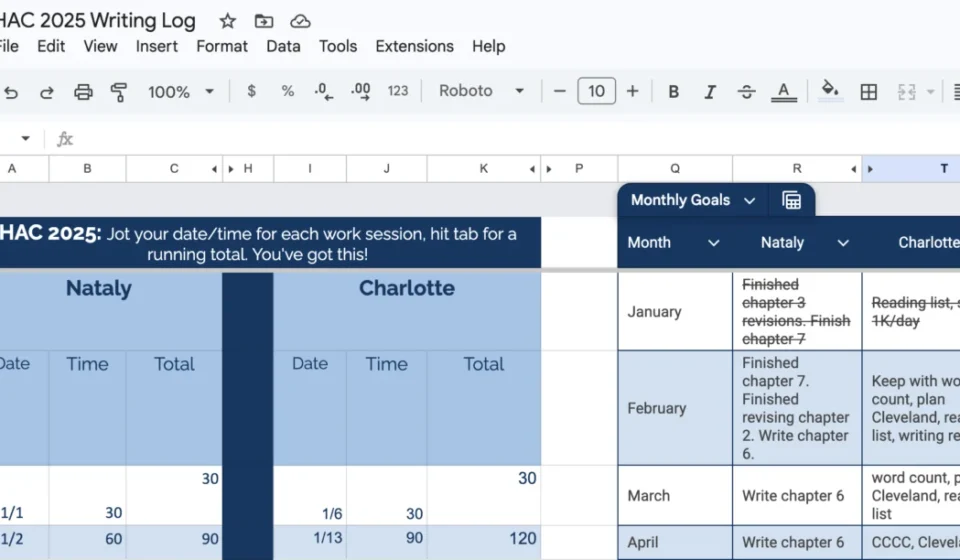
Driven by the belief that direct insight into their own writing lives could significantly impact her advisees, Professor Hogg conceptualized the HAC. The club, comprising Hogg herself and her graduate advisees Nataly Dickson, Sean McCullough, and Ashley Hughes, established a simple yet powerful framework. Each member would set monthly writing goals and meticulously log their progress on a shared Google Sheet. This digital ledger captured the date, time spent writing, and a running total, creating a transparent record of individual and collective effort. The initiative sought to cultivate the "mindsets of working writers," shifting from informal email check-ins to a more structured, collaborative environment that prioritized making labor visible and fostering intrinsic motivation.
Chronology and Evolution of the Hogg Advisees Club
The Hogg Advisees Club officially commenced in early 202X, operating consistently for nearly two years. From its inception, the shared Google Sheet became the central hub for the club’s activities. Members, including Professor Hogg, committed to logging their daily or weekly writing sessions, no matter how brief. This consistent tracking mechanism allowed for a real-time, evolving narrative of each member’s writing journey.
The club’s operation spanned a critical period in the advisees’ lives, demonstrating the adaptability and resilience of the model. Members navigated significant personal and professional milestones, including job changes, periods of job insecurity, and even childbirth, all while progressing on their dissertations. The shared log became a stable point of reference amidst these dynamic circumstances.
Approximately one year into the club’s operation, Professor Hogg initiated a structured reflection period. She prompted members to consider:
- How their logged hours compared to their initial expectations.
- What patterns emerged from their data regarding peak productivity or common avoidance behaviors.
- How the visibility of their writing time impacted their motivation and self-perception as writers.
These reflections catalyzed ongoing, in-depth discussions, significantly increasing the members’ awareness of their writing goals and habits. The communal analysis of individual data fostered a sense of shared experience and mutual understanding, transforming the potentially isolating endeavor of dissertation writing into a collective effort.
Supporting Data and Emerging Insights
The data collected through the HAC provided invaluable insights, challenging conventional notions of productivity and academic progress. For instance, Professor Hogg encouraged Nataly Dickson, who was pursuing her Ph.D. full-time, to consider the university’s often problematic "counting" of research time, suggesting a benchmark of at least 10 hours per week dedicated to dissertation writing alongside her teaching and service responsibilities. While this benchmark was unworkable for Sean and Ashley, who both held full-time jobs outside academia, all three advisees expressed surprise at their actual hourly averages. Sean McCullough, for example, noted that his logged hours were "higher than I expected, but lower than what I wanted to work," a sentiment common among graduate students who often overestimate their productive time or underestimate the sheer volume of work required.
Before the implementation of the HAC, Professor Hogg acknowledged that she, like many advisers, lacked a clear understanding of her advisees’ actual work patterns. The data, coupled with guided reflection, became the primary driver of motivation, effectively relieving Hogg of a "parenting dynamic" often associated with advising. Her role shifted from a supervisor to a facilitator, offering support ("yay!") but refraining from direct commentary on the logs themselves, instead focusing on listening to the members’ reflections. This approach fostered autonomy and self-directed growth, modeling a "marathon-type writing practice" that extends beyond the immediate goal of dissertation completion.
The challenges of dissertation writing are well-documented. National data from institutions like the Council of Graduate Schools indicate that the average time to degree for doctoral students in humanities fields can range from 7 to 9 years, with completion rates varying significantly. Common barriers include procrastination, imposter syndrome, lack of structured time, and the emotional toll of sustained independent research. The HAC directly addressed these issues by providing a structured, supportive environment that combatted isolation and provided tangible evidence of progress, no matter how incremental.
Perspectives from the Hogg Advisees Club Members
The true impact of the HAC is best understood through the experiences of its members, who shared their individual journeys and revelations.

Sean McCullough: Redefining Productivity Beyond the Billable Hour
Sean McCullough, who balanced his dissertation work with a full-time job outside academia, initially approached the idea of time tracking with resistance. His professional background as a consultant had ingrained a mindset where work hours were rigidly categorized into "billable" and "nonbillable" time, with yearly performance evaluations heavily weighting "productivity" in monetary terms. This corporate ethos made the prospect of tracking his dissertation hours feel like another burdensome obligation, reminiscent of the "9 to 5" grind Dolly Parton sang about.
However, the HAC log quickly transformed from a coercive tool into a liberating one. Sean discovered that the collaborative space made his "labor visible," not just to himself, but to his peers. Witnessing his progress alongside others, he realized that there are "many ways to use time and as many definitions for what’s productive." This collective visibility organically cultivated a sense of "our time" rather than just "my time," dismantling his ingrained corporate metrics and allowing him to see value in varied approaches to academic work. The logging experience, surprisingly, became freeing rather than constraining.
Nataly Dickson: Valuing Incremental Progress and Self-Compassion
For Nataly Dickson, the HAC writing log offered a crucial opportunity for self-reflection on her perception of time and her definition of "work." She learned to be "kinder to myself," particularly on days when she logged less than 30 minutes—even as little as 5, 15, or 20 minutes. These seemingly insignificant chunks of time stood out precisely because they were deemed "enough to record it in the log." This simple act of recording shifted her mindset, making her realize that all logged time, regardless of its duration, held value. This perspective proved invaluable when she became a mother, as the inevitable limitations on her work time did not discourage her. The log had already demonstrated that substantial progress could be achieved through small, consistent efforts.
Nataly’s experience further taught her to question what truly constituted "work worthy of logging." She realized that "looking for sources or revising my argument on the back of an electric bill" were just as valid as drafting several pages. This broadened definition of productive activity is critical for academic writers, as much intellectual labor involves thinking, planning, and revising, which often go uncounted in traditional metrics. The log provided tangible evidence of forward momentum, anchoring her dedication even when life’s detours, like motherhood, pushed the "prize" of dissertation completion further into the distance.
Ashley Hughes: Rethinking Productivity Metrics and Preventing Burnout
Ashley Hughes’s contributions to the HAC highlighted the potential pitfalls of overly relying on traditional productivity measures. While she diligently tracked her writing time, she often added her word count for each session, operating under the assumption that "more data equals better." However, her personal data revealed the inherent limitations of such quantifiable output. She observed that on rare occasions when she could immerse herself in her project for longer stretches, she experienced profound "breakthroughs that propelled my thinking forward," which she would then distill into concise prose. On paper, the "contrast between the hours spent and words produced was stark," showing long periods of deep intellectual engagement yielding relatively few words.
Ashley’s data also showed a tendency to abandon word count tracking during these longer, more reflective sessions, precisely when her "perceived productivity decreased." This suggested that traditional measurement practices, focused on quantifiable output, could subtly reinforce burnout rather than foster sustained engagement for some writers. Her experience led her to advocate for a shift towards "metrics that more fully capture the quality of intellectual labor and foreground purpose over productivity." For Ashley, the shared Google Sheet transcended a mere tracker; it became a tool for mutual motivation, making the "otherwise invisible and often isolated labor of working toward a finished product" visible and communal. It served as a "handprint on a cave wall," a testament to their shared presence, dedication, and connection, providing a crucial "small nudge to keep us all writing another day."
Broader Impact and Implications for Academic Institutions
The Hogg Advisees Club offers a powerful, low-cost, and highly effective model with significant implications for academic institutions, faculty advising, and graduate student success.
Redefining Academic Productivity: The HAC challenges the pervasive "publish or perish" culture that often prioritizes quantifiable output over the nuanced, iterative process of intellectual discovery. By valuing small chunks of time, diverse forms of "work" (thinking, revising, researching), and the quality of intellectual labor, the club promotes a more holistic and sustainable definition of academic productivity. This shift can help combat the "perceived productivity decreases" that Ashley identified as contributing to burnout.
Enhancing Graduate Student Well-being: Doctoral studies are notoriously stressful, with high rates of anxiety and depression reported among graduate students. The isolation of dissertation writing often exacerbates these mental health challenges. The HAC’s collaborative framework directly addresses this by fostering a sense of community, shared struggle, and mutual support. Knowing that others are also logging their hours, facing similar challenges, and celebrating small victories can significantly reduce feelings of isolation and imposter syndrome. Nataly’s experience of self-compassion is a testament to this benefit.
Transforming Faculty Advising: Professor Hogg’s intentional move away from a "parenting dynamic" towards a facilitative role offers a valuable blueprint for faculty advisers. By empowering students to self-monitor and reflect on their own data, advisers can foster greater autonomy and intrinsic motivation. This model frees advisers from the burden of constant supervision, allowing them to focus on intellectual guidance and mentorship rather than policing productivity. It also makes the advising relationship more equitable and collaborative.
Promoting Sustainable Writing Habits: The "marathon-type writing practice" modeled by Professor Hogg and cultivated within the HAC equips graduate students with invaluable skills that extend far beyond their dissertations. The ability to consistently engage with writing, to manage time effectively, and to derive satisfaction from incremental progress are critical for future academic careers, grant writing, and professional communication in any field. The lessons learned about redefining productivity and valuing diverse forms of intellectual labor are lifelong assets.
Replicability and Accessibility: The simplicity of the HAC model—utilizing a shared Google Sheet and fostering open communication—makes it highly replicable across different departments and universities. It requires minimal institutional resources, relying instead on the commitment of faculty and students to collective accountability. This accessibility means that even institutions with limited dedicated writing support services can implement similar initiatives to bolster graduate student success.
Conclusion
The Hogg Advisees Club at Texas Christian University stands as a compelling testament to the power of collaborative accountability in demystifying and humanizing the academic writing process. Through the simple yet profound act of logging time and engaging in shared reflection, Professor Charlotte Hogg and her advisees—Nataly Dickson, Sean McCullough, and Ashley Hughes—uncovered critical insights into the realities of scholarly productivity. They demonstrated that making the invisible labor of writing visible, fostering self-compassion for incremental progress, and challenging traditional metrics of output can lead to more sustainable, less isolating, and ultimately more successful academic journeys. As universities grapple with the ongoing challenges of graduate student retention and well-being, the HAC offers a pragmatic, empathetic, and highly effective model for cultivating not just productive writers, but resilient and self-aware scholars prepared for the marathon of intellectual life.