Mastering Python Iterators and Generators for Memory-Efficient Data Processing Pipelines

The transition from small-scale script execution to enterprise-level data processing often reveals a critical vulnerability in modern software architecture: the "eager" evaluation of data. For years, developers have relied on Python’s intuitive list comprehensions and straightforward file-reading methods to handle log files, database exports, and CSV datasets. However, as data volumes scale from megabytes to gigabytes, these traditional methods frequently trigger the dreaded MemoryError, a failure state that occurs when a program attempts to allocate more RAM than the system can provide. The solution to this systemic bottleneck lies in the fundamental shift toward "lazy" evaluation, utilizing Python’s built-in iterator and generator protocols to build memory-efficient pipelines.
The Architectural Crisis of Eager Evaluation
In the context of data engineering, eager evaluation refers to the practice of loading an entire dataset into memory before beginning any processing or filtering tasks. A typical scenario involves a nightly maintenance script designed to summarize application logs. In its early stages, such a script might open a file, parse every line into a list of dictionaries, filter for errors, and output a summary. While this approach is functional for small files, it fails catastrophically when log rotation policies change or traffic spikes.
Consider a 9 GB log file. In an eager processing model, Python must create a string object for every line and a list to hold those strings. Because Python objects carry metadata overhead, a 9 GB raw file can easily balloon to 20 GB or more of resident memory. When the system’s physical RAM is exhausted, the operating system’s OOM (Out Of Memory) killer terminates the process, often before a single line of data has been summarized. This failure is rarely due to a logic error in the parsing code; rather, it is a structural flaw in how data is held.
The industry-standard response to this challenge is the implementation of streaming pipelines. By ensuring that only one record exists in memory at any given time, developers can process files of arbitrary size—even those exceeding the total RAM of the host machine—with a near-constant memory footprint.
The Iterator Protocol: The Foundation of Streaming
At the heart of Python’s streaming capabilities is the iterator protocol, a formal contract between objects that has existed for over two decades. This protocol allows for the sequential traversal of a data structure without requiring the structure to be fully materialized in memory.
The protocol consists of two primary methods: __iter__() and __next__(). An "iterable" is any object that can return an iterator, such as a list, dictionary, or open file handle. The "iterator" itself is a stateful object that remembers its current position during traversal. When a developer utilizes a for loop, Python internally calls iter() on the object and repeatedly executes next() until a StopIteration exception is raised.
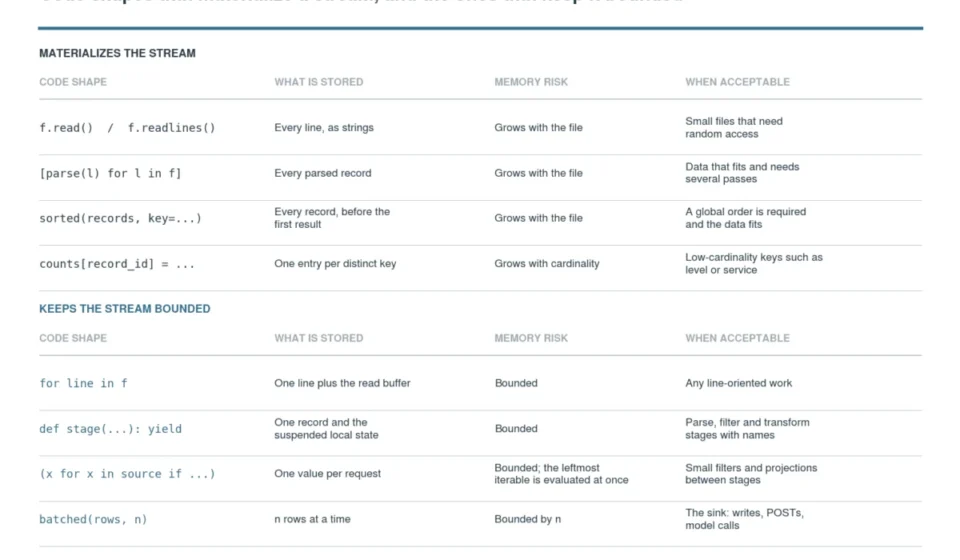
This mechanism is particularly powerful when applied to file I/O. Modern versions of Python treat file objects as iterators. Instead of using f.read() or f.readlines(), which pull the entire file into RAM, a simple loop for line in f: utilizes a small, internal buffer to read the file line by line. This single change can reduce the memory requirement of a log-parsing script from several gigabytes to a few kilobytes, representing the first and most significant "memory win" available in the standard library.
Generator Functions and the Power of Yield
While file iterators handle the input stage, complex data processing requires intermediate steps like parsing, cleaning, and filtering. Traditionally, these steps are nested within a single, massive loop, making the code difficult to test and maintain. Generator functions allow developers to break these steps into modular, reusable stages while maintaining the memory efficiency of a stream.
A generator function is defined like a standard function but uses the yield keyword instead of return. When a generator function is called, it does not execute the body immediately; instead, it returns a generator object. Execution only begins when the caller requests a value via the next() function. At each yield statement, the function’s state—including local variables, the instruction pointer, and the stack—is suspended.
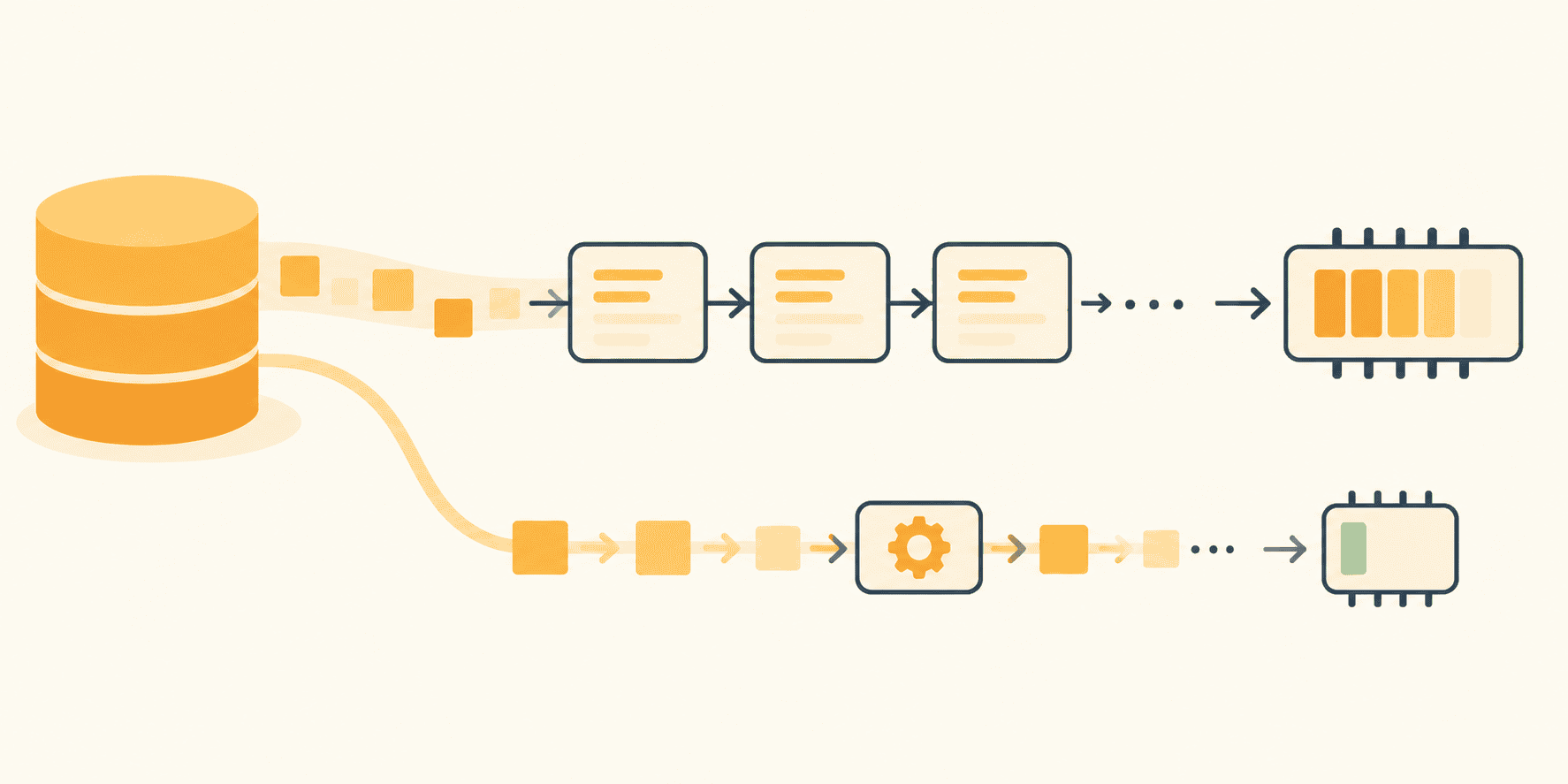
This suspension is the key to memory efficiency. When a record is "yielded" to the next stage of a pipeline, the generator holds only that specific record. It does not proceed to the next record until the downstream consumer is ready. This creates a "pull" architecture where data is drawn through the pipeline one item at a time, ensuring that the memory footprint remains tied to the size of a single record rather than the size of the entire dataset.
Constructing a Multi-Stage Data Pipeline
Effective data engineering involves composing these generators into a cohesive path. A professional-grade pipeline for processing log files typically follows a four-stage chronology:
- The Source: A generator that iterates over file paths, opening each and yielding lines using
yield from. This allows multiple rotated log files to be treated as a single, continuous stream. - The Parser: A stage that receives raw strings, applies regular expressions or JSON decoding, and yields structured dictionaries.
- The Filter: A stage that evaluates each record against specific criteria (e.g., "only ERROR levels" or "latency > 1000ms") and yields only the matches.
- The Projection: A final transformation stage, often implemented as a generator expression, that strips away unnecessary fields to prepare the data for its final destination.
By wiring these stages together, the developer creates a chain of assignments that performs no actual work until the final stage is iterated. This laziness allows for powerful "sanity checks," such as using itertools.islice to process only the first five records of a multi-terabyte dataset. The system will touch only the data necessary to produce those five records, providing near-instant feedback during the development process.
Comparative Data: Eager vs. Lazy Performance
To understand the impact of these architectural choices, consider a comparative analysis conducted on a standard workstation processing a synthetic 200,000-line log file (approximately 17 MB on disk).
- Eager Execution (List-based): The script reads all lines into a list, parses them into a second list, and filters them into a third. Monitoring tools like
tracemallocreveal a peak memory usage of approximately 198 MB. As the file size increases, this memory usage scales linearly. A file 100 times larger would require nearly 20 GB of RAM. - Lazy Execution (Generator-based): The streaming pipeline processes the same file but maintains a peak memory usage of only 0.4 MB. Crucially, this memory usage remains constant regardless of whether the file contains 200,000 lines or 200 million lines.
This data highlights the "scalability ceiling" of eager evaluation. While eager scripts may appear faster for very small datasets due to lower overhead, they possess a hard limit defined by available hardware. Lazy pipelines, conversely, trade a negligible amount of CPU overhead for an effectively infinite scalability ceiling.
Batching at the Boundary: Bridging Streams and Sinks
While streaming is ideal for internal processing, external systems—such as relational databases, search indices, or cloud APIs—often perform better when data is delivered in batches. Loading 1,000 records in a single SQL INSERT statement is significantly faster than performing 1,000 individual inserts.

The challenge for the developer is to implement batching without reintroducing the memory bug. Since Python 3.12, the itertools.batched() function provides an elegant solution. It consumes a specified number of items from an iterator, yields them as a tuple, and then clears the memory before fetching the next batch. This allows the developer to control the memory footprint by choosing a batch size that balances network efficiency with RAM constraints. A batch of 1,000 records is a "controlled" memory allocation; it does not grow with the size of the input file.
Identifying the "Materialization Traps"
Even the most well-designed pipeline can be compromised by a single eager step. Developers must remain vigilant against "materialization traps"—functions or library calls that internally convert a generator back into a list.
Common traps include:
- Global Sorting: The
sorted()function cannot determine the first element of a sorted list until it has seen the very last element of the input. Consequently, callingsorted()on a generator forces the entire stream into memory. - Deduplication: Using a
setto track seen IDs will grow in proportion to the number of unique records. In a dataset with millions of unique IDs, this can lead to memory exhaustion. - Library Requirements: Some popular data science libraries, such as older versions of Pandas or certain JSON encoders, require a full list or sequence as input rather than an iterable.
In cases where a global sort or total deduplication is unavoidable, developers must look beyond pure Python generators. External "disk-sort" utilities or database-backed state management (such as Redis for deduplication) are required to handle the data that exceeds RAM.
Broader Impact on Machine Learning and Data Science
The implications of memory-efficient processing extend far beyond server logs. In the current era of Artificial Intelligence, the preparation of massive JSONL (JSON Lines) datasets for model fine-tuning is a primary use case for generators. Training sets for Large Language Models (LLMs) often span hundreds of gigabytes. Loading these into memory is impossible on standard hardware.
By adopting an iterator-first approach, data scientists can build preprocessing pipelines that clean, tokenize, and format data on the fly. This "just-in-time" data delivery ensures that the expensive GPU memory is reserved for model weights and gradients, rather than being wasted on raw data storage.
Conclusion: The Cultural Shift Toward Lazy Code
The move toward iterators and generators represents a professionalization of Python development. It reflects a shift from "it works on my machine" to "it works on any volume of data." A well-constructed streaming pipeline is not only more robust and scalable but also more readable. It forces a clear separation of concerns, where each stage of the data’s journey is represented by a named, testable function.
As data continues to grow at an exponential rate, the ability to build memory-efficient pipelines is no longer a niche optimization; it is a fundamental requirement for reliable software engineering. By mastering the iterator protocol and the nuances of generator functions, developers can ensure their systems remain resilient, regardless of how many gigabytes—or terabytes—of data they are asked to process.