Architecting the Future: Six Strategic Patterns for Scaling Production-Ready Agentic AI Systems

The landscape of generative artificial intelligence is undergoing a seismic shift as enterprise requirements evolve from simple conversational interfaces to sophisticated agentic workflows. While conversational AI dominated the initial wave of adoption, the industry is now pivoting toward "Agentic AI"—systems capable of planning, reasoning, and executing actions autonomously. However, moving an agent from a successful proof-of-concept to a reliable, production-ready enterprise workflow requires meeting rigorous standards for scalability, responsiveness, and cost-effectiveness. The transition marks a move away from naive "single agent loops" toward heavily engineered multi-agent architectures and constrained topologies designed to handle the complexities of real-world business operations.
The Evolution of Autonomy: From Chatbots to Agents
The emergence of Agentic AI is a response to a fundamental limitation in early Large Language Model (LLM) implementations: conversational insight from data is often insufficient for end-to-end task completion. While a standard chatbot can summarize a document, an agentic system can identify a missing piece of information, query an external API to retrieve it, correct its own formatting errors, and collaborate with other specialized models to finalize a report.
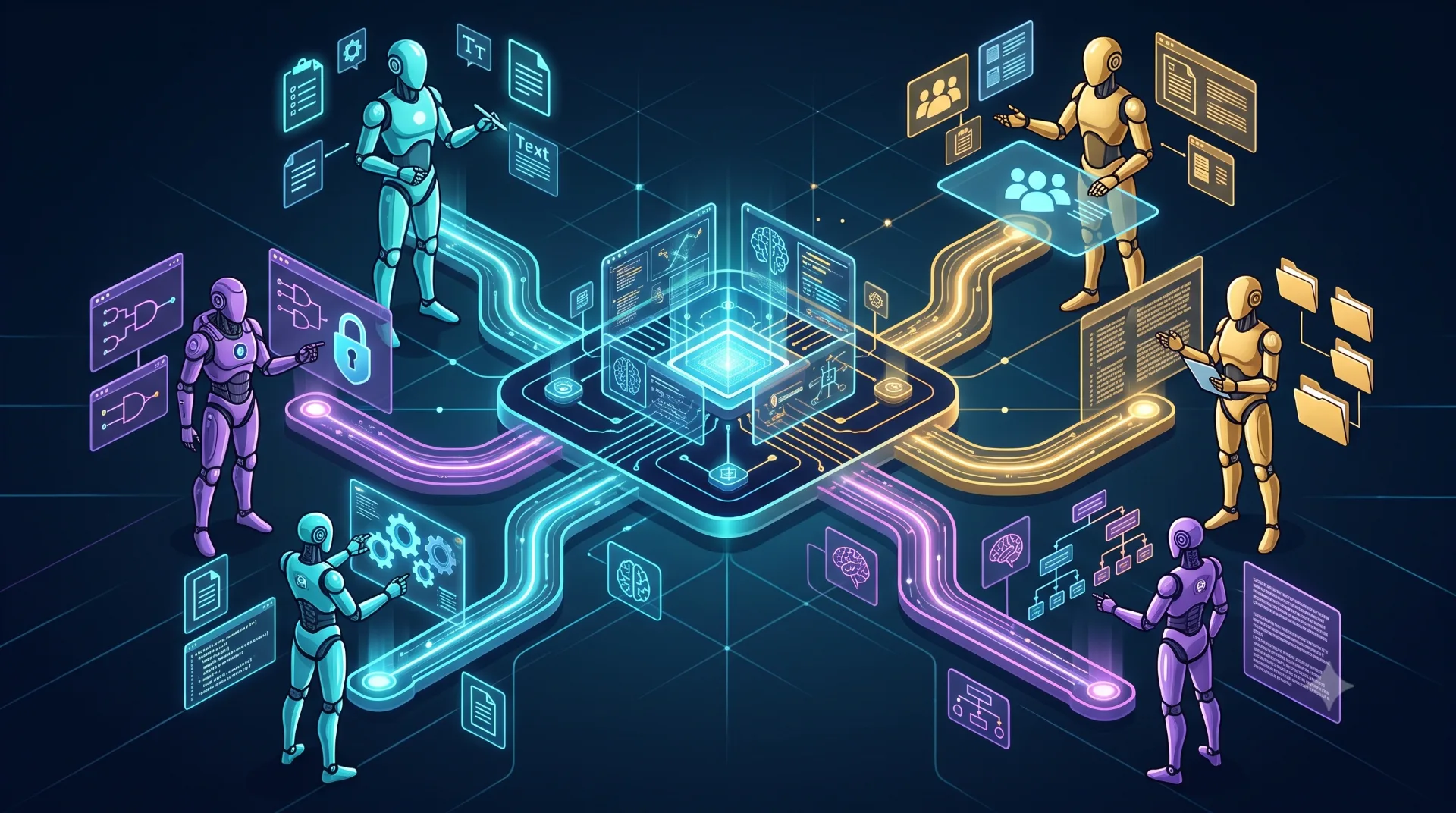
Architecturally, agents function as logical constructs built around an LLM "brain." These systems rely on high-frequency decision-making to determine the next step in a workflow, delegate tasks to sub-agents, or select the appropriate tool for a specific query. A significant milestone in this evolution is the advent of low-cost calibrated decision models, such as TypeSafe’s JEV. These models shift deterministic workloads away from expensive LLMs, allowing the primary model to focus exclusively on deep reasoning and synthesis. This specialization is critical for enterprise environments where every additional token contributes to latency and overhead.
The Foundation of Enterprise Reliability: Context Engineering
In the pursuit of production-ready AI, industry experts have identified "Context Engineering" as the hidden success criterion. Unlike traditional prompts, where context remains static, an agent’s context is highly dynamic. As an agent operates, it accumulates a history of observations, intermediate thoughts, and errors. If every data point is appended to the prompt without management, the context window quickly becomes bloated.
This bloat leads to the "Lost in the Middle" phenomenon, where LLMs lose visibility of granular facts buried within large blocks of text, resulting in hallucinations or incomplete responses. To combat this, practitioners are adopting several advanced techniques:

- State Projection: Only passing the finalized output of one agent to the next, rather than the entire history of attempts.
- Observation Truncation: Summarizing or shortening large tool outputs (such as web scrapes or database returns) before feeding them back into the reasoning loop.
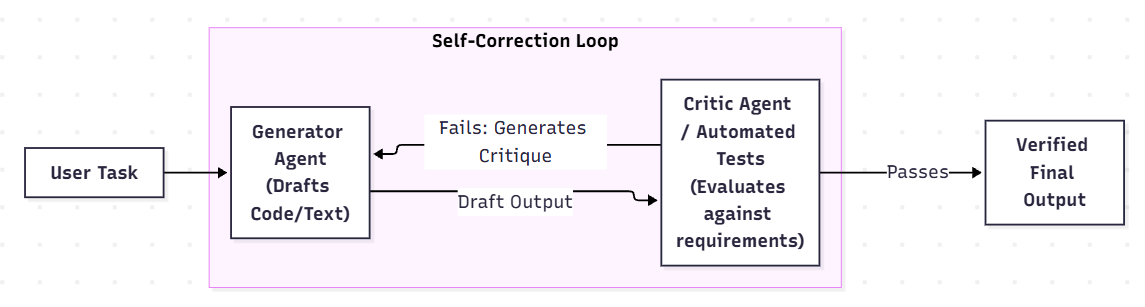
- Context Pruning via Diffing: In iterative processes, only the latest failure and the specific critique are retained, preventing the model from becoming confused by a long history of mistakes.
A Chronology of Agentic Architectural Development
The development of agentic patterns has followed a rapid timeline, moving from simple loops to complex hierarchical structures.
- Early 2023: The "ReAct" (Reason + Act) framework gained prominence, establishing the foundational "thought-action-observation" loop.
- Late 2023: As developers realized the limitations of single-agent systems, frameworks like Microsoft’s AutoGen and LangGraph emerged, enabling multi-agent collaboration.
- Early 2024: The industry shifted toward "Constrained Architectures," recognizing that total autonomy often led to unpredictable costs and behaviors. This era saw the rise of the "Supervisor" and "Router" patterns.
- Mid-2024 to Present: The focus has shifted to "Reflection" and "Self-Correction" loops, prioritizing accuracy and reliability for high-stakes enterprise applications such as financial auditing and automated coding.
Analysis of the Six Core Agentic Patterns
To achieve enterprise-grade performance, practitioners are now deploying six distinct architectural patterns, each suited for specific business needs.
1. The Standard ReAct Loop
The ReAct pattern remains the foundational building block. It forces the LLM to alternate between reasoning about a task and executing an action. While highly flexible and ideal for open-ended research, it is often too non-deterministic for user-facing applications requiring low latency. Its primary utility lies in data analysis and deep-dive research where the sequence of steps cannot be predicted in advance.

2. The Sequential Multi-Agent Workflow
Modeled after a factory assembly line, this pattern chains specialized agents together. A "Researcher Agent" might pass its findings to an "Analyst Agent," who then provides a brief to a "Writer Agent." By isolating the context window of each agent, this pattern significantly reduces token usage and prevents the degradation of logic that occurs in overstuffed prompts.
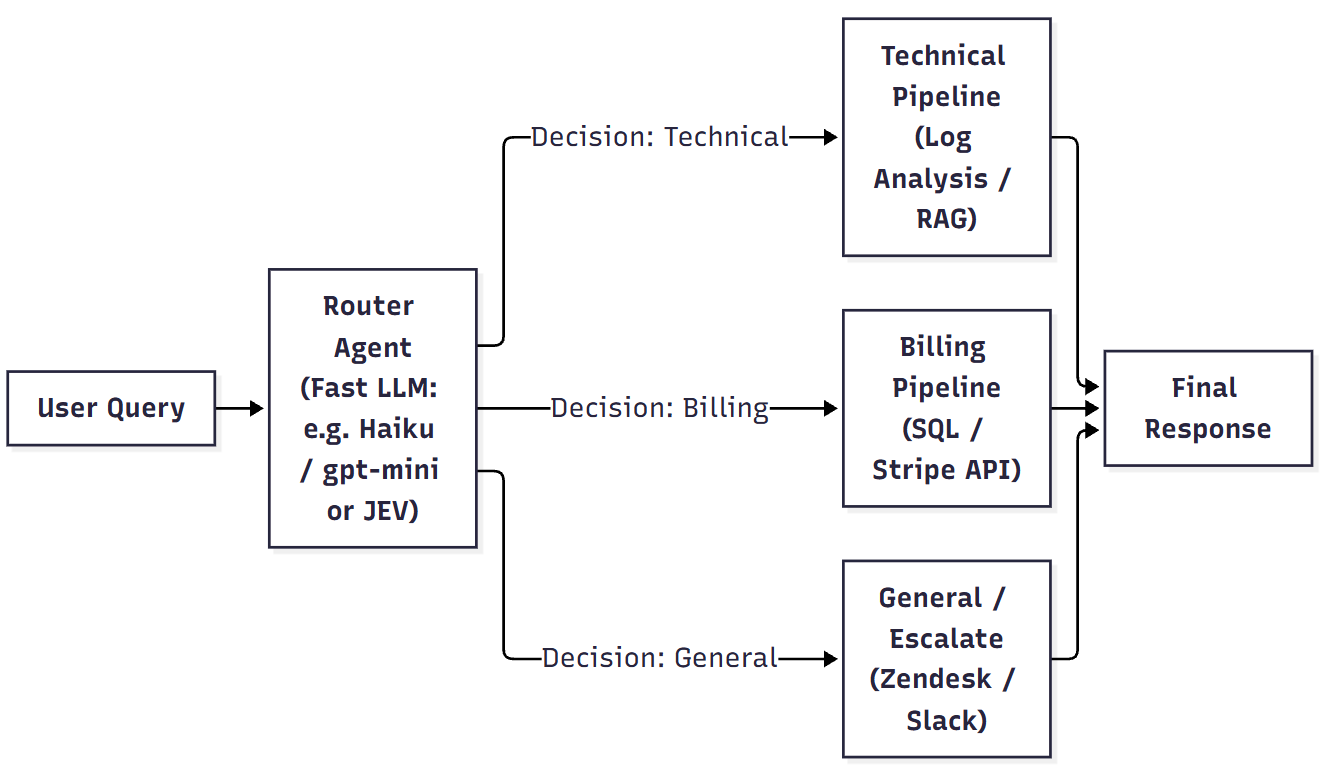
3. The Adaptive Router Agent
The Router pattern acts as an intelligent triage system. It uses a fast, low-cost model to classify user intent and route the query to a specialized sub-pipeline. This is the gold standard for multi-tenant enterprise chatbots, allowing a single interface to handle diverse requests—from technical support to billing—with high precision and minimal cost.
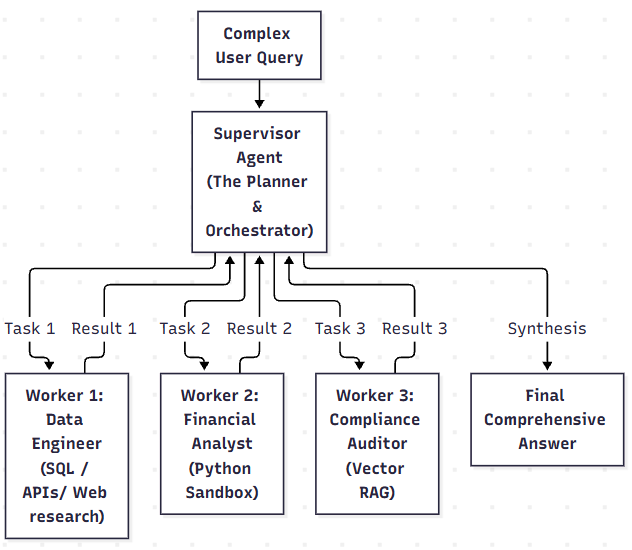
4. The Supervisor-Worker (Hierarchical) Architecture
In complex environments, a central "Manager" agent creates an execution plan and delegates sub-tasks to workers in parallel. The Supervisor maintains a "Global Context" (the master plan), while workers operate within a "Local Context." This hierarchy is essential for multi-modal content generation and comprehensive financial analysis, where multiple data sources must be synthesized simultaneously.
5. The Reflection and Self-Correction Loop
This pattern introduces a quality control layer. A "Generator" produces an output, which a "Critic" (either another LLM or a deterministic test) evaluates. If errors are found, the output is sent back for revision. This loop is mandatory for autonomous software engineering and legal drafting, where the cost of a mistake is high.
6. The Autonomous Swarm
The most experimental of the patterns, a Swarm consists of agents in a decentralized network. They collaborate and negotiate without a central manager. While offering maximum flexibility for creative simulations, Swarms are currently considered too unpredictable for most strict enterprise automation tasks due to potential "token storms" and chaotic communication.
Human-in-the-Loop (HITL) and Safety Protocols
As AI agents gain the ability to interact with external APIs—such as authorizing payments or modifying databases—the necessity for human oversight has become paramount. Enterprise applications cannot yet fully trust non-deterministic models with "write" operations.
The Human-in-the-Loop (HITL) mechanism acts as a critical control flow. In a state-graph implementation, the agent’s execution is paused and its state is serialized to a database when a high-risk tool is invoked. A human reviewer must then approve or edit the action before the orchestrator resumes the workflow. This "check-and-balance" system is a prerequisite for deploying agentic AI in regulated industries like finance and healthcare.
Data-Driven Evaluation: Trajectory Analysis
Traditional metrics used for Retrieval-Augmented Generation (RAG), such as faithfulness and context precision, are insufficient for evaluating multi-step agents. Instead, developers are turning to "Trajectory Analysis." This involves auditing the entire path an agent took to reach an answer:
- Did it select the correct tool?
- Were the tool arguments logically sound?
- Did it correctly interpret the tool’s output?
Observability platforms like LangSmith and Arize Phoenix have become essential tools for debugging these trajectories in production, providing the data necessary to refine agent prompts and architectural constraints.
Broader Impact and Industry Implications
The transition to agentic architectures represents a fundamental shift in software engineering. We are moving away from writing explicit, deterministic code toward orchestrating networks of probabilistic entities. For businesses, this means a shift in human resource allocation. The "vibe coding" era—where agents handle the bulk of syntax and execution—allows human developers to focus on higher-level system design and "Context Engineering."
However, this shift also brings challenges. The reliance on LLMs as "brains" introduces variable costs that are harder to predict than traditional software licensing. Furthermore, the "agentic tax"—the latency added by multiple loops of reasoning—must be balanced against the quality of the output.
Industry analysts suggest that the winners in the AI space will not necessarily be those with the largest models, but those who master the "orchestration layer." By combining strict architectural patterns with meticulous context management, enterprises can finally move beyond the "chatbot" phase and into a future of reliable, autonomous problem-solving. The goal is no longer just to answer questions, but to complete complex, multi-stage objectives with the same reliability as a human workforce, but at the scale of software.