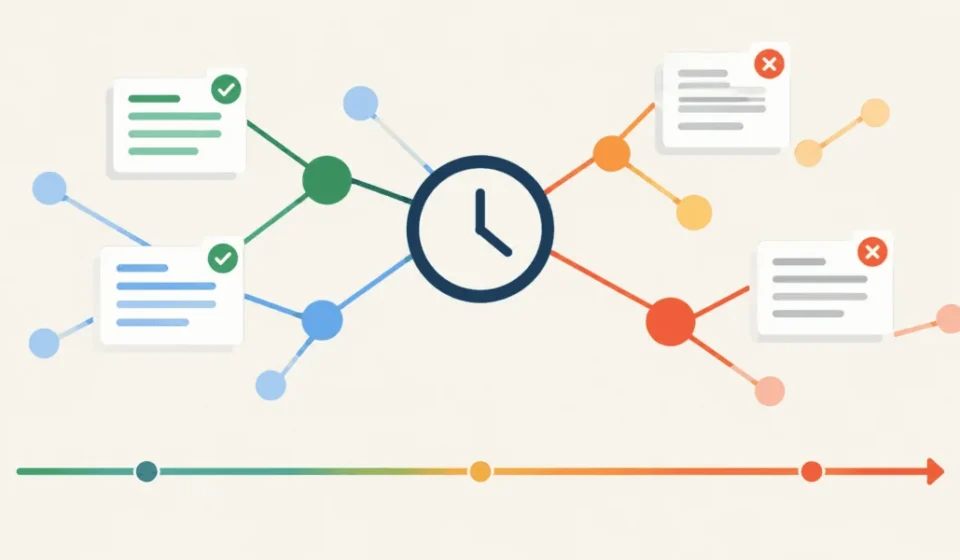
Adding Temporal Reasoning to Graph-RAG Tracking Fact Freshness and Staleness

The rapid evolution of Retrieval-Augmented Generation (RAG) has transformed how large language models (LLMs) interact with proprietary and real-time data. However, as enterprise adoption scales, a critical flaw has emerged in standard architectures: the inability to distinguish between current truths and historical artifacts. In the traditional RAG framework, information is often treated as a static repository, where a fact recorded three years ago carries the same weight as one recorded three hours ago. To solve this, developers are now implementing lightweight temporal reasoning layers within Graph-RAG systems, transitioning from "timeless" knowledge graphs to dynamic, time-aware engines that prioritize fact freshness and mitigate the risk of AI hallucinations.
The Architecture of Fact Persistence and the Hallucination Risk
Standard knowledge graphs operate on the principle of Subject-Predicate-Object (SPO) triples. For example, a graph might store the information (GlobalTech, HAS_CEO, Jane Doe). While this structure is efficient for mapping relationships, it lacks a chronological dimension. If Jane Doe resigns and is replaced by John Smith, a standard retrieval system may still surface the "Jane Doe" node during a query, especially if that node has high semantic similarity to the user’s prompt or a higher number of inbound edges in the graph.
This structural limitation is a primary driver of hallucinations in enterprise AI. When an LLM is presented with conflicting facts—such as two different people being listed as the current CEO of the same company—it often lacks the deterministic logic to choose the correct one. It may attempt to synthesize a compromise, suggest both are true, or confidently state the outdated information. By adding a temporal reasoning layer, developers can transform these triples into "temporal quads," adding a timestamp as the fourth dimension: (Subject, Predicate, Object, Timestamp). This allows the system to evaluate the "age" of a fact before it ever reaches the LLM’s context window.
Chronology of Development: From Vector Search to Temporal Graphs
The journey toward temporal reasoning in RAG systems has followed a clear evolutionary path. Initially, RAG relied almost exclusively on vector search, which retrieves document chunks based on mathematical similarity. While effective for general knowledge, vector search is notoriously poor at handling specific, conflicting data points.
The second phase saw the rise of Graph-RAG, which introduced a 3-tiered deterministic approach. This system used knowledge graphs to provide a structured "ground truth" that could override the probabilistic nature of vector embeddings. However, even these graphs struggled with the "messiness" of the real world, where leadership changes, stock prices fluctuate, and corporate policies are updated.
The current third phase, the implementation of temporal reasoning, introduces a mathematical decay function to the retrieval process. This process involves three distinct technical steps:
- Schema Expansion: Upgrading the data storage format from (S, P, O) to (S, P, O, T).
- Recency Weighting: Implementing an exponential decay algorithm to assign a "confidence score" based on the elapsed time between the fact’s recording and the user’s query.
- Ranked Retrieval: Sorting the retrieved facts by their temporal weight so that only the "freshest" data is injected into the prompt.
Technical Implementation: The Logic of Exponential Decay
The core of a temporal reasoning engine lies in its ability to calculate recency weights. In a professional implementation, this is often achieved through exponential decay, a mathematical principle commonly used in physics and finance. The system assigns a "half-life" to facts—a period after which a fact’s relevance is considered to have dropped by 50%.
For instance, in a highly volatile environment like a newsroom or a stock trading floor, the half-life of a fact might be set to 24 hours. In a more stable corporate environment, such as one tracking board memberships, the half-life might be 365 days.
The Python-based implementation of this logic requires two primary functions. The first, a calculate_recency_weight function, determines the age of the fact in days and applies the formula: weight = (0.5) ^ (age_in_days / half_life). This ensures that a fact asserted today has a weight of 1.0, while a fact that has reached its half-life has a weight of 0.5.
The second component is the query_temporal_graph function. This function does not merely look for matches; it filters facts based on the "as-of" date requested by the user. If a user asks, "Who was the CEO in 2022?" the system travels back in time, ignoring any facts timestamped after December 31, 2022, and then ranks the remaining facts by their proximity to that date.
Supporting Data: The Impact of Data Staleness on Accuracy
Recent industry benchmarks highlight the necessity of this approach. According to data from AI safety researchers, the accuracy of RAG systems in "dynamic environments"—defined as datasets where 20% or more of the facts change annually—drops by as much as 40% when temporal context is ignored.
Furthermore, the "cost of staleness" is not just a matter of accuracy but of computational efficiency. When a RAG system retrieves five conflicting versions of a fact, the prompt sent to the LLM becomes bloated. This increases token consumption and latency. By using a temporal reasoning layer to filter out stale facts before the prompt is generated, developers can reduce context window usage by an estimated 15-25%, leading to faster response times and lower operational costs.
Case Study: Navigating Organizational Chaos
To illustrate the effectiveness of temporal reasoning, consider a hypothetical scenario involving "TechCorp," a company undergoing a rapid leadership transition. In a single week, the CEO position changes from Alice to Bob, then briefly to Charlie, before Bob returns to the role.
A standard RAG system, when asked on Friday "Who is the CEO?", would likely retrieve all three names. It might conclude that TechCorp has a co-CEO structure or that the data is simply corrupted.
With a temporal reasoning engine, the system evaluates the timestamps:
- Alice (2021-01-15): Weight 0.13
- Bob (2023-11-17): Weight 0.97
- Charlie (2023-11-19): Weight 0.98
- Bob (2023-11-21): Weight 0.99
The engine identifies Bob’s most recent appointment as the "freshest" fact. If the system is integrated with a 3-tiered Graph-RAG architecture, it will pass only the top-ranked candidate to the LLM, resulting in a deterministic and correct answer: "As of today, Bob is the CEO of TechCorp."
Professional Reactions and Industry Perspectives
Data scientists and AI architects have largely welcomed the shift toward temporal graphs. "The industry is moving away from the ‘black box’ approach to RAG," says one senior machine learning engineer. "We are realizing that the LLM shouldn’t be responsible for sorting through our messy data. The retrieval layer needs to be smarter. Temporal reasoning provides a mathematical guarantee of relevance that semantic search simply cannot match."
However, experts also warn that the "half-life" parameter must be tuned with precision. If the decay is too aggressive, the system may discard valuable historical context. If it is too slow, the system remains susceptible to stale data. The consensus among practitioners is that the half-life should be a dynamic variable, potentially adjusted based on the "Predicate" of the triple. For example, a FOUNDED_IN relationship should have an infinite half-life, whereas a CURRENT_PRICE relationship should decay in minutes.
Broader Impact and Future Implications
The integration of temporal reasoning into Graph-RAG has implications far beyond corporate leadership tracking. In the legal sector, where the "truth" of a regulation depends on its effective date, time-aware AI can prevent lawyers from citing overturned precedents. In healthcare, it ensures that a patient’s most recent lab results are prioritized over historical data in a clinical decision support system.
As we look toward the future of autonomous AI agents, the ability to perceive the flow of time will be a foundational requirement. Agents must understand not only what is true, but when it became true and for how long it is expected to remain true. The move toward temporal quads and recency weighting is a significant step toward creating AI systems that possess a functional "memory" rather than just a static database.
In conclusion, the addition of a lightweight temporal reasoning layer represents a critical refinement of the RAG stack. By treating time as a first-class citizen in the knowledge graph, developers can build systems that are not only more accurate and efficient but also more resilient to the constant flux of information in the modern world. The transition from probabilistic guessing to deterministic, time-aware reasoning is the key to unlocking the next level of enterprise AI reliability.