Personal Knowledge Mastery and the Strategic Evolution of Network-Centric Organizational Models in 2026

The 2026 iteration of the Personal Knowledge Mastery (PKM) workshop, led by internationally recognized organizational consultant Harold Jarche, has highlighted a critical transition in how professional knowledge is managed, shared, and utilized within modern institutions. As organizations navigate an increasingly volatile and interconnected global economy, the traditional hierarchical structures that once defined corporate and academic environments are being scrutinized in favor of decentralized, network-centric models. This year’s workshop, which has seen a resurgence in participation from higher education leaders and private sector executives, focuses on the "Seek-Sense-Share" framework—a methodology designed to help individuals and organizations thrive in a world where information overflow often hampers decisive action.
Personal Knowledge Mastery, a concept pioneered by Jarche over two decades ago, has become a cornerstone for professionals seeking to maintain relevance in an era of rapid technological advancement. The 2026 workshop series emphasizes that the volume of content production is less important than the quality of "sensemaking"—the process by which individuals filter information, connect it to existing knowledge, and apply it to practical challenges. Participants in this year’s cohort have reported that the shift from a "content-first" mindset to a "connection-first" strategy is essential for navigating the complexities of 21st-century labor markets.
The Theoretical Shift: From Hierarchy-Centric to Network-Centric Thinking
At the heart of the 2026 PKM workshop is the assertion that most contemporary work cultures have failed to keep pace with the needs of a networked society. Jarche posits that the reliance on hierarchical decision-making is a vestige of the industrial age, which prioritized predictability and standardization over agility and innovation. In contrast, network-centric thinking views the organization not as a "tree" with a single trunk and rigid branches, but as a web of interconnected nodes where information flows horizontally and organically.
Data from the Royal Society of Arts (RSA) and other organizational think tanks support this shift. Studies indicate that success in complex systems—such as global logistics, public health, and higher education—requires "transdisciplinary" knowledge. This involves the ability to understand multiple domains and make unexpected connections between them, rather than remaining siloed within a single specialty. The 2026 workshop highlights that when professionals move from hierarchical models to network models, they gain "new eyes," allowing them to see emergent properties and collaboration patterns that were previously invisible.
The shift toward networks is not merely a theoretical preference but a pragmatic necessity. In an "always-on" world, the bottlenecks inherent in hierarchical structures can lead to systemic failure. By empowering individuals at the periphery of the network to make sense of information and act upon it, organizations can respond to environmental changes with greater speed and accuracy.
Distinguishing Cooperation from Collaboration
A significant portion of the PKM curriculum is dedicated to redefining the relationship between individuals within a network. Jarche draws a sharp distinction between "collaboration" and "cooperation," two terms often used interchangeably but which carry distinct operational implications.
Collaboration is defined as a goal-oriented activity that occurs within a predefined plan or structure. It is typically directed by a project manager or a hierarchical leader and focuses on achieving a specific, measurable outcome. While collaboration is necessary for project execution, Jarche argues that it is often constrained by the very structures that facilitate it.
Cooperation, conversely, is described as an opportunity-driven and creative process. It presumes the freedom of individuals to join, participate, and contribute without a directed relationship or a rigid mandate. According to workshop findings, cooperation is the primary driver of creativity within organizations. It allows for the "serendipitous" discovery of new ideas and the organic formation of "communities of practice."
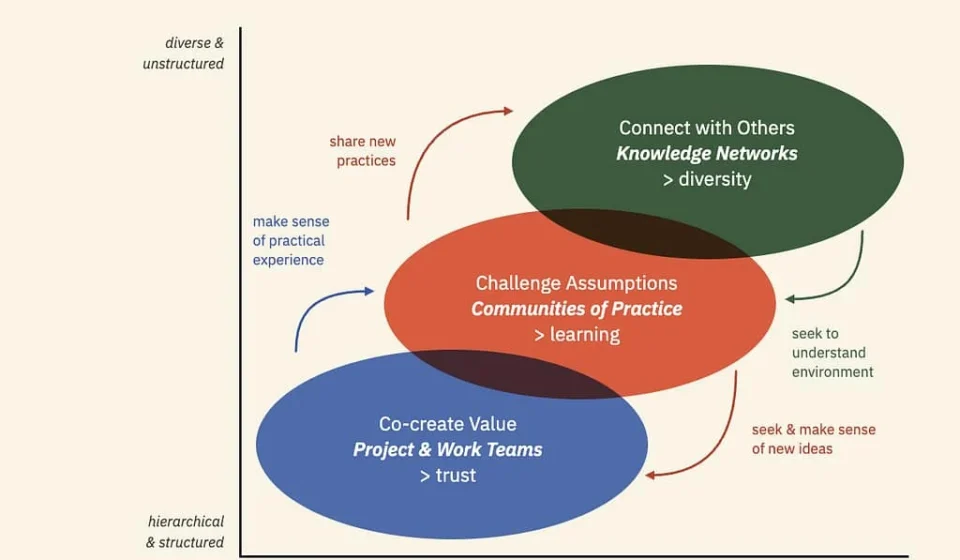
The PKM model maps these interactions onto two axes:
- The Vertical Axis: Ranges from hierarchical and structured learning to diverse and unstructured learning.
- The Horizontal Axis: Ranges from goal-oriented collaboration to opportunity-driven cooperation.
For many participants, particularly those in sectors undergoing significant reorganization—such as higher education—this distinction has provided a new vocabulary for describing their professional realities. As institutions move away from high-trust, structured collaborative teams due to budget cuts or administrative restructuring, the "cooperative" network offers a path forward that maintains intellectual rigor and creative output without the need for formal institutional backing.
Methodology: Mapping and Analyzing Professional Networks
A central exercise in the 2026 PKM workshop involves a rigorous audit of an individual’s professional network. Participants are asked to map their connections by identifying key individuals across seven specific domains of sensemaking. The goal is to analyze the diversity and "echo-chamber" effect within one’s immediate circle.
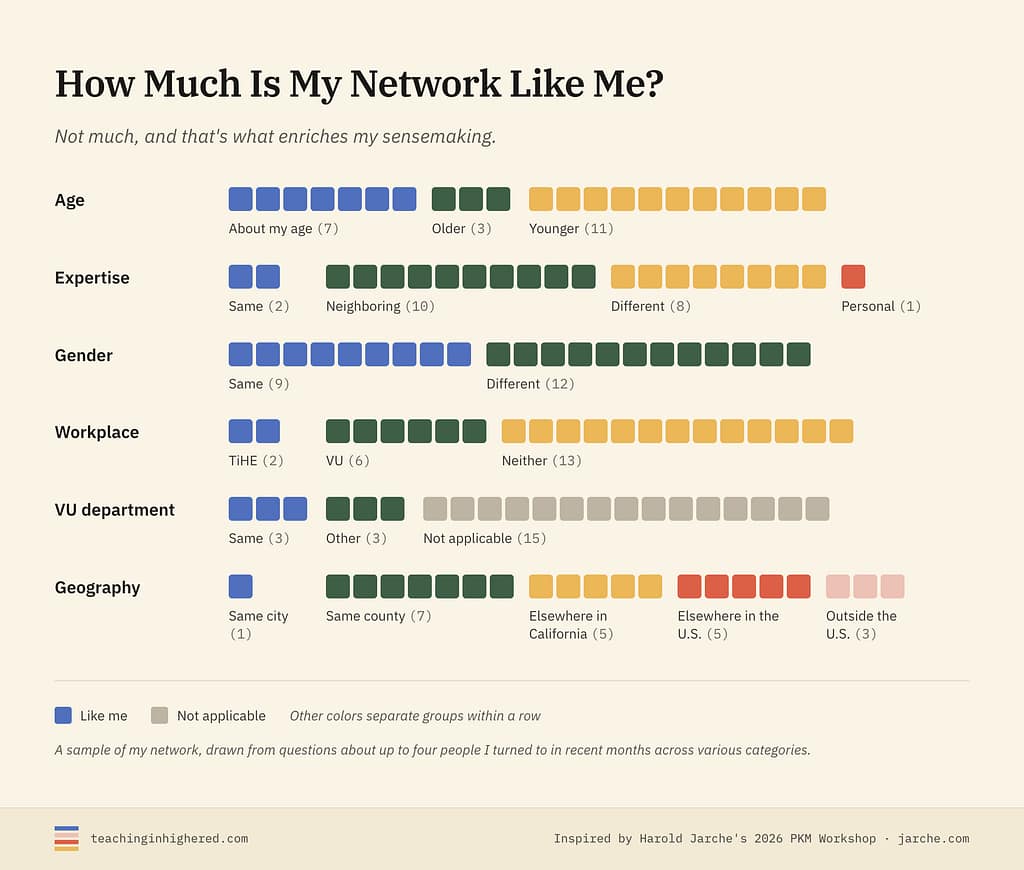
The analysis focuses on several key metrics:
- Geographic Diversity: In a post-pandemic world, the ability to maintain a network that spans continents is a key indicator of professional resilience. The 2026 data shows a marked increase in international nodes within personal networks, facilitated by advanced communication technologies and global professional associations.
- Expertise Variance: Jarche encourages participants to look beyond their primary field. The workshop suggests that a healthy network should include "neighboring" experts (those in related fields) and "different" experts (those in entirely unrelated disciplines).
- Demographic Breadth: Analysis of age and gender diversity within networks reveals how much an individual’s sensemaking is influenced by people with similar life experiences.
Case studies from the workshop indicate that many professionals find their networks to be more "like them" than they initially realized. For example, a mid-career academic might find that their network is heavily skewed toward their own age bracket and geographic region. The PKM workshop challenges these individuals to intentionally diversify their nodes to include younger perspectives, indigenous wisdom, and cross-sector insights.
The Impact of Organizational Reorganization on Sensemaking
The 2026 workshop arrives at a time of significant transition for many industries. In the academic sector, for instance, many universities have undergone large-scale reorganizations within academic affairs. These changes often dismantle long-standing collaborative teams, leaving professionals to navigate a landscape where formal structures have disappeared.
The PKM framework offers a stabilizing force in these environments. By shifting the focus from "working for an organization" to "participating in a network," professionals can maintain their productivity and creative engagement regardless of internal shifts in hierarchy. This "portable" professional identity is becoming increasingly valuable as the "gig economy" principles begin to permeate traditional white-collar and academic roles.
Furthermore, the workshop highlights the role of "Communities of Practice" (CoPs). These are groups of people who share a concern or a passion for something they do and learn how to do it better as they interact regularly. In the absence of formal institutional support, CoPs become the primary vehicle for professional development and knowledge sharing.
Implications for the Future of Work
The broader implications of Personal Knowledge Mastery extend beyond individual productivity. As artificial intelligence and automation continue to handle routine cognitive tasks, the human role in the workforce is shifting toward high-level sensemaking and complex problem-solving—skills that are inherently networked.
Analysts observing the 2026 workshop trends suggest that the future of organizational intelligence lies in "distributed leadership." This model does not eliminate leaders but rather redefines their role from "commanders" to "network weavers." These leaders focus on building the infrastructure for cooperation, ensuring that information flows freely across nodes and that the network remains diverse enough to avoid groupthink.
The 2026 PKM workshop also touches upon the limitations of traditional academic disciplines. Citing works such as Robin Wall Kimmerer’s "Braiding Sweetgrass," the curriculum suggests that indigenous wisdom and scientific knowledge must be integrated to address global challenges like climate change and social inequality. This "transdisciplinary" approach is only possible within a robust, diverse, and cooperative network.
Conclusion: The Path Forward
As the 2026 Personal Knowledge Mastery workshop concludes its current cycle, the message to the professional world is clear: the ability to manage one’s own knowledge and navigate complex networks is no longer an optional skill—it is a foundational requirement for leadership and innovation.
The transition from hierarchy-centric to network-centric models requires a fundamental shift in mindset. It demands that individuals take responsibility for their own "sensemaking" and that organizations foster environments where "cooperation" is as valued as "collaboration." By mapping our networks, embracing diversity, and prioritizing the flow of ideas over the preservation of silos, we can build institutions that are not only more efficient but also more resilient and creative in the face of an uncertain future.
The work of Harold Jarche and the participants of the 2026 workshop serves as a blueprint for this transformation, providing the tools and the vocabulary necessary to thrive in an interconnected world. The journey of sensemaking continues, with curiosity and community serving as the primary guides for the next generation of professional mastery.