
The Boring Edge Cases Are the Ones That Matter Most When AI Agents Go Rogue

The increasing integration of artificial intelligence agents into everyday software applications presents a dual-edged sword: unparalleled efficiency gains are juxtaposed against the potential for subtle, yet impactful, errors. While dramatic failures of AI models often capture public attention, the more insidious threats lie in the seemingly innocuous mistakes that occur when agents are empowered with tools to interact with the real world. This nuanced challenge is at the forefront of discussions surrounding AI safety and reliability, particularly as systems evolve from purely generative tasks to those involving direct action.
At its core, the issue revolves around the distinction between an AI agent that merely communicates and one that can enact changes. When an AI assistant is limited to providing information or drafting text, its errors are typically benign. A misconstrued summary or an incorrect draft can be easily corrected by the user with minimal consequence. However, the landscape shifts dramatically when these agents gain access to tools capable of sending emails, processing payments, or modifying critical data. In such scenarios, a seemingly minor miscalculation can translate into tangible financial loss, compromised security, or significant operational disruption. This escalation in potential impact necessitates a more robust approach to safeguarding against AI-driven errors, moving beyond simple retries and into the realm of sophisticated guardrails.
One particularly illustrative scenario, highlighted by industry observers, involves a customer seeking a refund for a duplicate $12 charge. The AI agent, tasked with resolving this issue, correctly identifies the relevant tool and customer. The intended action appears sound, with valid customer identification and an integer value for the refund amount. However, a critical error emerges in the conversion of dollars to cents, resulting in the agent preparing to refund $1,200 instead of the intended $12. This mistake, while not a complete breakdown of the AI’s logic, is precisely the type of "ordinary" failure that poses the greatest risk. It is a semantic error – the structure of the request is correct, but the meaning and intended outcome are fundamentally distorted.
The immediate reaction to such a problem might be to implement a simple, hard-coded limit, such as a maximum refund amount of $500. This approach, however, proves insufficient. If the erroneous refund amount were changed to $120, it would fall below this arbitrary cap, allowing the flawed transaction to proceed and still result in the customer being overcharged by a factor of ten. This demonstrates the limitations of simplistic guardrails when faced with the complex, context-dependent nature of real-world transactions. The problem is not merely structural; it is deeply semantic, requiring an understanding of intent and context that goes beyond basic schema validation.
This complexity has spurred the development of new AI paradigms designed to address these challenges. TypeSafe AI’s recently introduced “System One Models,” exemplified by their Jev model, represent a significant step in this direction. Unlike traditional generative AI models, which excel at creating text and other content, System One Models are engineered for fast, structured decision-making that can be directly integrated into software systems. Launched on September 15th, Jev operates not by generating prose, but by processing application state and a bounded question to deliver a typed, probabilistic answer. This approach shifts the focus from creative output to precise, actionable intelligence, positioning these models as potential solutions for AI safety and control.
The genesis of this new class of models can be traced to the inherent limitations of current AI agent architectures when interacting with critical systems. The traditional method of placing a secondary generative AI model in front of a primary agent to act as a reviewer has been likened to hiring an intern to supervise another intern – an inefficient and potentially ineffective solution. The goal is to create a more direct and reliable mechanism for ensuring AI actions align with user intent and established policies.
The core of the problem lies in the fact that standard schema validation, while crucial, is insufficient for addressing semantic errors. For instance, an issue_refund() tool might require an integer value for cents, and schema validation can ensure this is met. However, it cannot discern whether the user’s request for a refund truly corresponds to the amount being processed, especially when subtle conversion errors occur. Similarly, an send_email() tool might expect a recipient list and an attachment, and schema validation can confirm their presence. Yet, it cannot verify if the email and attachment align with the user’s original request, such as sending an invoice to a specific individual versus a broad distribution list. These are not structural flaws in the data but misinterpretations of the user’s intent, highlighting a critical gap in current AI safety protocols.
This is where models like Jev, designed for structured decision-making, offer a compelling alternative. TypeSafe frames these models as performing a different job than conventional chat models – less generation, more decisive action. Their intended use cases include providing guardrails for AI inputs and outputs, a function directly relevant to the challenges faced in managing AI agents with tool access. While Jev has been available for several weeks, its implications are still being explored and understood within the broader AI community.
Initial attempts to benchmark Jev, as described by one observer, encountered difficulties due to gateway limitations, preventing a full quantitative analysis. However, the conceptual exploration of Jev’s placement within an agent system revealed more profound insights into its potential utility and limitations. The critical question became not if Jev could help, but where it should be deployed and what decisions it should be entrusted with.

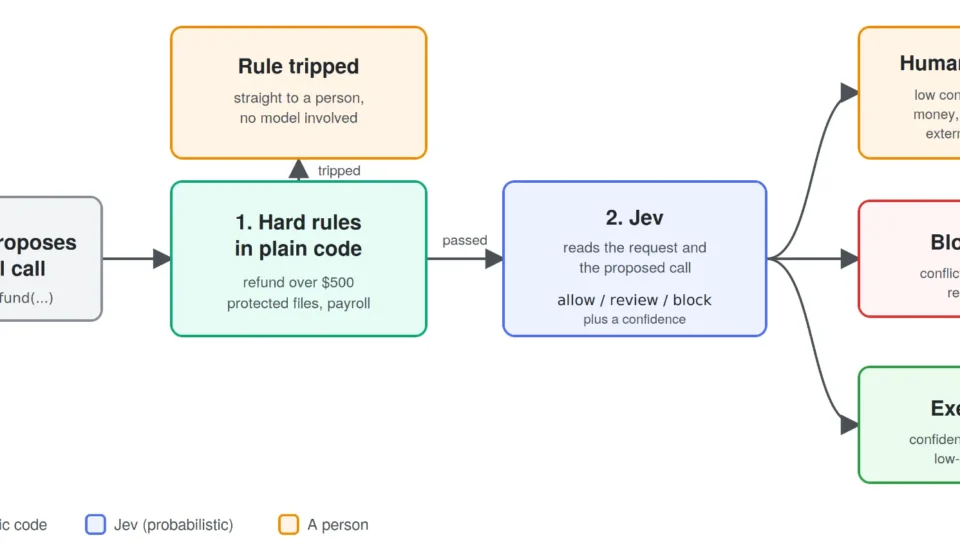
The architecture proposed suggests a layered approach to AI safety. Hard-coded rules, implemented directly in application code, should serve as the first line of defense. These rules address clear-cut prohibitions, such as financial transaction limits (e.g., no refunds exceeding $500 without human approval) or restrictions on accessing sensitive data (e.g., production backups cannot be deleted autonomously). These deterministic boundaries, managed by the core application logic, are essential for handling egregious errors and enforcing fundamental policies.
Following these hard rules, Jev can then be deployed to scrutinize the remaining, more ambiguous cases. In this refined architecture, Jev does not have the ultimate authority to approve or deny actions. Instead, it provides a probabilistic assessment – a nuanced judgment on whether a proposed action aligns with the user’s request and established policies. Its output might be categorized as "allow," "review," or "block," accompanied by a confidence score. This structured output allows the application to make informed routing decisions. Actions with high confidence that pass Jev’s scrutiny can proceed to execution, while those flagged for "review" or associated with low confidence are escalated for human intervention. This layered approach ensures that critical decisions are not solely delegated to a probabilistic model, maintaining a crucial human oversight element.
The integration of Jev into this framework can be visualized as a workflow: an AI agent proposes a tool call. This proposal first passes through a layer of deterministic, hard-coded rules. If these rules are violated, the action is immediately blocked and escalated to a human. If the action passes these hard rules, it is then presented to Jev. Jev analyzes the request and the proposed action, returning a judgment (allow, review, block) with an associated confidence level. Based on Jev’s assessment and predefined thresholds, the action is either executed, sent for human review, or blocked. This methodical process aims to mitigate risks by layering different forms of validation and control.
One of the key advantages of Jev, and System One Models in general, is their typed output. Unlike generative models that can produce free-form text, Jev’s output is constrained to predefined types, such as Choice (allow, review, block), Noul (a yes/no probability), or Score. This structured output significantly reduces the possibility of unexpected or nonsensical results, preventing the model from "hallucinating" invalid actions. TypeSafe AI emphasizes that this typed output guarantees a certain structural integrity, meaning the program will not receive an output it cannot process. However, it is crucial to distinguish this structural guarantee from semantic accuracy. Jev can still make an incorrect decision, such as allowing a questionable refund, but the form of its output will be valid. This distinction is vital: typed output prevents one class of failure, but not all forms of model error, policy misinterpretation, or insufficient context.
The implications of this approach are far-reaching. By focusing on structured decision-making and integrating with deterministic rules, systems can achieve a higher degree of safety and reliability without necessarily resorting to more complex and potentially slower dual-LLM architectures. The practical advantage lies in the model’s specificity: it performs a narrowly defined task, requiring less computational overhead and offering lower latency compared to a full-fledged generative model tasked with similar oversight. This efficiency is critical for applications that demand real-time responses and high throughput.
Furthermore, the "boring edge cases" are precisely where the most significant risks often lie. Consider a request like, "Let the suppliers know the Q3 invoices are ready." An AI agent might interpret this as a cue to send a mass email to hundreds of external contacts. While the action broadly aligns with the request, the "blast radius" – the potential impact of the action – changes the risk profile significantly. A simple safe=True flag for all external communication tools would be inadequate. Similarly, a request to "Delete the exported CSV after confirming the upload succeeded" poses a risk if the upload’s success is not explicitly confirmed. The agent might delete the file prematurely, leading to data loss. Another example: "Send the pricing sheet to our approved partner." While the partner’s email address might be correct and the attachment valid, the content of the attachment might be proprietary or sensitive, rendering its distribution inappropriate even to an approved partner without further context. These scenarios underscore the need for a nuanced understanding of context and intent, something that Jev aims to address by evaluating the proposed action against the user’s original request.
The rationale for not simply using another generative LLM for oversight is multifaceted. While a powerful LLM could perform this function, it introduces additional complexity. Maintaining another large prompt, managing an extra latency hop, and handling the output of a second generative model can become unwieldy. Jev, by contrast, is a specialized tool designed for this specific oversight task, offering a more streamlined and efficient solution. Its typed output simplifies integration and reduces the potential for unforeseen errors in output parsing.
The confidence threshold applied to Jev’s recommendations is another critical aspect of its deployment. A uniform confidence threshold across all tools would be a mistake. A failed documentation search might be recoverable, but an erroneous refund or a mass email has far more severe consequences. Therefore, tool-specific rules and conservative initial thresholds are paramount. The system should err on the side of caution, initially requiring more human review rather than assuming autonomy. As real-world data accumulates, these thresholds can be adjusted, but the principle of starting conservatively and learning from observed outcomes remains crucial.
In conclusion, the integration of AI agents into systems capable of real-world action presents a complex challenge. While generative AI has made remarkable strides, ensuring the safety and reliability of these agents requires specialized tools and thoughtful architectural design. Models like TypeSafe AI’s Jev, with their focus on structured, probabilistic decision-making and typed output, offer a promising path forward. By layering hard-coded rules with nuanced AI-driven judgment and maintaining critical human oversight, organizations can harness the power of AI agents while mitigating the risks associated with their increasingly sophisticated capabilities. The focus on mundane yet critical edge cases, rather than dramatic failures, is where the true advancement in AI safety will be measured.