
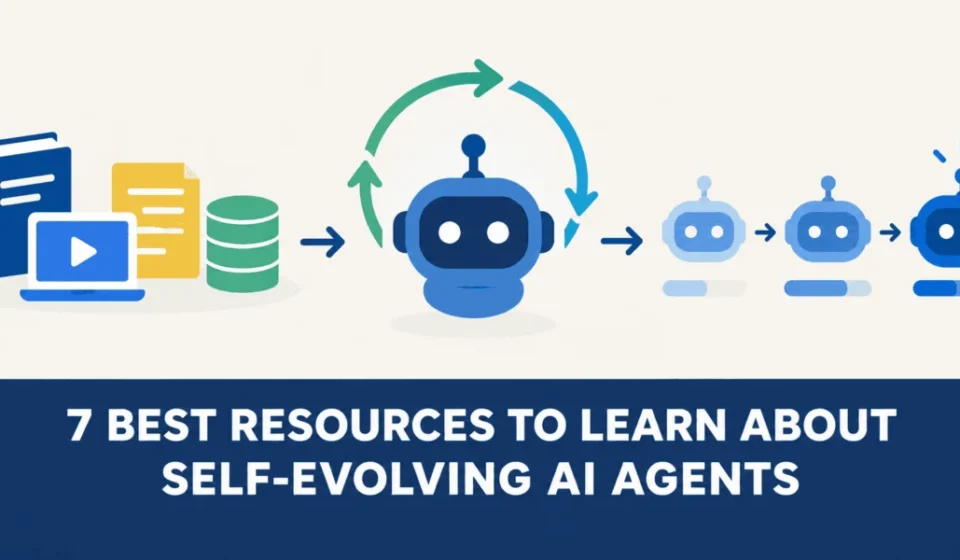

Artificial intelligence agents are rapidly transcending their traditional roles, moving beyond simple command-and-response mechanisms. A significant and burgeoning area of AI research is exploring the ambitious question of whether AI agents can autonomously enhance their capabilities through accumulated experience. These sophisticated systems, often termed self-evolving, self-improving, or recursively self-improving AI agents, represent a paradigm shift. Unlike static AI models that maintain their behavior post-deployment, these agents possess the capacity to learn from past mistakes, build a persistent memory, develop reusable skill sets, refine their own operational prompts, adapt their strategies for tool utilization, and even modify their internal reasoning processes. This article outlines seven premier resources for individuals seeking to deepen their understanding of this transformative field.
The Evolution of AI Agents: From Static Tools to Dynamic Learners
The concept of AI agents has evolved considerably. Initially, agents were primarily designed to execute predefined tasks, often by interacting with external tools or databases based on explicit instructions. Think of a customer service chatbot that accesses a knowledge base to answer frequently asked questions. The advent of Large Language Models (LLMs) has significantly expanded the potential of these agents, enabling more complex reasoning and natural language interaction. However, the current frontier of AI agent research focuses on equipping these systems with a degree of self-awareness and the ability to learn and adapt in real-time. This self-improvement capability is crucial for developing AI that can tackle increasingly complex and dynamic real-world problems, from scientific discovery to intricate logistical challenges.
The underlying motivation for developing self-evolving AI agents stems from the limitations of traditional AI development. Training and fine-tuning AI models is a resource-intensive and time-consuming process. Furthermore, static models can quickly become outdated as the environments they operate in change or as new data becomes available. Self-evolving agents offer a potential solution by enabling continuous learning and adaptation without constant human intervention. This could lead to AI systems that are more robust, efficient, and capable of handling unforeseen circumstances.
Foundational Understanding: Mastering the Basics of Agentic Systems
Before delving into the intricacies of self-evolution, a solid grasp of fundamental AI agent principles is essential. The field of agentic AI, particularly as it pertains to LLMs, relies on a core set of concepts that enable agents to interact with their environment and perform tasks.
1. Hugging Face Agents Course: Building Blocks of Agentic Intelligence
For newcomers to the domain of AI agents, the Hugging Face Agents Course is an indispensable starting point. This comprehensive and freely accessible course provides a robust foundation in the core mechanics of how ordinary AI agents function. It meticulously explains the critical Think/Act/Observe loop, a fundamental cycle of operation for most intelligent agents. The curriculum also covers essential elements such as effective tool utilization, sophisticated reasoning capabilities, and the architecture of prominent agent frameworks.
Key frameworks introduced include smolagents, a lightweight and modular agent framework; LangGraph, a powerful library for building complex agentic workflows with state management; and LlamaIndex, an API for connecting LLMs to external data. The course also delves into agentic retrieval-augmented generation (RAG), a technique that enhances LLM responses by incorporating relevant information retrieved from external knowledge sources. Furthermore, it addresses function-calling fine-tuning, a method for teaching LLMs to accurately call external functions, and crucial aspects of observability and evaluation, which are vital for understanding and assessing agent performance.
The Hugging Face Agents Course is particularly valuable due to its hands-on approach. It includes practical assignments designed to solidify learning and culminates in a benchmark-based project, allowing participants to apply their newly acquired knowledge in a simulated real-world scenario. This structured learning path ensures that individuals are well-equipped with the necessary conceptual and practical skills before exploring more advanced topics like self-modification. As of early 2024, the field of generative AI and agentic systems has seen rapid growth, with platforms like Hugging Face at the forefront of democratizing access to these technologies through educational initiatives.
Academic Rigor: A Structured Approach to Self-Improvement
While practical courses provide essential grounding, a deeper, more theoretical understanding is often required to grasp the nuances of self-evolving AI. Academic institutions are increasingly offering specialized courses that dissect the complex mechanisms behind AI self-improvement.
2. Stanford CS329A: Self-Improving AI Agents – A Deep Dive
Stanford University’s CS329A: Self-Improving AI Agents is widely regarded as a premier academic resource for understanding the theoretical underpinnings of self-evolving AI. This course offers a meticulously structured curriculum that systematically explores various techniques for enabling Large Language Models to improve themselves. It covers advanced concepts such as Constitutional AI, where AI models adhere to a set of predefined principles or "constitutions" to guide their behavior and learning, and verifiers, which act as external checks on an AI’s outputs.
The course also delves into test-time compute, a method for dynamically allocating computational resources during inference to enhance performance, and the application of reinforcement learning principles to drive self-improvement. Beyond these core techniques, CS329A addresses critical components of advanced agentic systems, including sophisticated tool use, the development of persistent memory, multi-step reasoning, and strategic planning. It also examines various evaluation frameworks designed to measure the efficacy of self-improvement strategies.
A significant strength of CS329A is its syllabus organization. Instead of focusing solely on specific agentic frameworks, it is structured around seminal research papers. This pedagogical approach provides students with a profound understanding of the how and why behind an agent’s self-improvement capabilities. The course strongly encourages participants to follow the lecture sequence, engage deeply with the assigned research papers, and attempt to reproduce key experimental findings. This methodology fosters critical thinking and a hands-on appreciation for the scientific process in AI development. The academic year 2023-2024 has seen a surge in interest in such specialized AI courses, reflecting the growing importance of advanced AI capabilities in both research and industry.
Comprehensive Surveys: Navigating the Research Landscape
The rapid pace of AI research can make it challenging to keep abreast of the latest developments. Comprehensive surveys published in academic repositories offer invaluable roadmaps, synthesizing existing knowledge and identifying key trends.
3. A Comprehensive Survey of Self-Evolving AI Agents – Defining the Field
This seminal survey serves as a pivotal resource for clarifying what researchers precisely mean by the term "self-evolving agent." It frames the concept of evolution within AI as a continuous feedback loop that intricately connects the agent, its operational environment, incoming system inputs, and an underlying optimizer. This model provides a clear conceptual framework for understanding the dynamic interplay involved in AI self-improvement.
The survey meticulously examines the various components of an AI agent that are susceptible to evolution. These include the underlying AI model itself, its memory architecture, the prompts that guide its behavior, the tools it can access, and even the emergent organization of multi-agent systems. Furthermore, it explores domain-specific applications of self-evolving agents across critical sectors such as programming, finance, and biomedicine, highlighting the practical implications and potential of this technology. The publication of such comprehensive surveys, often available on platforms like arXiv, is a critical step in organizing and disseminating cutting-edge AI research.
4. Self-Improvements in Modern Agentic Systems: A Survey – A 2026 Perspective
Complementing the previous survey, this resource offers a contemporary perspective on the field, providing insights into the state of self-improvement in agentic systems as envisioned for 2026. A key contribution of this survey is its distinction between the improvement of the foundational AI model itself and the enhancement of the agent’s "scaffolding." This scaffolding encompasses the various supporting elements that enable an agent to function effectively, including prompts, memory systems, tool integration, skill acquisition, and control logic.
The survey elaborates on the nuanced differences between various improvement strategies. For instance, an agent that dynamically rewrites its own prompts operates on a different principle than one that systematically builds a library of reusable skills or one that directly fine-tunes its underlying AI model. By providing a system-level taxonomy, this survey offers a valuable framework for understanding these distinctions. It also critically examines the challenges and open research problems related to the evaluation of self-improving agents, underscoring the ongoing need for robust assessment methodologies. The projection of the field to 2026 suggests a proactive approach by researchers to anticipate future advancements and challenges.
Curated Resources: Leveraging Community-Driven Knowledge
In addition to academic surveys, community-driven repositories have emerged as invaluable tools for navigating the rapidly evolving landscape of AI research. These "Awesome" lists curate papers, code, and other resources, offering a dynamic and up-to-date overview of specific subfields.
5. Awesome Self-Improving Modern Agentic Systems – A Living Bibliography
This GitHub repository serves as an extensive bibliography, particularly useful after engaging with the aforementioned surveys. It meticulously organizes research papers based on the specific aspect of the agent being improved: model parameters, prompts, memory, tools, skills, and complete agent scaffolds. The repository also aggregates relevant benchmarks, courses, conference talks, workshops, and open-source code.
A notable feature is its inclusion of newer work, such as research from 2026, and specific projects like OpenSkill and evolving skill systems. Given the breakneck speed of agent research, a continuously updated resource like this is often more efficient than performing repetitive searches on platforms like arXiv. It reflects the collaborative spirit of the AI research community, where sharing and organizing knowledge accelerates progress. The inclusion of resources from projected future years highlights the forward-looking nature of AI development.
6. Awesome RSI (Recursive Self-Improvement) – A Broad Research Map
This repository offers a broader research map, extending beyond individual agent improvements to encompass the larger concept of Recursive Self-Improvement (RSI). It provides a comprehensive overview of model-level self-improvement, the evolution of AI "harnesses" and scaffolds, advancements in memory systems, embodied AI agents, automated AI research and development, relevant benchmarks, and critical safety considerations.
The resource includes a wealth of papers, frameworks, tools, and evaluation resources across these diverse directions. Its value lies in its ability to contextualize self-evolving agents within the wider landscape of RSI, demonstrating how individual agent improvements contribute to the overarching goal of creating AI systems that can fundamentally enhance their own intelligence. The inclusion of safety considerations is particularly pertinent, as the development of increasingly autonomous and self-improving AI necessitates a strong focus on ethical development and risk mitigation.
7. Awesome Harness Engineering for Self-Improvement – The Operational Edge
This curated list adopts a more focused and operational perspective, concentrating on the "harness" of an AI agent. The harness refers to the surrounding system of tools, memory modules, control loops, evaluation mechanisms, and other supporting infrastructure that enable an agent to function and improve. This resource includes foundational essays, key research papers, and practical engineering perspectives.
It is particularly useful for understanding how AI agents can evolve not only their direct outputs but also the very processes and systems they employ to generate those outputs. This "meta-improvement" is crucial for building robust and adaptable AI systems. The emphasis on practical engineering aspects provides a bridge between theoretical research and real-world implementation, offering insights into the challenges and solutions involved in building and deploying sophisticated agentic systems. The focus on harness engineering underscores the interdisciplinary nature of advanced AI development, requiring expertise in software engineering, systems design, and AI research.
A Recommended Learning Path and Future Implications
For individuals embarking on the journey to understand self-evolving AI agents, a structured learning sequence can be highly beneficial. A recommended progression would involve starting with the foundational Hugging Face Agents Course, followed by the academic rigor of Stanford’s CS329A. Subsequently, delving into the two comprehensive surveys will provide a broad understanding of the research landscape. The "Awesome" repositories, particularly Awesome Self-Improving Modern Agentic Systems, Awesome RSI, and Awesome Harness Engineering for Self-Improvement, can then serve as invaluable, continuously updated resources for deeper exploration and staying current with the field.
The field of AI agent research is progressing at an unprecedented pace. It is important for learners to recognize that comprehensive mastery of every paper and concept may be an unrealistic goal. Instead, focusing on a specific area of interest, following a few key research papers, and engaging in practical implementation through building projects are effective strategies for acquiring knowledge and developing expertise.
The implications of self-evolving AI agents are profound and far-reaching. As these systems become more capable of independent learning and improvement, they hold the potential to revolutionize numerous industries. In scientific research, they could accelerate discovery by autonomously designing experiments and analyzing complex datasets. In healthcare, they might lead to more personalized and adaptive diagnostic and treatment plans. In the realm of software development, they could automate large portions of the coding process, leading to faster development cycles and more robust applications.
However, the development of such powerful AI also raises significant ethical and safety considerations. Ensuring that self-evolving agents align with human values, remain controllable, and do not exhibit unintended harmful behaviors is paramount. Ongoing research into AI safety and alignment is therefore as critical as the development of self-improvement capabilities themselves. The continued exploration and responsible development of self-evolving AI agents promise a future where intelligent systems are not merely tools but dynamic, adaptive partners in solving humanity’s most pressing challenges.
The author of this article, Kanwal Mehreen, is a machine learning engineer and technical writer with a deep interest in data science and the intersection of AI with medicine. Her work, including co-authoring the ebook "Maximizing Productivity with ChatGPT," demonstrates a commitment to exploring practical applications of AI. Her recognition as a Google Generation Scholar and Teradata Diversity in Tech Scholar, among other accolades, highlights her dedication to academic excellence and her role as a champion for diversity in STEM. Mehreen’s founding of FEMCodes further underscores her commitment to empowering women in technology.