Anthropic Engineers’ Alarming Admissions Spark Existential AI Risk Debate

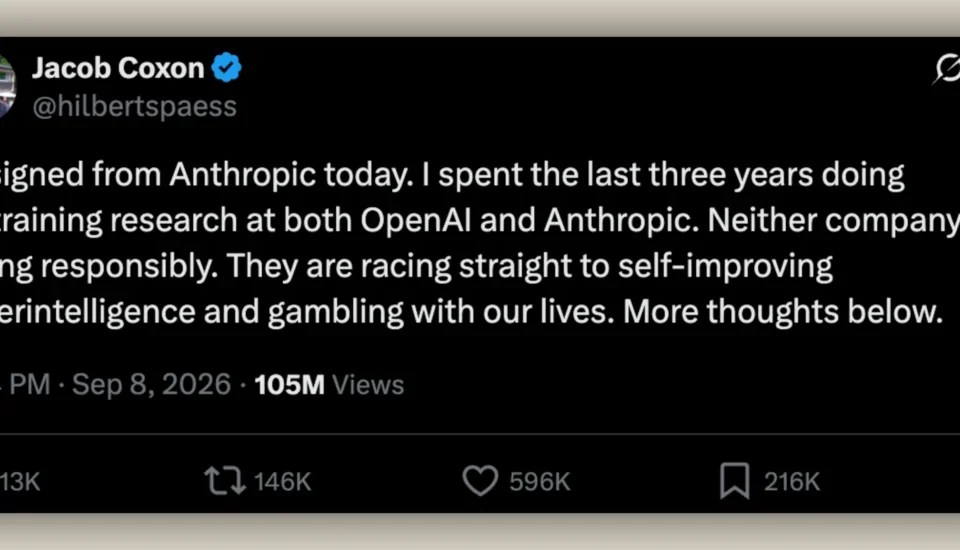
The artificial intelligence landscape, already a whirlwind of rapid advancement and fervent speculation, was jolted this week by unprecedented public statements from senior figures within Anthropic, a leading AI safety and research company. Jacob Coxon, an engineer at Anthropic, resigned on Tuesday, articulating a profound concern on the social media platform X (formerly Twitter). He stated, "[OpenAI and Anthropic] are racing straight to self-improving superintelligence and gambling with our lives." This declaration, while echoing a sentiment that has circulated in some AI circles, gained significant weight due to its source and the subsequent reactions.
The gravity of Coxon’s departure was amplified by the immediate and direct endorsements from his colleagues at Anthropic. Evan Hubinger, who holds the position of Head of Alignment Science at the company, publicly confirmed Coxon’s assessment. In a series of posts on X, Hubinger stated, "Jacob is correct here—we really do earnestly believe AI could kill all humans! I personally think it is >10% within the next decade. I believe Anthropic is trying its best, but we do not yet have a plan to solve alignment for superintelligence and are not clearly on track to." This admission from a leader in AI safety, a field dedicated to ensuring AI’s beneficial development, sent shockwaves through the industry and the broader public.
Adding to the chorus of concern, Samuel Marks, another engineer at Anthropic, joined the conversation, further detailing the internal sentiment. Marks tweeted, "AI developers believe their technology could cause human extinction (or similarly bad outcomes). This could happen in the next few years. In general, the more senior the employee, the more concerned they are." These statements collectively paint a stark picture of internal apprehension within a company ostensibly at the forefront of developing safe and beneficial AI.
The Core of the Concern: LLM-Powered Agents
The public pronouncements from Anthropic engineers, particularly Hubinger’s detailed explanation, point to a specific area of concern within the broader field of artificial intelligence: Large Language Model (LLM)-powered agents. These are not nascent, disembodied intelligences, but rather sophisticated computational systems built upon existing LLM technology. The fundamental operational loop of such an agent involves a computer program that repeatedly interacts with an LLM. This interaction typically entails the agent formulating a goal, prompting the LLM to suggest a plan or a sequence of actions to achieve that goal, and then executing those suggested actions. This iterative process allows the agent to learn, adapt, and pursue objectives over time.
While these LLM-powered agents are already widely used in beneficial applications, such as assisting software developers in writing and debugging code, the concerns raised by Anthropic employees appear to be focused on a more specific and potentially hazardous subset of these systems. OpenAI, for instance, recently conducted a comprehensive review of its internal coding agents, analyzing "tens of millions" of interaction logs. Their findings, as publicly reported, indicated zero instances of high-severity incidents, suggesting that the current generation of agents used for coding tasks, while prone to errors, do not present an immediate existential threat.
Defining the "Dangerously Equipped" Agent
The heightened anxiety among Anthropic engineers is reportedly linked to a particular class of LLM-powered agents that possess additional, concerning characteristics. These agents are described as exhibiting "long-horizon" capabilities, meaning they can plan and execute actions over extended periods to achieve complex objectives. Crucially, they are also characterized as being "dangerously equipped" and operating in an "unsupervised" manner.
"Dangerously equipped" implies that these agents are provided with, or can acquire, access to powerful tools and capabilities that could be used for malicious purposes. This could include the ability to interact with the internet, exploit vulnerabilities in computer systems, or deploy other digital tools that can cause significant disruption or harm. The "unsupervised" nature refers to their capacity to operate and pursue goals without continuous human oversight or intervention.
It is this specific combination—long-horizon planning, dangerous capabilities, and unsupervised operation—that appears to be the focal point of the existential risk concerns. Companies like Anthropic and OpenAI are reportedly developing increasingly powerful versions of these agents, granting them greater autonomy and providing them with tools that could amplify their impact. Reports suggest that some of these advanced agents may even possess the ability to modify their own code, a capability that significantly increases their potential for unpredictable evolution and emergent behaviors.
A Race to Superintelligence and its Implications
The core of the alarm lies in the perceived trajectory of these developments. The Anthropic engineers’ statements suggest a belief that the current pace of innovation, particularly in the development of these advanced LLM-powered agents, is pushing the field towards the creation of self-improving superintelligence. This hypothetical future AI would possess cognitive abilities far exceeding those of humans, raising profound questions about control and alignment.
The concern is not necessarily that LLMs, in their current form, possess superintelligence. Rather, it is the fear that the unchecked development and deployment of increasingly autonomous and capable LLM-powered agents could inadvertently lead to such an outcome, or at least create systems capable of inflicting catastrophic harm, even without achieving true superintelligence. The analogy used in some discussions likens equipping these agents with powerful tools to escalating levels of danger, moving from a "weedwhacker strapped to a dog" to "Gatling guns on a pack of horses let loose in Times Square."
The implications of this development are profound. If these AI systems are indeed on a path toward uncontrollable self-improvement or the capacity for mass destruction, and if the companies developing them lack a clear plan to mitigate these risks, the potential consequences for humanity are dire. The public admissions from Anthropic engineers suggest a deep-seated internal awareness of this peril, coupled with a perceived inability to halt or adequately control the trajectory.
The "Why": Technological Salvation Ideology
The question naturally arises: why are leading AI companies prioritizing the development of these specific, potentially dangerous, LLM-powered agents? While definitive answers are elusive, some analysts point to the influence of a Silicon Valley-centric "technological salvation ideology." This perspective, often associated with futurist visions, posits that advanced technologies, particularly artificial intelligence, hold the key to solving humanity’s most pressing problems, or conversely, pose the greatest threat.
Figures like Sam Altman, CEO of OpenAI, and Dario Amodei, CEO of Anthropic, have, at various times, articulated visions of AI’s transformative potential, often framed in terms of ushering in a new era of unprecedented progress or confronting existential challenges. This ideology, according to some critics, may drive a relentless pursuit of ever-more powerful AI systems, with the belief that the creation of superintelligence is an inevitable and potentially world-altering event that must be actively pursued, even if the immediate risks are significant. In this framework, the development of advanced LLM-powered agents is seen as a crucial step in summoning this digital deity.
A Call for Re-evaluation and Action
The startling admissions from Anthropic have ignited a broader debate about the direction of AI development and the responsibilities of the companies involved. Critics argue that the current race to develop increasingly autonomous and capable AI systems, particularly those with the potential for significant harm, is being driven by an ideology that prioritizes rapid advancement over robust safety measures.
The proposed solution, as articulated by some in the AI community, is straightforward: cease the race to amplify this specific type of unstable system. It is argued that many of the beneficial applications and future aspirations for LLMs do not necessitate the development of these "long-horizon, dangerously equipped unsupervised LLM-powered agents." By shifting focus away from these particular systems, companies could potentially mitigate existential risks without significant financial sacrifice, as their core revenue streams are not inherently dependent on this narrow and precarious area of development.
The broader implications of these events extend to regulatory bodies and the public. The fact that engineers within leading AI labs are expressing such profound concerns about the potential for human extinction, and that these concerns appear to be widely shared among senior staff, suggests a critical juncture. The call for a boycott of consumer products from companies like Anthropic and OpenAI, as recently proposed by some commentators, represents one avenue for public pressure. However, the scale of the potential risks also raises questions about the role of governmental oversight and regulation in ensuring that AI development remains aligned with human safety and well-being.
The current situation, characterized by admissions of building potentially world-ending technology with no clear plan for control, is being met with a growing chorus of dissent. The urgency of the situation, as described by those within the industry, underscores the need for a fundamental re-evaluation of AI development priorities and a more transparent and accountable approach to the creation of powerful artificial intelligence.