UnifiedML 0.2.1 Released: Streamlining R Machine Learning Interfaces with Enhanced Flexibility

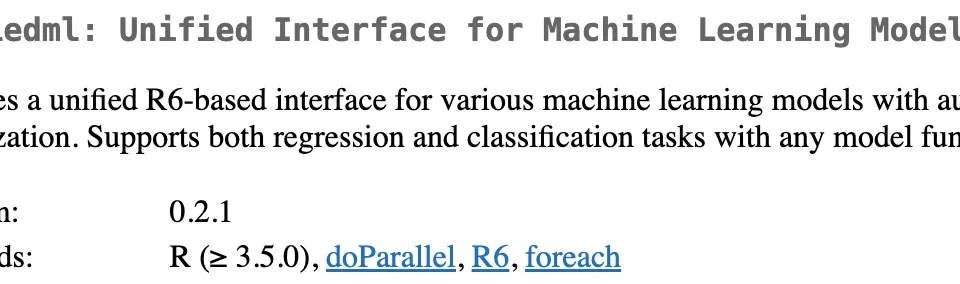
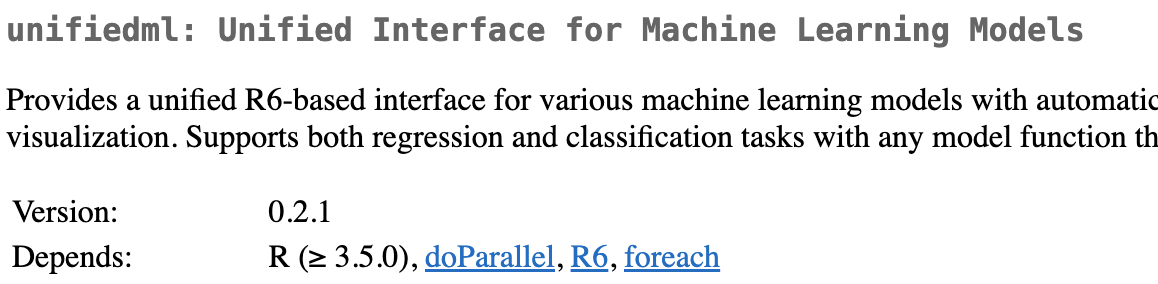
A significant update to the R package unifiedml has been announced, with version 0.2.1 now available on the Comprehensive R Archive Network (CRAN). This release introduces key changes aimed at providing a more unified and adaptable interface for R’s diverse machine learning models. The primary modification involves the deprecation of the explicit type argument within the predict function, replaced by the more generalized ... argument, offering greater flexibility for users.
This latest iteration of unifiedml focuses on refining the interaction between R users and various machine learning algorithms. The package’s core mission is to abstract away the complexities of different model implementations, allowing data scientists and analysts to leverage a consistent API across a range of popular machine learning tools. Version 0.2.1 marks a strategic evolution in this effort, responding to the dynamic needs of the R machine learning ecosystem.
The shift from a specific type argument to the ellipsis (...) in the predict function signifies a move towards a more idiomatic R approach, allowing for the passing of arbitrary arguments to the underlying prediction functions. This change is particularly impactful for advanced users who often need to fine-tune prediction behavior based on the specific requirements of the model being used. The developers have highlighted that this enhancement promotes greater interoperability and reduces the need for specialized prediction logic for each individual model wrapper.
The release notes and accompanying documentation emphasize the package’s utility for classification tasks, providing advanced examples that demonstrate its application with prominent algorithms like ranger and xgboost. These examples, alongside expanded content in the package’s vignettes, serve as valuable resources for users looking to implement sophisticated machine learning workflows within R.
Background and Evolution of UnifiedML
The development of unifiedml stems from a recognized need within the R community for a more cohesive approach to machine learning model integration. Historically, R users have had to navigate a landscape of diverse packages, each with its own syntax for model fitting and prediction. While this diversity fosters innovation, it can also create a steep learning curve and complicate the process of comparing or deploying different models.
unifiedml aims to bridge this gap by creating a meta-package that acts as a wrapper, providing a standardized interface. The package’s design philosophy centers on the principle of "unified interfaces," enabling users to apply the same fundamental operations (like fit and predict) regardless of the underlying algorithm. This not only simplifies code but also enhances reproducibility and maintainability of machine learning projects.
The journey to version 0.2.1 has involved iterative development, with each release building upon the foundational principles of the package. Previous versions likely focused on establishing the core wrapper functionality and integrating a foundational set of algorithms. The current release, with its emphasis on prediction flexibility, suggests a maturation of the package, moving from basic integration to more nuanced control over model behavior.
Key Changes in Version 0.2.1
The most impactful change in unifiedml 0.2.1 is the modification of the predict function. Previously, users might have specified the type of prediction required (e.g., class labels, probabilities). The new implementation replaces this explicit argument with the ... ellipsis, which acts as a placeholder for any additional arguments that the underlying model’s prediction function might accept.
This change offers several advantages:
- Increased Flexibility: Users can now pass arguments directly to the underlying
predictmethods ofranger,xgboost, or any other integrated model. This is crucial for advanced use cases where specific prediction parameters, such as threshold adjustments for binary classification or specific output formats, are required. - Generality: By using
..., theunifiedmlpackage becomes more generic. It can accommodate a wider range of prediction functionalities offered by various models without needing to explicitly define them in theunifiedmlinterface for every model. - Simplified Interface: For common prediction tasks, the
predictfunction can still be called with minimal arguments, maintaining ease of use for standard applications.
The transition to using ... is a common pattern in R package development when aiming for maximum flexibility and extensibility. It allows the wrapper package to remain relevant even as the underlying models evolve and introduce new prediction options.
Advanced Examples: Ranger and XGBoost in Classification
The developers have gone to considerable lengths to illustrate the practical applications of unifiedml 0.2.1, particularly for classification tasks. The release prominently features detailed examples involving two highly popular machine learning algorithms: ranger and xgboost.
Ranger Example: Streamlining Random Forest Predictions
The ranger package, known for its fast implementation of random forests, is a staple in many R machine learning workflows. The provided example demonstrates how to create a custom S3 wrapper for ranger that integrates seamlessly with unifiedml.
The my_ranger function serves as the S3 wrapper. It takes input data x and y, preprocesses it into a suitable format for ranger (ensuring x is a data frame and y is a factor), and then calls the ranger::ranger function. The probability = TRUE argument is specified, indicating that the model should be trained to output probabilities, which is often desirable for classification tasks.
The predict.my_ranger function is crucial for integrating with unifiedml‘s prediction mechanism. It handles incoming newdata or newx, ensures consistent column naming with the training data, and then uses predict(object$fit, data = newdata)$predictions to obtain the model’s output. The logic to convert probabilities to class labels for binary classification (based on a 0.5 threshold) is also included, showcasing how prediction outputs can be managed.
The example then proceeds with a practical demonstration using the Iris dataset, specifically a binary classification scenario between ‘setosa’ and ‘versicolor’. It includes:
- Data Preparation: Subseting the Iris dataset and splitting it into training and testing sets.
- Model Initialization and Fitting: Using
Model$new(my_ranger)to create aunifiedmlmodel object and then fitting it to the training data (mod$fit(X_train, y_train, num.trees = 150L)). - Prediction: Generating predictions on the unseen test set (
mod$predict(X_test)). - Evaluation: Calculating accuracy by comparing predicted labels to true labels and visualizing the results with a confusion matrix.
- Cross-Validation: Demonstrating the use of
cross_val_scorefor robust performance evaluation on the training set, yielding an average cross-validation accuracy.
The inclusion of cross-validation highlights unifiedml‘s capability to facilitate rigorous model assessment, a critical step in building reliable machine learning systems.
XGBoost Example: Harnessing Gradient Boosting Power
Similarly, the xgboost package, a leading implementation of gradient boosting machines, is integrated into unifiedml through a custom wrapper, my_xgboost.
The my_xgboost function preprocesses the input data, ensuring x is a matrix and y is converted to numeric labels (0-indexed for xgboost). It then calls xgboost::xgboost with the provided data and any additional arguments passed via ....
The predict.my_xgboost function handles predictions. It ensures the input newdata is a matrix and then uses predict(object$fit, newdata) to get the raw predictions from the XGBoost model. A key feature demonstrated here is the automatic conversion of predicted probabilities to class labels for binary classification objectives (like binary:logistic), based on a 0.5 threshold.
The example mirrors the ranger demonstration with the Iris dataset, showcasing:
- Data Preparation: Converting features to a matrix and preparing the target variable.
- Train/Test Split: Creating distinct training and testing datasets.
- Model Initialization and Fitting: Instantiating the XGBoost model within
unifiedml(Model$new(my_xgboost)) and fitting it with specificxgboostparameters likenroundsandobjective = "binary:logistic". - Prediction: Making predictions on the test set.
- Evaluation: Assessing model performance through a confusion matrix and overall accuracy.
- Cross-Validation: Employing
cross_val_scoreto estimate the model’s generalization performance, again usingxgboost-specific arguments.
The successful integration and demonstration of both ranger and xgboost underscore unifiedml‘s versatility in handling different algorithmic architectures and their specific parameter requirements.
Broader Implications for the R Ecosystem
The release of unifiedml 0.2.1 with its refined prediction interface has several positive implications for the R machine learning community:
- Increased Efficiency for Data Scientists: By abstracting away model-specific prediction details,
unifiedmlallows data scientists to focus more on model selection, feature engineering, and interpretation rather than the intricacies of API calls for each algorithm. - Enhanced Model Comparability: A unified interface makes it significantly easier to compare the performance of different algorithms on the same dataset. Users can swap out models with minimal code changes, facilitating robust model selection.
- Improved Reproducibility and Maintainability: Standardized workflows lead to more reproducible research and more maintainable codebases. When a project relies on
unifiedml, it becomes easier for collaborators to understand and contribute to the machine learning components. - Facilitation of AutoML and Meta-Learning: Packages like
unifiedmlare foundational for developing automated machine learning (AutoML) systems or meta-learning frameworks within R. These systems can leverage the unified interface to systematically explore a vast array of models. - Support for New and Evolving Models: The flexible design, particularly the use of
...inpredict, ensures thatunifiedmlcan readily accommodate new machine learning algorithms or updates to existing ones without requiring immediate updates to the coreunifiedmlpackage itself, as long as the underlying models follow common R conventions.
The continuous development and availability of unifiedml on CRAN signal a commitment to advancing the usability and power of machine learning in R. The package’s evolution, marked by significant updates like version 0.2.1, positions it as an increasingly vital tool for anyone working with statistical modeling and predictive analytics in the R environment. As the field of machine learning continues to expand, tools that democratize access to advanced algorithms and streamline workflows become ever more critical, and unifiedml appears to be a key player in this ongoing effort.