
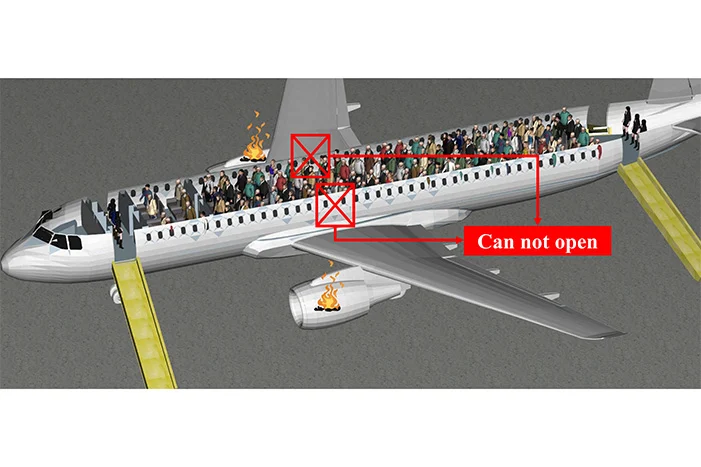
To evacuate quickly in case of an emergency, elderly passengers, who may be limited in dexterity, should be evenly distributed among aircraft cabins.

WASHINGTON, March 31, 2026 – A critical new study published in AIP Advances by AIP Publishing highlights the urgent need for strategic seating arrangements on commercial aircraft, particularly concerning elderly passengers, to ensure rapid evacuation during emergencies. The research, conducted by an international collaboration of experts from institutions including the University of Sydney and the China Academy of Building Research, indicates that the current demographic shift towards an older global population presents significant challenges to the Federal Aviation Administration’s (FAA) stringent 90-second evacuation mandate.
The study’s core finding is stark: even under optimized conditions, a common narrow-body aircraft like the Airbus A320, with a modest proportion of elderly passengers, failed to meet the FAA’s evacuation timeline, requiring 141 seconds in the fastest simulated scenario. This delay underscores a growing safety concern as the global median age continues to rise, bringing new complexities to aviation safety protocols that were established in a different demographic era.
The Evolving Landscape of Aviation Safety
Aircraft safety has long been a paramount concern for regulators and airlines worldwide. Decades of research, incident analysis, and technological advancements have culminated in highly robust safety standards. A cornerstone of these standards is the ability to evacuate an aircraft quickly and efficiently in the event of an emergency, such as a fire or ditching. The FAA’s 90-second rule, which dictates that an aircraft must be fully evacuated in 90 seconds or less with half of its exits blocked, is a testament to this commitment. This rule was largely influenced by tragic incidents, such as the 1985 British Airtours Flight 28M fire at Manchester Airport, where the speed of evacuation was a critical factor in survival rates. The Manchester incident, which resulted in 55 fatalities, predominantly due to smoke inhalation, highlighted the critical importance of rapid egress. Subsequent regulatory changes across the globe, including those by the European Union Aviation Safety Agency (EASA) and other national authorities, often mirror or are harmonized with these stringent evacuation requirements.
However, the world’s demographics are shifting dramatically. According to the United Nations, the global population aged 60 years or over is projected to more than double by 2050, reaching 2.1 billion. This demographic transformation directly impacts the aviation industry, as a larger proportion of airline passengers will fall into this age bracket. While modern aircraft are designed with advanced safety features, the human element in an evacuation remains critical. Factors such as physical mobility, cognitive response time, and situational awareness can vary significantly with age, posing new considerations for emergency procedures and cabin design.
Simulating Disaster: The A320 Study Methodology
To investigate these emerging challenges, the research team focused on a dual-engine fire scenario in an Airbus A320. The A320 family is one of the most widely used narrow-body aircraft globally, making it an ideal model for a study with broad applicability. The researchers employed sophisticated simulation techniques, creating full-scale computer-aided design (CAD) models of the A320 cabin. These models were then integrated with Pathfinder, an industry-standard software specifically designed for evacuation modeling. Pathfinder allows researchers to simulate complex human behaviors, movement patterns, and interactions within a defined space, providing a highly accurate representation of an evacuation event without the inherent risks and costs of real-world trials.
The study systematically explored 27 different evacuation scenarios. These scenarios varied across three key parameters:
- Cabin Layouts: Three distinct cabin configurations were tested, representing different seating densities and class divisions (e.g., economy-only, economy with a first-class section).
- Ratios of Elderly Passengers: Three different proportions of passengers over the age of 60 were modeled, reflecting various potential flight demographics.
- Distribution of Elderly Passengers: Critically, the study examined three different ways these elderly passengers were distributed throughout the cabin: clustered in specific areas, randomly distributed, or evenly distributed.
Author Chenyang (Luca) Zhang emphasized the rationale behind selecting a dual-engine fire scenario, stating, "While a dual-engine fire scenario is statistically rare, it falls under the broader category of dual-engine failures and critical emergencies in aviation. History has shown that dual-engine failures and emergencies, such as the famous ‘Miracle on the Hudson’ involving Captain Sullenberger, can happen and lead to severe consequences. Our study focuses on these low-probability but high-impact events to ensure the highest safety standards." This perspective highlights the proactive approach of the research, addressing potential catastrophic events even if their occurrence is infrequent. The "Miracle on the Hudson" in 2009, where Captain Chesley Sullenberger successfully landed US Airways Flight 1549 on the Hudson River after a dual-engine failure caused by bird strike, serves as a powerful reminder of the human skill and rapid decision-making required in such high-stakes situations, even if it wasn’t an evacuation from a burning plane, it still demonstrates the critical nature of rapid, coordinated responses in emergencies.
Unpacking the Findings: Distribution is Key
The simulations revealed that the proportion and, more importantly, the location of elderly passengers exerted the most significant influence on overall evacuation time. The most efficient scenario identified was a cabin layout accommodating 152 passengers, featuring two rows of first-class seats at the front, where 30 elderly passengers were evenly distributed throughout the cabin. Even in this optimized configuration, the evacuation still took 141 seconds for all passengers to reach the ground. This figure significantly exceeds the FAA’s 90-second mandate, flagging a substantial gap between current regulatory requirements and achievable evacuation times under modern demographic conditions.
The implication is profound: simply having fewer elderly passengers is not enough; their strategic placement within the aircraft cabin is a critical determinant of evacuation speed. Clustered elderly passengers, or those placed in areas far from exits, significantly hampered the flow of evacuation, creating bottlenecks and increasing the overall time. This suggests that the current "first-come, first-served" or random seating assignments, while operationally convenient, may inadvertently compromise safety in an emergency.
The Human Factor: Cognitive and Physical Limitations
Previous scientific studies have consistently demonstrated that age-related physiological and cognitive changes can impact an individual’s response in high-stress situations. Cognitive decline, even mild, can affect situational awareness, decision-making speed, and the ability to process complex instructions under duress. Reduced dexterity, a common age-related physical change, can further exacerbate these challenges, making tasks like unbuckling seatbelts, navigating narrow aisles, or opening emergency exits more difficult and time-consuming. These factors, when combined with the inherent chaos and stress of an emergency evacuation, can lead to delays that ripple through the entire evacuation process.
The researchers hope that by explicitly incorporating this understanding into their findings, airlines and regulators can develop more targeted interventions. For instance, offering additional safety briefings specifically tailored for elderly passengers, perhaps focusing on visual cues, simplified instructions, or pre-assigned assistance roles, could potentially accelerate the deboarding process. Such briefings could be delivered proactively during boarding or via in-flight entertainment systems, preparing passengers more thoroughly for potential emergencies.
Strategic Seating and Operational Efficiency
The findings present a clear directive for airlines: proactive risk mitigation through strategic seating arrangements. Zhang articulated this, stating, "We hope these findings help airlines proactively mitigate risks. By understanding how passenger distribution affects evacuation, airlines could potentially implement more strategic seating arrangements to optimize safety without compromising operational efficiency." This statement highlights the delicate balance between ensuring safety and maintaining the economic viability of airline operations.
Implementing strategic seating could involve various approaches:
- Automated Seating Algorithms: Developing software that automatically distributes passengers based on age and mobility data (collected during booking, with appropriate privacy safeguards) to ensure an even spread of elderly passengers.
- Priority Seating for Assistance: Encouraging or mandating that elderly passengers who require assistance be seated in specific, easily accessible rows, rather than scattered throughout the cabin.
- Voluntary Self-Identification: Offering passengers the option to self-identify as requiring assistance or having reduced mobility during booking, allowing airlines to plan seating accordingly.
- Enhanced Crew Training: Training cabin crew to quickly identify and assist passengers who may need extra help, particularly in areas where elderly passengers might be concentrated.
The challenge lies in integrating these safety-driven seating strategies without creating new operational hurdles, such as extended boarding times or increased complexity in seat assignment. However, the potential for significant safety improvements could outweigh these operational adjustments, especially given the FAA’s strict evacuation timelines.
Future Frontiers in Evacuation Research
The research team recognizes that the current study, while groundbreaking, represents one piece of a larger puzzle. They explicitly plan to investigate other passenger groups who introduce unique physical capabilities and behaviors to evacuation modeling, including children, infants, and pregnant women. These groups present their own set of challenges: children may not follow instructions as readily, infants require caregivers, and pregnant women may have reduced mobility or specific medical needs. Integrating these factors into future simulations will provide an even more comprehensive understanding of aircraft evacuation dynamics, paving the way for truly holistic safety protocols.
Beyond passenger demographics, future research could also explore:
- Impact of Cabin Baggage: How carry-on luggage, often a source of delay in real evacuations, affects movement.
- Psychological Factors: The role of panic, altruism, and leadership among passengers.
- Different Aircraft Types: Applying similar methodologies to wide-body aircraft (e.g., Boeing 747, Airbus A380) with multiple decks and larger passenger capacities.
- Exit Design Optimization: Investigating whether modifications to emergency exit design or placement could further improve evacuation speed.
- Emergency Lighting and Signage: The effectiveness of current visual aids in guiding passengers, especially those with impaired vision.
Conclusion: Prioritizing Safety in an Aging World
The study published in AIP Advances serves as a vital wake-up call for the aviation industry. As the global population continues to age, the challenges to meeting critical safety benchmarks like the 90-second evacuation rule will only intensify. The findings underscore that a seemingly simple factor like passenger distribution can have profound implications for emergency preparedness.
By demonstrating that evenly distributing elderly passengers can significantly improve evacuation times, even if still falling short of the FAA’s mandate in certain scenarios, the research provides actionable insights. Airlines, in collaboration with regulatory bodies, now have a clearer path towards implementing strategic seating arrangements, enhancing safety briefings, and refining crew training protocols. This proactive approach, grounded in rigorous scientific simulation, is essential to ensure that the aviation industry continues its unwavering commitment to passenger safety in an ever-evolving world. The ultimate goal remains to safeguard every life onboard, making air travel as secure as possible for all demographics.