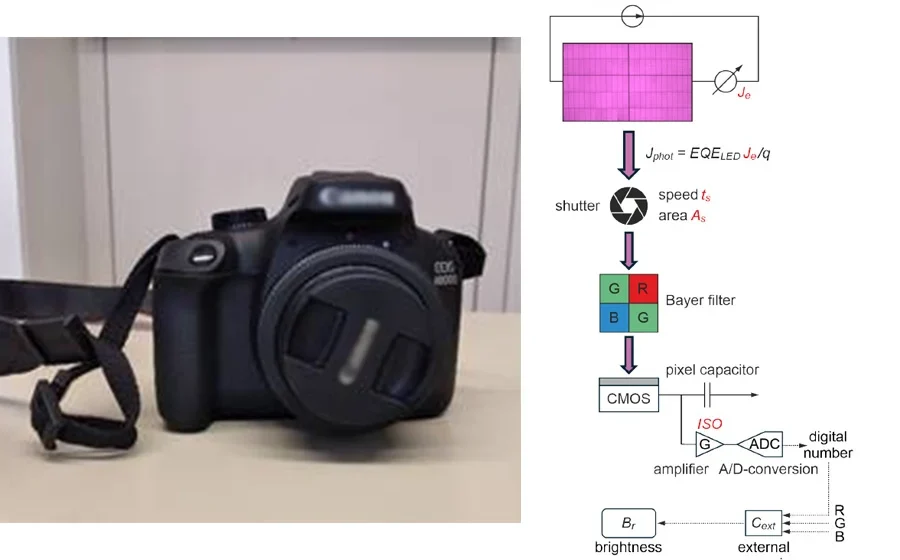
New camera model for absolute quantum efficiency measurements from electroluminescence of solar cells or modules

WASHINGTON D.C. – A groundbreaking advancement in solar energy diagnostics has been unveiled, promising to revolutionize how the efficiency and quality of solar cells are assessed. Researchers from the University of Stuttgart, the Research Center Jülich, and the German company Solarzentrum Stuttgart have successfully developed a methodology that allows commercially available cameras, with only minor modifications, to capture and quantitatively analyze electroluminescence (EL) images of solar cells. This breakthrough, detailed in the Journal of Applied Physics on September 22, 2026, significantly reduces the cost and complexity associated with a crucial diagnostic technique, thereby democratizing access to high-precision solar cell evaluation.
Traditionally, measuring the electroluminescent quantum efficiency (EQE) of solar cells – a direct indicator of their voltage and overall performance – has required specialized, often prohibitively expensive industrial cameras coupled with intricate calibration processes. The new approach demonstrates that a relatively inexpensive consumer camera, when properly modeled and calibrated, can yield quantitative results comparable to those obtained from high-end laboratory equipment. This innovation holds immense potential for accelerating research and development, streamlining manufacturing quality control, and ultimately contributing to the global push for more efficient and reliable renewable energy sources.
The Critical Role of Electroluminescence in Solar Energy Diagnostics
Solar energy has emerged as a cornerstone of the global transition to sustainable power, with installed photovoltaic capacity soaring to unprecedented levels. As of recent estimates, global solar capacity has surpassed the terawatt mark, with projections indicating continued exponential growth driven by technological advancements, decreasing costs, and supportive policy frameworks. However, the widespread adoption and long-term reliability of solar technology hinge on the ability to efficiently manufacture and accurately assess the performance and durability of solar cells and modules.
One of the most powerful and non-invasive diagnostic techniques for evaluating solar cell quality is electroluminescence (EL) imaging. When a forward bias voltage is applied to a solar cell in the dark, it emits light in the infrared spectrum. This phenomenon, known as electroluminescence, is essentially the reverse process of the photovoltaic effect. The intensity and uniformity of the emitted light provide critical insights into the internal workings of the cell. Brighter regions indicate areas of higher efficiency and lower recombination losses, while darker regions or distinct patterns can reveal defects such as microcracks, shunts, finger interruptions, or areas of degraded material.
The electroluminescent quantum efficiency (EQE) directly correlates with the open-circuit voltage (Voc) of a solar cell, making it a powerful metric for assessing overall performance. A higher EQE signifies better charge carrier separation and collection, leading to higher voltage and, consequently, higher power output. For manufacturers and researchers alike, EL imaging is indispensable for identifying potential failures, optimizing production processes, and developing next-generation solar cell architectures.
However, the barrier to entry for this crucial diagnostic has historically been high. Industrial-grade EL cameras, designed for precise spectral response and high sensitivity in the infrared, often cost tens of thousands of dollars, placing them out of reach for smaller research groups, educational institutions, or emerging manufacturers in developing economies. Furthermore, operating these systems typically requires specialized expertise for both image acquisition and the complex calibration procedures necessary to convert raw light intensity data into meaningful quantitative metrics. This economic and technical hurdle has limited the widespread application of high-precision EL diagnostics.
Unlocking Precision with Accessible Technology: The Stuttgart-Jülich-Solarzentrum Innovation
The core of the recent breakthrough lies in a clever adaptation of readily available commercial camera technology. The research team, comprising Jürgen H. Werner, Georgette Udo, and Liviu Stoicescu, identified that certain consumer cameras, particularly those favored by astrophotographers or enthusiasts of artistic infrared photography, lack an internal infrared-blocking filter. Most conventional digital cameras incorporate such a filter to ensure that images capture only the visible light spectrum, mimicking human vision. However, for applications requiring infrared sensitivity, its absence is a distinct advantage.
Leveraging this inherent characteristic, the researchers performed a remarkably simple modification: they added an external long-pass filter directly in front of the camera lens. This filter effectively blocks visible light while allowing infrared wavelengths, including those emitted by solar cells during electroluminescence, to pass through to the sensor. This straightforward optical setup transforms a standard consumer camera into a highly sensitive infrared imaging device capable of capturing the subtle glow of EL from solar cells.
The truly innovative aspect, however, extends beyond mere image capture. As Jürgen Werner, one of the lead authors, stated, "Our approach shows that even a relatively inexpensive consumer camera can provide quantitative results when its physical response is properly modeled and calibrated." The team developed a sophisticated physical camera model and a robust calibration methodology that accounts for the camera’s specific spectral response, noise characteristics, and linearity. This model enables the conversion of raw pixel brightness values from the captured EL images into absolute luminescent quantum efficiency measurements.
This quantitative leap is critical. Without proper calibration and modeling, an EL image merely shows bright and dark regions, offering only qualitative insights into potential defects. With the Stuttgart-Jülich-Solarzentrum method, these images become a powerful analytical tool, providing precise, localized data on the EQE across the entire surface of a solar cell or module. This detailed mapping can pinpoint exact locations of performance degradation, quantify the extent of material defects, and inform targeted interventions for repair or optimization. The ability to derive absolute quantum efficiency measurements from such an accessible device represents a paradigm shift in solar cell characterization.
Democratizing Solar Cell Quality Control: Economic and Research Implications
The implications of this research are far-reaching, promising to reshape various aspects of the solar energy industry and academic research.
Cost Reduction and Accessibility: The most immediate and tangible benefit is the drastic reduction in the cost of high-precision EL imaging. While industrial EL systems can cost upwards of $50,000 to $100,000, a consumer camera suitable for this modification, even a high-end one, typically costs a fraction of that. This cost differential makes sophisticated diagnostic capabilities accessible to a much broader audience, including:
- Small and Medium-sized Enterprises (SMEs): Enabling smaller solar cell manufacturers or module assemblers to implement rigorous quality control protocols without significant capital expenditure.
- Academic Research Labs: Providing university and institutional researchers with essential tools for material science, device physics, and prototype development, particularly in budget-constrained environments.
- Developing Nations: Facilitating the growth of indigenous solar industries and research capacities in regions where advanced laboratory equipment might be prohibitively expensive.
- Field Diagnostics and Repair: Potentially leading to portable, low-cost EL imaging systems for on-site inspection of deployed solar panels, aiding in maintenance and fault detection.
Acceleration of Research and Development: Easier access to quantitative EL diagnostics can significantly accelerate the pace of innovation in solar cell technology. Researchers can quickly and affordably characterize new materials, optimize device architectures, and test novel fabrication processes. The ability to obtain detailed performance maps of experimental cells rapidly allows for faster iteration cycles and more informed design choices, potentially leading to breakthroughs in efficiency and durability at a quicker pace. For instance, the development of perovskite solar cells, a rapidly advancing technology, could greatly benefit from more accessible diagnostic tools for understanding their unique degradation mechanisms and optimizing stability.
Enhanced Manufacturing Quality Control: Integrating this low-cost EL imaging method into production lines could lead to more stringent and frequent quality checks. Manufacturers could inspect a higher percentage of cells or modules, identifying defects earlier in the production process. This proactive approach minimizes waste, improves overall product quality, and enhances consumer confidence in solar products. Early detection of issues like microcracks, which can propagate over time and significantly reduce power output, can prevent faulty modules from reaching the market, thereby extending the operational lifespan of solar installations.
Contribution to a Circular Economy: Improved diagnostic capabilities also contribute to the circular economy principles by enabling better repair and recycling strategies for solar panels. By precisely identifying degraded or faulty regions, it might be possible to repair specific sections of a module rather than replacing the entire unit. Furthermore, a detailed understanding of module degradation can inform more efficient recycling processes, ensuring valuable materials are recovered effectively.
A New Era for Solar Energy Research and Manufacturing
The publication of this research marks a significant milestone in the ongoing quest to make solar energy more efficient, affordable, and widespread. By demonstrating that sophisticated quantitative analysis can be achieved with commercially available and relatively inexpensive equipment, the University of Stuttgart, Research Center Jülich, and Solarzentrum Stuttgart team has opened new avenues for innovation and accessibility. This is not merely an incremental improvement but a foundational shift in how solar cell diagnostics are approached, potentially broadening the scientific and industrial community engaged in advancing photovoltaic technology.
The global solar market, which is projected to grow substantially in the coming decades, stands to benefit immensely. With hundreds of gigawatts of solar capacity being installed annually, ensuring the quality and long-term reliability of these installations is paramount. This innovation provides a powerful, yet accessible, tool to support that endeavor.
The Road Ahead: Expanding the Camera’s Capabilities
The research team is not resting on its laurels. Their future work, as outlined by Jürgen Werner, aims to expand the capabilities of this calibrated camera system, maintaining a strong emphasis on leveraging commercially available technology. "Our next step is to use the calibrated camera to determine quantum efficiencies and open-circuit voltages of further, previously uncharacterized solar cells and modules," Werner explained. This expansion will validate the model’s versatility across a wider range of solar cell types and technologies, from conventional silicon cells to thin-film and emerging perovskite devices.
Furthermore, the researchers plan to explore the applicability of their model to photoluminescence (PL) measurements. While EL involves injecting current to make the cell emit light, PL uses an external light source (e.g., a laser) to excite the cell and measure the emitted light. PL is another critical diagnostic technique, and extending the model to PL would further broaden its utility. Perhaps most ambitiously, the team aims to investigate the possibility of performing these measurements in daylight. Current EL and PL measurements typically require dark conditions to minimize background light interference. Achieving accurate quantitative measurements under ambient light would be a significant breakthrough, enabling on-site diagnostics of operational solar panels without needing to disconnect or shade them, thereby enhancing practicality and reducing downtime for inspections.
This forward-looking approach underscores the team’s commitment to making advanced solar cell diagnostics not only affordable but also increasingly versatile and user-friendly. The integration of such capabilities into a single, accessible platform could truly democratize high-level solar research and quality assurance.
About the Research and Institutions
The article, titled "New camera model for absolute quantum efficiency measurements from electroluminescence of solar cells or modules," is authored by Juergen H. Werner, Georgette Udo, and Liviu Stoicescu. It was published in The Journal of Applied Physics on September 22, 2026, with the DOI: 10.1063/5.0349589. The contributing institutions are the University of Stuttgart, a leading research university in Germany known for its strong focus on engineering and natural sciences; Forschungszentrum Jülich, one of Europe’s largest interdisciplinary research centers specializing in energy and environmental research; and Solarzentrum Stuttgart, a German company likely involved in solar energy research, development, and application. The collaborative nature of this research, bringing together academic rigor, specialized research infrastructure, and industrial insight, highlights the multifaceted approach required to tackle complex challenges in renewable energy technology. The Journal of Applied Physics, published by AIP Publishing, is a prestigious international journal that serves as a vital platform for disseminating significant new experimental and theoretical results in applied physics research, making it an ideal venue for this impactful study.