
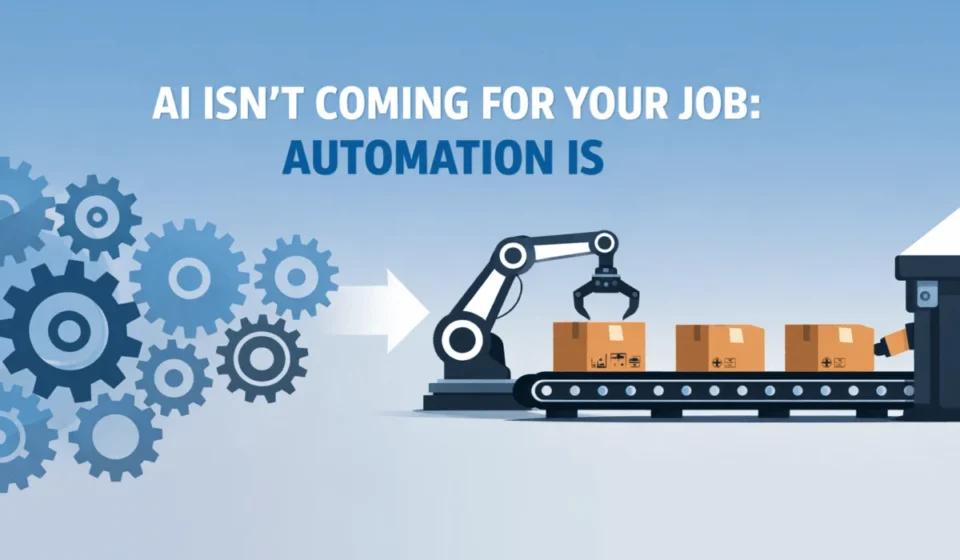

A recent wave of discourse, amplified across professional networking platforms like LinkedIn and social media channels such as Twitter, has been dominated by alarming predictions concerning the future of employment due to advancements in Artificial Intelligence (AI). These studies frequently project the displacement of millions of jobs, prompting widespread concern and leading individuals to search for "recession-proof careers" or consider entrepreneurial ventures perceived as resistant to technological disruption. However, a critical distinction often overlooked in this widespread anxiety is that the primary driver of job transformation is not AI itself, but rather the automation it enables.
This nuanced perspective is crucial for professionals seeking to understand where to invest their skills and career development efforts. The conflation of AI and automation, while seemingly semantic, leads to a misdirection of professional focus and a potentially flawed understanding of the evolving labor market.
The Perils of Conflating AI and Automation
The prevailing narrative often treats "AI" and "automation" as interchangeable terms. This is a fundamental misunderstanding that distorts the landscape of professional impact. AI, in its essence, is a capability—a set of technologies that enable machines to perform tasks that typically require human intelligence, such as learning, problem-solving, and decision-making. Automation, on the other hand, is the practical application of these capabilities, or other rule-based systems, to replace repeatable human actions within a workflow.
Consider the generation of marketing copy. An AI model can be instrumental in drafting product descriptions, generating creative text, or summarizing lengthy documents. However, the AI’s output is only integrated into a business process through an automated system. This automated pipeline dictates when and how the AI’s generated content is triggered, where it is routed, and whether it is ultimately reviewed by a human. The AI may create the content, but it is the surrounding automated infrastructure that determines its ultimate fate and impact on human involvement.
This distinction is vital because it reframes the perceived threat. Blaming AI models for job displacement is akin to blaming an engine for the inefficiencies of an entire assembly line. The true source of disruption lies in the systematic integration of these intelligent capabilities into operational workflows, thereby automating tasks that were previously performed by humans. This systemic approach, rather than the AI’s inherent intelligence, is what fundamentally alters job requirements and potentially reduces the need for certain human roles.
Identifying Automation’s True Targets: Tasks, Not Entire Jobs
Automation’s impact is most acutely felt in its ability to address tasks that are predictable, high-volume, and governed by a clear set of rules. Functions such as data entry, invoice processing, customer service ticket routing, and basic content formatting are prime examples of areas highly susceptible to automation. These tasks have, in many instances, been meticulously documented and optimized for machine execution, setting them on a trajectory towards obsolescence for human handlers.
The perceived threat to junior developers, for instance, often stems from an outdated view of their roles as mere "code monkeys" performing repetitive coding tasks. While AI can indeed assist with code generation and bug detection, the argument is not that AI is making junior developers redundant. Instead, it highlights how automation can streamline certain aspects of development, allowing junior roles to evolve towards more complex problem-solving and system design, rather than simple, rule-based coding. The underlying issue is not AI replacing developers, but rather the automation of the more rudimentary aspects of their work, demanding a higher level of cognitive engagement.
A useful exercise for any professional is to dissect their daily responsibilities and identify tasks that could be competently handled by a capable intern armed with a detailed checklist. These represent the "exposure points" within a role that are most vulnerable to automation. Conversely, work that genuinely demands nuanced understanding of relationships, strategic context, or real-time, complex judgment remains more insulated from immediate automation, at least in its current forms.
The challenge for many professionals lies in accurate self-assessment. There is a tendency to either overstate the vulnerability of one’s entire role or, conversely, to feel a false sense of security based on a sophisticated job title. A quality assurance (QA) tester who employs critical thinking and analytical skills, for example, is arguably more valuable in an automated environment than a Chief Technology Officer (CTO) who makes decisions based on superficial or arbitrary criteria. The emphasis is shifting from the title of a job to the quality of cognitive engagement within it.
Beyond "Learn AI": Developing Future-Proof Skills
The pervasive advice to "learn AI or get left behind" is partially correct but fundamentally incomplete. While the AI market is indeed experiencing exponential growth—with some reports indicating year-over-year growth rates exceeding 100% for AI-related technologies—the skills that truly fortify a professional’s position are not solely technical. They are the distinctly human attributes that complement, rather than compete with, automation.
These essential skills include:
- Critical Judgment: The ability to discern the plausibility and accuracy of AI-generated outputs. This involves understanding when an AI’s response is technically correct but contextually flawed, or when it presents a superficial solution to a deeper problem.
- Contextual Understanding: The capacity to grasp the broader implications and nuances of a situation that an AI, operating on pattern recognition, might miss. This includes understanding stakeholder needs, organizational culture, and the ethical dimensions of a task.
- Effective Communication: The skill to articulate decisions and rationale to stakeholders who may not understand or trust algorithmic outputs. This bridges the gap between technical capabilities and business understanding.
- Failure Mode Analysis: The comprehension of potential failure points within automated systems. While automation may achieve high success rates (e.g., 95%), understanding the implications of the remaining 5% and being able to intervene effectively is paramount. This requires a deep understanding of the automation tools being utilized.
- Domain Expertise: The profound knowledge of a specific industry or field. When combined with an understanding of systems thinking, this creates a potent combination for identifying opportunities and mitigating risks associated with automation. Companies are increasingly recognizing the value of this blend, often learning through costly trial and error.
Prompt engineering, while a valuable skill in interacting with generative AI, is only one facet. The ability to diagnose why an automated system consistently produces suboptimal results in specific edge cases, leveraging domain knowledge and systems thinking, is a far more robust and defensible competency.
The Ascent of New Roles in the Automated Economy
Observing employment trends reveals a clear pattern of growth in roles that bridge human oversight and automated systems. Positions such as AI oversight specialists, workflow architects, process automation consultants, and pipeline designers are experiencing significant demand. These are not hypothetical future jobs but actively posted roles on professional platforms, with compensation reflecting the scarcity of qualified candidates.
These burgeoning roles are characterized by their position at the nexus of human intelligence and machine capabilities. They require individuals who can orchestrate both the technical potential of AI and the practical realities of its implementation within complex organizational environments. The supply of individuals adept at both strategic thinking and managing "agentic automation"—systems capable of acting autonomously—remains considerably lower than the demand.
A less discussed but equally significant trend is the emergence of "cleanup" roles within organizations that have implemented automation poorly. As companies rush to automate without adequate foresight, oversight, or robust exception handling, they create a demand for roles focused on quality control, exception management, and human-in-the-loop review. These positions are multiplying rapidly in sectors where automation was deployed too aggressively, without the necessary human safeguards.
The True Nature of the Shift: Leverage, Not Just Intelligence
The prevailing "AI will take your job" narrative fundamentally misses the core of the current technological transformation. The shift is not merely about the increasing intelligence of machines; it is about the amplified leverage that automation provides to organizations. Automation empowers companies to achieve greater output with fewer human resources dedicated to the more mechanical aspects of work.
This evolution is not inherently negative. However, it unequivocally elevates the value of genuine human judgment, sophisticated contextual reasoning, and vigilant oversight. For professionals charting their career paths, the most prudent investment lies not just in learning specific tools, but in cultivating a deep understanding of the systems within which these tools operate. This systems-level thinking and human-centric approach to leveraging technology will remain a critical differentiator, irrespective of the next wave of technological advancements. The future of work is not about being replaced by AI, but about collaborating with it to achieve unprecedented levels of productivity and innovation, driven by human insight and strategic application.