
Advances in Theoretical and Applied Physics Redefining Quantum Gravity Plasma Dynamics Geophysical Modeling and Fluid Turbulence

Modern scientific inquiry has reached a pivotal juncture where the boundaries between theoretical abstraction and practical application are increasingly blurred. From the infinitesimal scales of quantum spin to the massive complexities of planetary interiors and the chaotic nature of fluid flow, researchers are developing new mathematical and physical frameworks to address long-standing enigmas. These breakthroughs, spearheaded by leading academics at institutions such as Boston University, the University of Kansas, and the University of Utah, represent a significant leap forward in our understanding of the universe. By rethinking the foundational principles of spacetime, electromagnetism, and fluid dynamics, these scientists are not only solving theoretical puzzles but also providing the tools necessary for the next generation of industrial and astrophysical exploration.
Twistor Theory and the Reconceptualization of Spacetime
At the forefront of theoretical physics, Professor Tian Yu Cao of Boston University is leading a fundamental reassessment of modern physics through the lens of twistor theory. Originally proposed by Sir Roger Penrose in the late 1960s, twistor theory suggests that the traditional four-dimensional spacetime we perceive is not a primary entity but a secondary construction derived from a deeper, more fundamental space known as twistor space.
Professor Cao’s research delves into the Penrose transform, a mathematical procedure that maps fields on spacetime to certain types of geometric objects in twistor space. His work highlights a profound implication: the primary physical agents of the universe are best described by elements of cohomology, a branch of algebraic topology. This shift suggests that the defining feature of these agents is rooted in "spin," a quantum mechanical property of particles.
The Role of Spin in Quantum Gravity
A major pillar of Cao’s framework is the hypothesis that quantum behavior itself may emerge from the physical property of spin. In traditional quantum mechanics, spin is often treated as an intrinsic angular momentum, but Cao’s work posits it as the foundational element from which other quantum properties arise. This perspective offers a promising path toward a consistent theory of quantum gravity—a "Holy Grail" of physics that seeks to unify General Relativity, which describes the macro-world of gravity, with Quantum Mechanics, which describes the micro-world of atoms.
By utilizing the ongoing development of operator product expansion (OPE) formulas defined on twistor space, Cao’s framework addresses several "unsolvable" puzzles:
- Black Hole Evaporation: Solving the information paradox by redefining how energy and information are processed at the event horizon.
- Cosmological Transitions: Providing a mathematical basis for the transitions between different cycles of the cosmos, supporting theories of a cyclic universe rather than a singular Big Bang event.
Plasma Behavior in Extreme Quantum Regimes
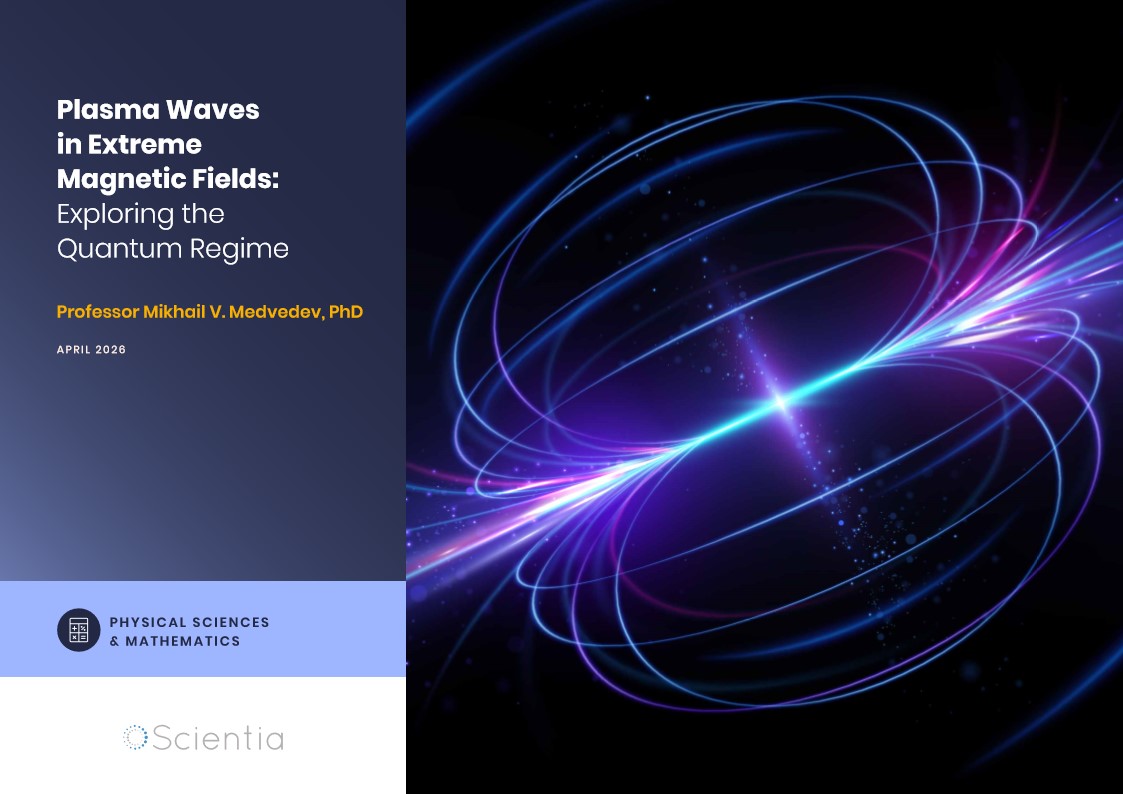
While Cao explores the foundations of spacetime, Professor Mikhail V. Medvedev and his colleagues are investigating the behavior of matter in the most extreme environments imaginable. In the vicinity of magnetars—neutron stars with magnetic fields trillions of times stronger than Earth’s—and within the focal points of next-generation high-intensity lasers, classical physics ceases to be sufficient.
In these "extreme magnetic field" regimes, plasma (the fourth state of matter consisting of charged particles) undergoes a radical transformation. Professor Medvedev’s research focuses on how these fields, which exceed the "Schwinger limit" where the vacuum itself can become polarized, reshape plasma waves.
From Classical to Quantum Plasmas
In a classical plasma, wave structures like Langmuir waves or cyclotron waves are well-understood. However, under extreme magnetic pressure, quantum effects such as Landau quantization (the discretization of electron orbits) become dominant. Medvedev’s framework reveals that while the familiar structures of plasma waves persist, their properties—such as velocity, frequency, and damping—are significantly modified.
The implications of this research are twofold:

- Astrophysics: It provides a critical foundation for interpreting observations from magnetars and pulsar wind nebulae, where high-energy radiation is the only source of data for scientists on Earth.
- Energy and Technology: On Earth, these insights are vital for high-energy plasma experiments, particularly in the pursuit of inertial confinement fusion, where stabilizing plasma under extreme conditions is the primary hurdle to achieving clean, limitless energy.
Innovations in Geophysical Modeling and Resource Exploration
Moving from the stars to the Earth’s crust, the challenge of visualization takes a different form. Distinguished Professor Michael Zhdanov of the University of Utah has spent years refining the mathematical frameworks used to "see" underground. Geophysics relies on various sensing methods—seismic, gravitational, and magnetic—but each provides only a partial, often blurry, image of the subsurface.
The "Inverse Problem" in geophysics involves taking observed data from the surface and calculating the properties of the hidden structures below. This is notoriously difficult because many different underground configurations can produce the same surface data.
Multiphysics Data Fusion
Professor Zhdanov’s team has pioneered a method for generating detailed models from "multiphysics" data. By mathematically linking seismic data (which shows density and structure) with electromagnetic data (which shows conductivity and fluid content), they can create a high-resolution, 3D map of the Earth’s interior.
The efficacy of this approach has been proven in two major case studies:
- Yellowstone Magma Chambers: By applying their models to the Yellowstone supervolcano, Zhdanov’s team has mapped the plumbing system of magma with unprecedented accuracy, aiding in volcanic hazard assessment.
- Barents Sea Exploration: In the energy sector, this technology has been used to identify oil and gas deposits in the Barents Sea, reducing the environmental and financial risks associated with exploratory drilling.
Unravelling the Mysteries of Turbulence
Perhaps the most ubiquitous yet least understood phenomenon in the physical world is turbulence. From the wake of a jet engine to the flow of blood through an artery, turbulence is a chaotic state of fluid motion that has eluded a complete mathematical description for centuries.
Dr. Alex Fedoseyev is tackling this problem using the Alexeev Hydrodynamic Equations (AHE). For decades, the gold standard for fluid dynamics has been the Navier-Stokes equations. However, these equations often fail to accurately predict behavior at high Reynolds numbers, where flow becomes turbulent.
The Alexeev Hydrodynamic Equations (AHE)
The AHE model represents a significant evolution in fluid mechanics. By incorporating terms that account for the non-equilibrium nature of turbulent flow, Dr. Fedoseyev has enabled major advances in the prediction and management of turbulence.
As Richard Feynman famously remarked, turbulence is "the most important unsolved problem of classical physics." The work of Fedoseyev offers a potential resolution to this mystery. The practical applications are vast:
- Aviation: Designing aircraft that experience less drag and can handle "clear-air turbulence" more safely.
- Industrial Engineering: Improving the efficiency of pipelines and chemical reactors where fluid mixing is critical.
- Climate Science: Enhancing the accuracy of weather and climate models, which rely heavily on the movement of turbulent air and ocean currents.
Chronology of Development in Theoretical and Applied Physics
The current breakthroughs are the result of a decades-long evolution in scientific thought:
- 19th Century: Maxwell and Boltzmann lay the groundwork for electromagnetism and statistical mechanics, which underpin plasma and fluid studies.
- 1940s-60s: The development of the Navier-Stokes applications and early quantum field theory.
- 1967: Roger Penrose introduces Twistor Theory, providing the seeds for Professor Cao’s current work.
- 1990s-2000s: The rise of computational geophysics allows Professor Zhdanov to begin integrating multiphysics data.
- 2010s-Present: The advent of petawatt lasers and advanced space telescopes (like Fermi and James Webb) provides the empirical data needed for Medvedev’s quantum plasma theories and Fedoseyev’s turbulence models.
Global Implications and Future Outlook
The convergence of these diverse fields of study signals a new era of "Precision Physics." By moving beyond classical approximations, scientists are developing models that can predict the behavior of the universe at its most chaotic and extreme.

The work of Professor Cao suggests that we may be nearing a "Theory of Everything" that finally integrates gravity into the quantum world. Simultaneously, the practical frameworks developed by Medvedev, Zhdanov, and Fedoseyev are providing the "blueprints" for future technology. Whether it is navigating the transition between cosmic cycles, harvesting energy from plasma, mapping the Earth’s hidden resources, or taming the chaos of turbulent air, these researchers are defining the parameters of 21st-century science.
The broader impact of these studies extends into the economic and environmental spheres. Improved geophysical modeling reduces the footprint of resource extraction, while better turbulence management can lead to a significant reduction in global fuel consumption for transport. As these theories continue to be validated by experimental data, they will undoubtedly form the bedrock of future scientific and industrial progress.