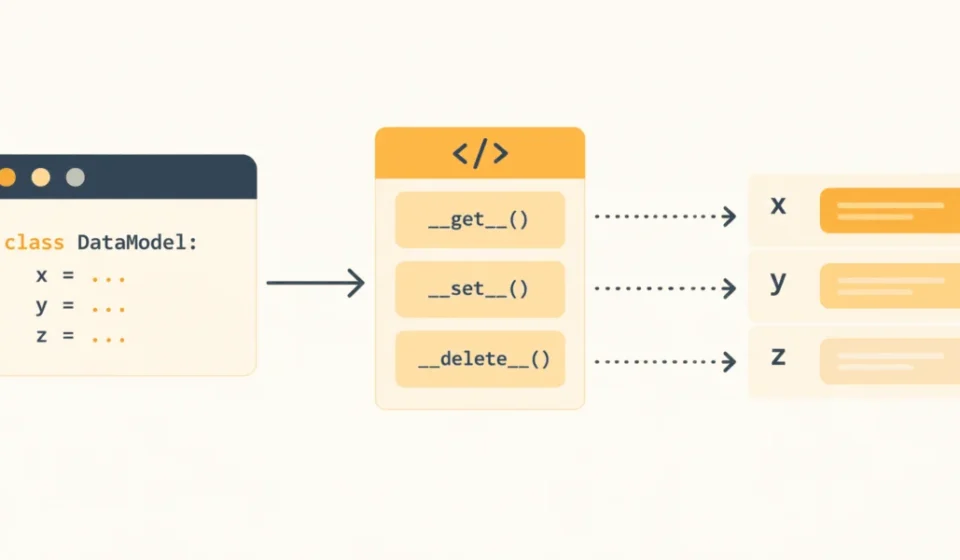
Mastering Python Descriptors to Build Robust Controlled Attributes for Scalable Software Development

In the landscape of modern software engineering, the Python programming language has maintained its dominance largely due to its flexibility and the sophisticated "under-the-hood" mechanics that allow developers to manage data with high precision. Among these mechanics, the descriptor protocol stands out as a cornerstone of Python’s object-oriented power. Descriptors are objects that define the access logic for attributes in other classes, effectively governing what occurs when a user attempts to read, write, or delete an attribute. By implementing special methods such as __get__, __set__, and __delete__, developers can create "controlled attributes" that go far beyond simple data storage. These controlled attributes are essential for building enterprise-grade applications, such as the fictitious Japan tourism tracking system explored in this analysis, where data integrity, real-time computation, and resource management are paramount.
The Evolution of Attribute Management in Python
To understand the significance of descriptors, one must look at the chronology of Python’s development. In the early days of the language, managing attribute access required the manual implementation of getter and setter methods, a practice common in Java but often criticized in Python for being "un-pythonic" and verbose. The introduction of the @property decorator in later versions of Python 2 provided a cleaner syntax for defining managed attributes, but it suffered from a lack of reusability. If a developer needed the same validation logic for twenty different attributes, they would have to write twenty different property methods.
The definitive shift occurred with the formalization of the Descriptor Protocol. This allowed for the creation of standalone classes that encapsulate attribute logic, which can then be reused across multiple parent classes. The most significant recent update to this protocol arrived with Python 3.6, which introduced the __set_name__ method. This addition solved a long-standing "boilerplate" problem by allowing a descriptor to automatically learn the name of the attribute it was assigned to, eliminating the need for developers to pass strings manually into the descriptor’s constructor.
Strategic Implementation of Validated Attributes
Data integrity is the first pillar of robust software design. In a tourism application, for instance, a user rating for a destination must fall within a specific numerical range to remain meaningful for the recommendation engine. Using a descriptor-based approach for validation allows developers to enforce these constraints at the class level, ensuring that no object can ever enter an invalid state.
The implementation of a ValidatedRating descriptor involves defining the __set__ method to intercept any assignment attempt. If a developer tries to assign a value that is not a number or falls outside the 1.0 to 5.0 range, the descriptor raises a TypeError or ValueError before the data ever reaches the object’s internal dictionary.
class ValidatedRating:
    def __init__(self, min_val=1.0, max_val=5.0):
        self.min_val = min_val
        self.max_val = max_val

    def __set_name__(self, owner, name):
        self.public_name = name
        self.private_name = f"_name"

    def __get__(self, obj, objtype=None):
        if obj is None:
            return self
        return getattr(obj, self.private_name)

    def __set__(self, obj, value):
        if not isinstance(value, (int, float)):
            raise TypeError(f"self.public_name must be a number.")
        if not (self.min_val <= value <= self.max_val):
            raise ValueError(f"self.public_name must be between self.min_val and self.max_val.")
        setattr(obj, self.private_name, float(value))
Industry analysts note that this "fail-fast" approach to data validation is a hallmark of high-quality code. By centralizing the validation logic, teams can update business rules—such as changing a maximum rating from 5.0 to 10.0—in a single location without searching through thousands of lines of code for individual setter methods.
Dynamic State Management through Computed Attributes
The second type of controlled attribute is the computed attribute. In globalized applications, data is often stored in a base format but must be presented in various derived formats. A tourism app tracking prices in Japanese Yen (JPY) frequently needs to display those costs in US Dollars (USD) for international travelers.
Instead of storing a separate price_usd variable that could fall out of sync with the base price, a descriptor can calculate the value on the fly. This ensures "single source of truth" architecture. The ComputedUSDPrice descriptor implements a __get__ method that fetches the current JPY price and applies an exchange rate. Furthermore, by implementing a __set__ method that raises an AttributeError, the developer can create a read-only attribute that prevents accidental overwriting of calculated data.
class ComputedUSDPrice:
    def __init__(self, exchange_rate=0.0067):
        self.exchange_rate = exchange_rate

    def __set_name__(self, owner, name):
        self.name = name

    def __get__(self, obj, objtype=None):
        if obj is None:
            return self
        jpy_price = getattr(obj, 'price_jpy', 0)
        return round(jpy_price * self.exchange_rate, 2)

    def __set__(self, obj, value):
        raise AttributeError(f"self.name is a computed read-only attribute.")
This pattern is widely used in financial technology and scientific computing, where maintaining derived states is critical for accuracy. According to software architecture experts, computed descriptors reduce the memory footprint of an application because they eliminate the need to store redundant data points.
Performance Optimization via Lazy Loading
The third and perhaps most advanced use of descriptors is the implementation of lazy loading. Modern applications often interact with "heavy" resources, such as external APIs, large JSON files, or complex database queries. Loading all this data during the initialization of an object can lead to significant latency and memory bloat, especially if the user never actually accesses that specific data.
A "lazy descriptor" defers the execution of expensive operations until the attribute is explicitly requested. Upon the first access, the descriptor performs the calculation or query, stores the result directly in the instance’s __dict__, and then essentially "hides." Because Python’s attribute lookup priority checks the instance dictionary before class-level descriptors, all subsequent calls to that attribute bypass the descriptor logic entirely, retrieving the cached value instantly.
import time

class LazyItinerary:
    def __set_name__(self, owner, name):
        self.name = name

    def __get__(self, obj, objtype=None):
        if obj is None:
            return self

        # Simulating a high-latency operation
        print(f"[System] Querying database for obj.destination...")
        time.sleep(1)

        itinerary = (
            f"Day 1: Arrival in obj.destination.n"
            f"Day 2: Temple tours.n"
            f"Day 3: Departure."
        )

        # Caching the result in the instance dictionary
        obj.__dict__[self.name] = itinerary
        return itinerary
This technique is a staple in high-performance frameworks like Django and SQLAlchemy. It allows for the creation of "lightweight" objects that only become "heavy" when necessary, optimizing both CPU and network usage.
Integration and Broader Impact
When these three descriptors are integrated into a single class, such as JapanTour, the result is a highly disciplined and efficient data model. The class becomes a declarative structure where the behavior of each attribute is clearly defined at the top level.
class JapanTour:
    rating = ValidatedRating(min_val=1.0, max_val=5.0)
    price_usd = ComputedUSDPrice()
    itinerary = LazyItinerary()

    def __init__(self, destination, price_jpy, rating):
        self.destination = destination
        self.price_jpy = price_jpy
        self.rating = rating
From a project management perspective, using descriptors facilitates a cleaner separation of concerns. Senior architects can design the descriptors (the "how" of data management), while junior developers can focus on implementing the business logic in the main classes (the "what" of the data).
The broader implications of mastering descriptors extend to the very foundations of the Python ecosystem. Descriptors are the technology behind classmethod, staticmethod, and even the way functions become bound methods when attached to a class. Understanding them is equivalent to understanding the "DNA" of Python’s object model.
Technical Analysis and Best Practices
While descriptors offer immense power, they require a nuanced understanding of Python’s Method Resolution Order (MRO) and attribute lookup chain. A common pitfall is the confusion between "data descriptors" (which define both __get__ and __set__) and "non-data descriptors" (which only define __get__). Data descriptors always take precedence over instance dictionary entries, whereas non-data descriptors do not. This distinction is what allows the lazy loading pattern to work effectively.
Furthermore, developers must be cautious regarding memory leaks when descriptors are used to store data about instances. Using self.private_name with setattr(obj, ...) as shown in the ValidatedRating example is the preferred modern method because it stores the data on the instance itself, allowing the standard garbage collector to clean up the object when it is no longer in use.
Conclusion
The use of Python descriptors to build validated, computed, and lazily loaded attributes represents a sophisticated approach to software design that prioritizes stability and efficiency. By moving logic out of the main class body and into specialized descriptor objects, developers can create codebases that are easier to test, maintain, and scale. As Python continues to be the language of choice for data science, web development, and automation, the ability to control attribute behavior through these advanced protocols will remain a vital skill for any professional programmer. Whether it is ensuring a tour rating never exceeds five stars or deferring a heavy database query until the last possible second, descriptors provide the precision tools necessary for modern digital craftsmanship.