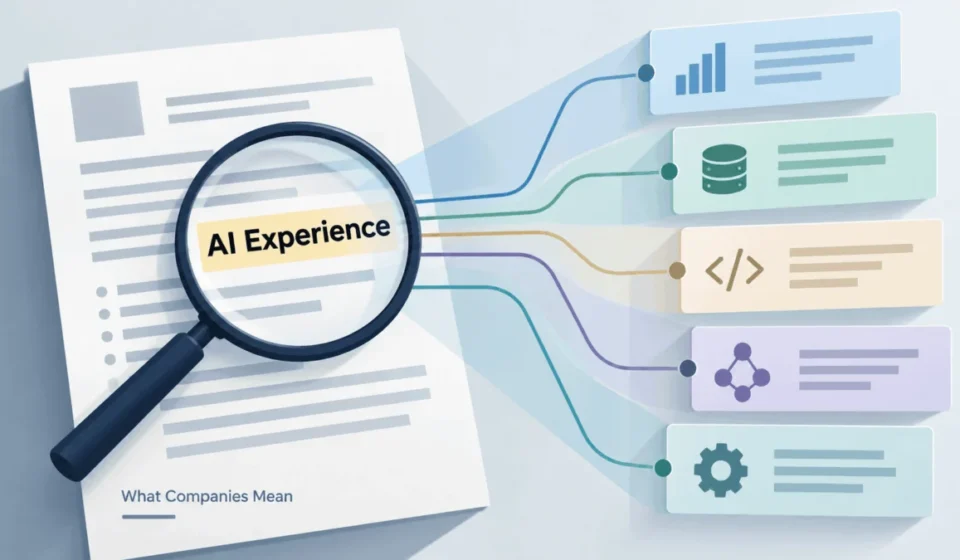

The burgeoning demand for "AI experience" in job postings for data analysts, statisticians, and researchers often obscures a complex reality: the phrase carries vastly different meanings across industries and organizations. This ambiguity stems from its nature as a marketing term rather than a precise technical specification, leading to a disconnect between employer expectations and candidate understanding. Navigating this landscape requires a nuanced approach, deciphering the underlying needs behind the buzzword and recognizing how existing statistical expertise forms the bedrock of AI proficiency.
The term "AI experience" has emerged as a ubiquitous, yet ill-defined, requirement in the contemporary job market, particularly within fields that leverage data analysis, statistical modeling, and research. While its inclusion signals a desire for candidates attuned to modern technological advancements, its lack of a standardized definition creates significant hurdles for both recruiters and applicants. A hiring manager in the retail sector might interpret "AI experience" as proficiency in customer segmentation algorithms, whereas a biotech startup could be seeking someone familiar with predictive modeling for drug discovery, and a financial services firm might prioritize candidates with expertise in fraud detection systems powered by machine learning. This wide spectrum of interpretations underscores the critical need to deconstruct job descriptions and understand the specific context in which "AI experience" is being requested.
The Ambiguity of "AI Experience": A Marketing Term in Disguise
Unlike quantifiable skills such as "five years of regression analysis" or "proficiency in R," the term "AI experience" lacks a universally agreed-upon technical definition. This vagueness is often not accidental but rather a strategic choice by hiring teams. In many instances, internal consensus on precisely what constitutes AI expertise is lacking. The phrase is frequently employed to project an image of modernity and to attract candidates who have demonstrably kept pace with the rapid evolution of artificial intelligence. Consequently, it acts as a broad filter, designed to draw in a pool of interested individuals rather than to pinpoint a specific, pre-defined skill set.
The challenge for job seekers lies in decoding these postings. The true intent behind the "AI experience" requirement is often embedded within the broader job description, the specific industry context, and the seniority level of the role. By carefully analyzing these elements, candidates can gain a more accurate understanding of what employers are truly seeking, moving beyond the superficial buzzword.
Deconstructing the Four Pillars of "AI Experience"
The myriad applications of "AI experience" in job postings can generally be categorized into four distinct pillars. Recognizing which of these pillars a particular role emphasizes is crucial for candidates to effectively frame their qualifications.
- Pillar 1: Familiarity with AI Concepts and Tools: This category typically applies to roles where a general understanding of AI principles and a comfort with common AI-powered tools are sufficient. This might include using AI-driven analytics platforms, understanding the outputs of machine learning models, or being aware of the ethical considerations surrounding AI.
- Pillar 2: Applied AI Understanding and Problem Solving: Here, employers seek candidates who can not only grasp AI concepts but also apply them to solve specific business problems. This involves understanding how different AI techniques can be leveraged to improve processes, drive insights, or create new products.
- Pillar 3: Hands-On Machine Learning and Model Development: This is the most technically demanding category, requiring candidates to have practical experience in building, training, and deploying machine learning models. This often involves proficiency in programming languages like Python or R, familiarity with machine learning libraries, and an understanding of the model development lifecycle.
- Pillar 4: Domain-Specific AI Expertise: In certain specialized industries, "AI experience" refers to knowledge of AI applications within that particular domain. For instance, in healthcare, it might mean understanding AI for medical image analysis; in finance, it could be AI for algorithmic trading or risk assessment.
The Indispensable Role of Statistical Foundations in AI
At its core, much of what is labeled "AI" in a business context is built upon a robust foundation of statistical principles. The transition from being a statistician to an AI practitioner often involves a shift in terminology and the adoption of new tooling, rather than a fundamental change in analytical reasoning. Consequently, individuals with a strong statistical background already possess a significant portion of the skills employers associate with "AI experience."
The task for these professionals is not to reinvent their resumes but to translate their existing expertise into the language of AI. For example, a resume entry detailing the construction of "predictive regression models to forecast quarterly demand" can be reframed to highlight an understanding of supervised learning and model evaluation. By emphasizing the outcomes achieved and the underlying reasoning processes, the connection to AI capabilities becomes evident to hiring managers.
Key statistical concepts that directly map to AI experience include:
- Regression Analysis: Forms the basis of many predictive modeling techniques in AI, including linear regression, logistic regression, and time series forecasting.
- Classification Algorithms: Statistical methods for categorizing data are foundational to AI tasks like image recognition and spam detection.
- Clustering and Segmentation: Unsupervised learning techniques used in AI for customer segmentation, anomaly detection, and data exploration.
- Hypothesis Testing and Statistical Significance: Essential for evaluating the performance and reliability of AI models.
- Data Preprocessing and Feature Engineering: Skills honed in statistical analysis are directly applicable to preparing data for AI algorithms.
- Model Evaluation and Validation: Understanding metrics like accuracy, precision, recall, and AUC is critical for assessing AI model performance.
Interpreting Job Postings: A Data-Driven Approach
Treating job postings as a form of data requires a critical and analytical mindset, much like approaching any dataset. Headline requirements, while important, are often aspirational, representing an ideal candidate profile rather than a strict checklist. Companies frequently list every conceivable skill they might desire, understanding that a single individual may not possess all of them. The weight of "AI experience" in a lengthy list of requirements is often less significant than its prominence and elaboration within the body of the job description.
The true essence of the role and the specific AI competencies sought are typically revealed in the description of day-to-day responsibilities and the problems the position is intended to solve. A useful shortcut for candidates is to look for how the responsibilities section describes the use of data and analytical techniques. If the role involves building predictive models, optimizing algorithms, or interpreting complex data patterns, then "AI experience" is likely referring to hands-on technical skills. Conversely, if the focus is on using AI-powered dashboards or understanding AI-driven reports, the requirement may lean more towards conceptual understanding and application.
Furthermore, the modifiers used alongside "AI experience" offer valuable clues. "AI experience preferred" indicates a desirable but not essential qualification. "AI experience required," without further clarification, often points towards categories 1 or 2. A requirement for "hands-on machine learning experience" coupled with specific tool mentions is a strong indicator of category 3.
Seniority as a Key Differentiator in AI Experience Interpretation
The level of seniority associated with a role significantly alters the interpretation of "AI experience." What employers seek in a junior candidate differs vastly from their expectations of a senior professional.
| Seniority Level | What They Actually Want | What That Looks Like in Practice |
|---|---|---|
| Junior | Adaptability and a willingness to learn | Demonstrating comfort with new tools, an eagerness to learn internal systems, and a lack of apprehension towards AI outputs. |
| Mid-Level | Informed collaboration and execution | Working effectively alongside engineering teams, contributing meaningfully to model evaluation discussions, and bridging communication gaps between data science and business stakeholders. |
| Senior | Strategic judgment and leadership | Possessing the acumen to discern when AI is the appropriate solution, effectively communicating limitations to leadership, and guiding the organization to avoid the pitfalls of careless AI deployment. |
For junior roles, employers are primarily looking for individuals who are adaptable, open to learning new technologies and internal processes, and not intimidated by the outputs of AI systems. Mid-level positions often require individuals who can collaborate effectively with engineering teams, participate in crucial model evaluation conversations, and act as a bridge between technical data science teams and business stakeholders. At the senior level, the emphasis shifts to strategic judgment. This involves knowing when AI is the right tool for the job, understanding its limitations, and being able to articulate these nuances to leadership to ensure responsible and effective AI implementation.
Addressing Common Misconceptions About AI Experience
Several prevalent misconceptions can hinder job seekers in their pursuit of AI-related roles. Clarifying these points is essential for a realistic and effective job search strategy.
Misconception 1: Listing Every AI Tool Ever Touched is Beneficial.
This approach can often be counterproductive. Hiring managers tend to value candidates who demonstrate sound judgment and problem-solving skills over those who merely possess a broad, superficial knowledge of numerous tools. The focus should be on articulating the problems solved and the reasoning processes employed, with tools mentioned as supporting context rather than the primary focus. For instance, instead of listing "Familiar with TensorFlow, PyTorch, Keras, Scikit-learn," a more effective approach would be to describe a project where these tools were used to achieve a specific outcome, such as "Developed a deep learning model using TensorFlow to improve image classification accuracy by 15%."
Misconception 2: Disqualification Without Building Models from Scratch.
For the majority of roles that list "AI experience," not having built a machine learning model from scratch is not an automatic disqualifier. What more frequently leads to disqualification is an inability to critically assess data quality, understand model assumptions, and interpret results accurately. These are fundamental statistical skills, precisely what many companies need but often fail to articulate clearly in their job postings. Proficiency in understanding the implications of data bias, the potential for overfitting, or the ethical considerations of model deployment are often more valued than the ability to code a model from the ground up.
Misconception 3: The Necessity of AI Certifications Before Applying.
While certifications can be beneficial in certain contexts and for specific roles, they are often not the primary determinant for analyst-level positions. During interviews, hiring managers are typically more interested in evaluating a candidate’s reasoning abilities and problem-solving approach. The capacity to explain when an AI system might err and why is often far more persuasive than a list of completed online courses. Demonstrating practical understanding and critical thinking is paramount. For example, being able to discuss the potential biases in a facial recognition system and how they might be mitigated is more impactful than simply stating a certificate in AI ethics.
The Evolving Landscape of AI in Business
The increasing prevalence of "AI experience" in job descriptions reflects a broader trend: the integration of artificial intelligence into core business operations across virtually every sector. According to recent industry reports, the global AI market is projected to experience significant growth. For instance, Statista data indicates that the AI market size was valued at approximately $150 billion in 2023 and is expected to grow to over $1.8 trillion by 2030, showcasing a compound annual growth rate (CAGR) of around 37%. This rapid expansion fuels the demand for talent capable of developing, implementing, and managing AI solutions.
The timeline of this trend can be traced back to the proliferation of big data and advancements in computational power, which made sophisticated machine learning algorithms more feasible for practical applications. Early applications often focused on automation and optimization, but the scope has since expanded to encompass predictive analytics, personalized customer experiences, and even generative AI capabilities.
This evolution has led to the creation of new job roles and the redefinition of existing ones. Data scientists, machine learning engineers, AI researchers, and AI ethicists are now in high demand. Concurrently, traditional roles like data analysts and statisticians are increasingly expected to possess some level of AI literacy. This shift underscores the growing importance of AI as a strategic imperative for businesses seeking to remain competitive.
The implications of this trend are far-reaching. Organizations that successfully integrate AI are likely to see improvements in efficiency, innovation, and customer satisfaction. However, the rapid adoption of AI also presents challenges, including the need for robust data governance, ethical considerations, and the potential for job displacement. The demand for "AI experience" is thus a symptom of a larger technological and economic transformation.
Conclusion: Translating Statistical Prowess into AI Capital
In essence, "AI experience" as found in job postings serves as an initial point of dialogue, not a rigid technical blueprint. In most cases, it signifies one of four key areas: a comfort level with AI tools, an awareness of machine learning concepts, practical experience in model development, or specialized knowledge in domain-specific AI applications. Crucially, a solid statistical background already provides a substantial foundation across all these categories. The key for job seekers lies in their ability to meticulously dissect job postings, identify the specific category of "AI experience" being sought, and then artfully reframe their existing qualifications to make the connection undeniable. This strategic translation of statistical expertise into the language of AI is paramount for navigating the modern job market successfully.
Vinod Chugani, the educator behind this insightful analysis, is a recognized figure in bridging the gap between cutting-edge AI technologies and their practical implementation for working professionals. His expertise spans agentic AI, machine learning applications, and automation workflows. Through his roles as a technical mentor and instructor, Chugani has empowered countless data professionals to enhance their skills and navigate career transitions. Drawing on his analytical background in quantitative finance, he champions a hands-on teaching methodology, emphasizing actionable strategies and frameworks that professionals can immediately apply. His work aims to demystify complex AI concepts and equip individuals with the knowledge to thrive in an increasingly AI-driven world.