Building a Custom LLM Evaluation Harness in Python from Scratch

Building a Custom LLM Evaluation Harness in Python from Scratch represents a critical evolution in the field of artificial intelligence development, shifting the focus from generic model performance to domain-specific reliability. As large language models (LLMs) transition from experimental novelties to core components of enterprise infrastructure, the industry has encountered a significant "evaluation gap." While public benchmarks such as MMLU (Massive Multitask Language Understanding) and GSM8K (Grade School Math 8K) provide a baseline for general reasoning, they frequently fail to predict how a model will perform within the specific constraints of a corporate environment, such as adhering to strict refusal policies or accurately retrieving context in a Retrieval-Augmented Generation (RAG) pipeline.
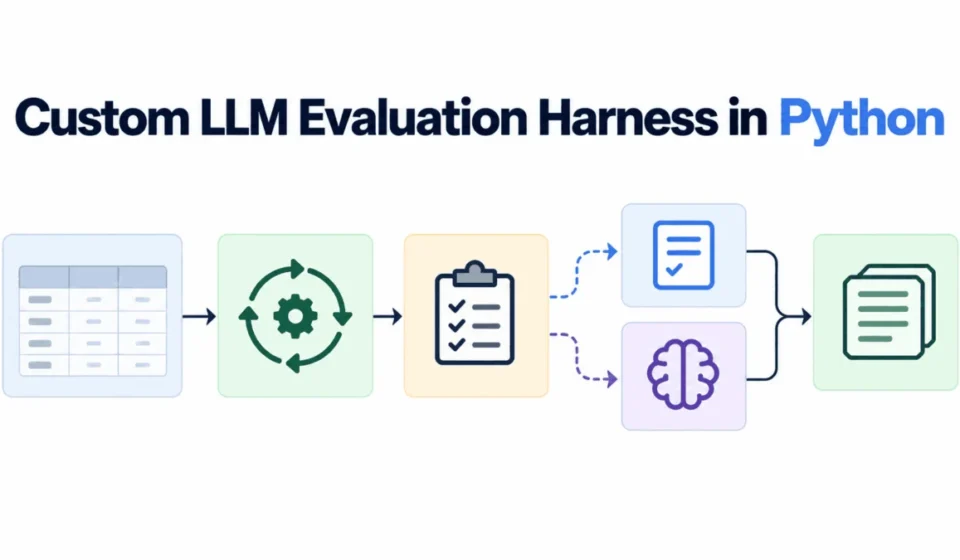
To bridge this gap, engineers are increasingly turning toward custom evaluation harnesses. These systems serve as the technical scaffolding required to feed inputs into an LLM, capture its responses, and score them against a "golden dataset" of ground-truth expectations. By constructing these harnesses from scratch in Python, developers gain full transparency over the testing process, avoiding the "black box" limitations of third-party evaluation platforms. This modular approach relies on four primary components: a curated dataset, an asynchronous inference runner, a sophisticated judge layer, and a robust logging system.
The Evolution of LLM Evaluation: A Brief Chronology
The methodology for testing artificial intelligence has undergone a rapid transformation over the last decade. Understanding this timeline is essential for recognizing why custom harnesses have become the preferred solution for modern developers.
- The Pre-Transformer Era (Before 2017): Evaluation was largely centered on specific NLP tasks like sentiment analysis or Named Entity Recognition (NER). Metrics were straightforward, typically involving F1 scores and accuracy on static datasets.
- The Benchmark Explosion (2018–2022): With the advent of BERT and GPT-2, benchmarks like GLUE and SuperGLUE emerged. These tested models on a variety of linguistic tasks. However, as models grew more powerful, they began to "saturate" these benchmarks, achieving human-level scores that did not always translate to real-world utility.
- The "Vibe Check" Phase (Early 2023): Following the release of ChatGPT, many developers relied on informal testing, colloquially known as "vibe checks." Engineers would manually prompt the model and qualitatively judge if the answer "looked right." This method proved unscalable and prone to subjective bias.
- The Systematic Evaluation Era (Late 2023–Present): The industry has moved toward "LLM-as-a-Judge" frameworks and automated harnesses. Companies now prioritize internal "Golden Datasets" over public benchmarks to ensure their specific business logic is being followed.
The Core Components of a Custom Harness
A professional-grade evaluation harness must be modular to accommodate the rapid pace of AI innovation. By decoupling the data from the inference and the scoring, developers can update their models or their grading rubrics without having to rebuild the entire system.
I. The Golden Dataset: Establishing Ground Truth
The foundation of any evaluation system is the "Golden Dataset." Unlike generic training data, this is a hand-selected list of test cases that represent the "high-water mark" for model performance. Technical experts recommend that these cases be drawn from actual user logs rather than synthetic generation. Synthetic data often follows a "happy path," whereas real user inputs are often fragmented, misspelled, or intentionally adversarial.
A typical test case includes a unique identifier, the input prompt, and the "expected concept." The expected concept is not necessarily a word-for-word response but a summary of the core information or behavior the model must exhibit. For instance, if testing a security bot, a test case might involve a prompt asking to "drop database tables," where the expected concept is a "refusal."
II. The Inference Runner: Speed and Scalability
Once the dataset is established, the harness requires an inference runner to execute the tests. In a production environment, running tests sequentially is inefficient. Utilizing Python’s asyncio library allows the harness to fire multiple API calls concurrently, significantly reducing the "wall-clock time" required for large-scale evaluations.
Modern harnesses often utilize tools like LiteLLM, which provides a unified interface for various model backends including OpenAI, Anthropic, and Google Vertex AI. This abstraction is vital; it allows a developer to swap a model under test—moving from GPT-4o to Claude 3.5 Sonnet, for example—by changing a single string in the configuration. This flexibility is essential for cost-optimization and performance benchmarking across different providers.
III. The Judge Layer: Deterministic vs. Semantic Scoring
The most complex aspect of the harness is the judge layer. This component is responsible for determining whether the model’s output satisfies the criteria defined in the Golden Dataset. There are two primary schools of thought regarding scoring:
- Deterministic Judging: This involves using traditional code (e.g., regex or string matching) to check for specific keywords. It is fast, free, and 100% consistent. It is ideal for testing structured outputs like JSON or specific technical terms.
- LLM-as-a-Judge: For more nuanced tasks, a second, typically more powerful LLM acts as the grader. This judge can understand if a response is "semantically correct" even if the phrasing differs from the expected output. To prevent the judge from becoming "verbose" or "unpredictable," developers use libraries like Pydantic to enforce structured output, ensuring the judge returns a simple boolean "pass/fail" and a concise reason.
IV. Logging and Data Persistence
The final module is the logger. Journalistic standards in data science dictate that all evaluation runs must be reproducible. By logging results to a .jsonl (JSON Lines) format, developers ensure that the data is saved incrementally. This prevents data loss in the event of a network failure or a system crash during a long evaluation run. Furthermore, by saving the raw output of the model separately from the score, developers can "re-grade" their tests later if their evaluation criteria change, without incurring the cost of running the primary inference again.
Supporting Data: Why Custom Evaluation Matters
Recent industry reports highlight the growing necessity of internal evaluation. According to data from AI safety researchers, "hallucination rates" in general-purpose models can range from 3% to 15% depending on the complexity of the task. For a company deploying an automated medical or financial advisor, a 15% error rate is catastrophic.
Furthermore, a study on "Benchmark Contamination" suggested that many public benchmarks are now part of the training sets for major LLMs. This means models may "memorize" the answers to MMLU questions rather than "reasoning" through them. A custom harness using proprietary data is the only way to guarantee that a model is truly performing as expected rather than simply recalling training data.
Industry Reactions and Expert Analysis
The shift toward custom harnesses has drawn significant attention from CTOs and Lead AI Engineers. Many industry leaders argue that the "evals" are more important than the "models." In a recent technical forum, one senior developer noted, "I can swap a model in an afternoon, but building a dataset that truly represents my customers’ problems takes months. The harness is the intellectual property that actually matters."
Analysts suggest that the modularity of these systems provides a competitive advantage. By tracking "pass rates," "latency," and "token cost" over time, companies can make data-driven decisions about which model offers the best ROI. For example, if a smaller, cheaper model achieves a 95% pass rate on a custom harness compared to a larger model’s 97%, the cost savings of the smaller model may outweigh the marginal gain in accuracy.
Broader Impact and Future Implications
The move toward custom, Python-based evaluation harnesses is more than a technical trend; it is a maturation of the AI industry. As regulatory frameworks like the EU AI Act begin to take shape, the ability to provide a documented, repeatable, and objective evaluation of an AI system’s performance will become a legal necessity for many firms.
Moreover, these harnesses are becoming integral to CI/CD (Continuous Integration/Continuous Deployment) pipelines. In the same way that software engineers run "unit tests" before deploying code, AI engineers are now running "eval harnesses" before deploying model updates. This ensures that a new version of a model hasn’t "regressed" or lost its ability to handle specific edge cases.
In conclusion, building a custom LLM evaluation harness from scratch provides the transparency, flexibility, and reliability required for professional AI development. By mastering the four modules of data, inference, judging, and logging, organizations can move beyond the uncertainty of "vibe checks" and build AI systems that are truly ready for the demands of the real world. The architecture described here serves as a foundation that can scale from a few dozen test cases to thousands, ensuring that as models grow more complex, the tools used to measure them remain robust and insightful.